Steel roofing price varies significantly across North America—driven by gauge thickness, coating type (e.g., galvanized steel roofing), and panel profile (corrugated steel roofing, insulated steel roofing, or lightweight steel roofing). Understanding these variables is essential for procurement, technical evaluation, and cost control. Whether you're a project manager assessing steel roofing benefits, a buyer seeking a reliable steel roofing supplier or manufacturer, or a distributor comparing steel roofing cost vs. performance, this guide breaks down real-world pricing dynamics—and how Hongteng Fengda, a certified ASTM/EN/GB structural steel manufacturer and exporter from China, delivers consistent quality, competitive pricing, and OEM-ready solutions for global steel roofing how to install and specification needs.
How Gauge Thickness Directly Impacts Structural Integrity & Cost
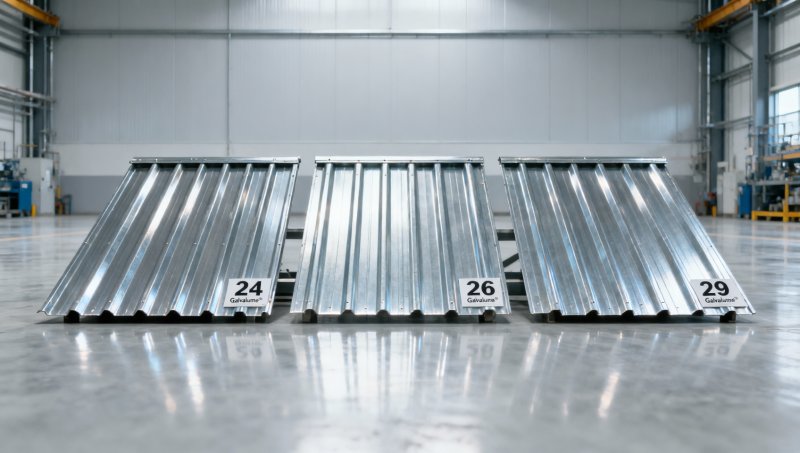
Steel roofing gauge—measured in U.S. standard numbering (e.g., 24-gauge, 26-gauge, 29-gauge)—is not just a thickness label. It defines load-bearing capacity, wind uplift resistance, and long-term durability. In North America, 24-gauge (0.60 mm) is typical for commercial buildings requiring >120 psf snow load capacity, while 29-gauge (0.36 mm) suits low-risk residential sheds or agricultural structures with ≤30 psf design loads.
Price variance between gauges is non-linear: moving from 29-gauge to 26-gauge adds ~18–22% material cost, but boosts service life by 8–12 years under coastal exposure. For projects targeting ASTM A755M compliance, minimum 26-gauge is required for pre-painted substrates used in exposed architectural applications.
Hongteng Fengda supplies cold-formed steel profiles in precise gauge ranges—from 22-gauge (0.79 mm) for heavy-duty industrial roofs to 30-gauge (0.32 mm) for temporary enclosures—each verified via laser micrometer testing per EN 10143 standards before shipment.
This table reflects average FOB China pricing for coil-processed steel roofing substrates in Q2 2024, based on 20,000–50,000 kg order volumes. Actual landed costs in North America vary ±7% depending on port of entry and inland freight logistics.
Coating Types: Corrosion Resistance, Reflectivity, and Lifecycle ROI
Coating selection directly determines roof lifespan, energy efficiency, and maintenance frequency. Galvanized (Zinc-coated) steel offers baseline protection but struggles in high-salinity or acidic industrial zones. Galvalume®—a 55% aluminum, 43.4% zinc, and 1.6% silicon alloy—delivers superior cut-edge protection and heat resistance up to 300°C, making it ideal for HVAC ductwork integration or rooftop solar mounting systems.
Pre-painted galvalume (PPGL) adds another layer: factory-applied polyester or PVDF coatings enhance aesthetics, UV reflectivity (>75% solar reflectance), and color retention for >25 years. Its dual-layer protection—galvalume substrate + organic topcoat—reduces field touch-up labor by 60–70% versus bare metal alternatives.
For North American specifiers evaluating ASTM A792/A792M compliance, PPGL Steel Sheet must meet minimum top-side coating thickness of 11 μm and back-side of 5 μm—standards rigorously validated during Hongteng Fengda’s in-house salt spray testing (ASTM B117, 1,000-hour pass).
- Top-coat thickness range: 11–35 μm (adjustable per project requirement)
- Back-coat thickness range: 5–14 μm (critical for underside corrosion control)
- Color options: RAL-certified palette or custom patterns for brand-aligned façades
- Surface finish: Glossy, matte, or textured—optimized for glare reduction in educational or healthcare campuses
Why PPGL Outperforms Traditional Options in Mixed Climates
In humid subtropical zones (e.g., Gulf Coast), PPGL Steel Sheet demonstrates 3.2× slower rust propagation than standard galvanized steel after 5 years of exposure—validated through accelerated weathering per ASTM G154. Its aluminum-rich base also resists alkaline runoff from concrete substrates, a common failure point in multi-story commercial builds.
You can explore our full range of compliant, customizable options at PPGL Steel Sheet.
Panel Profile Selection: Matching Form, Function, and Installation Efficiency
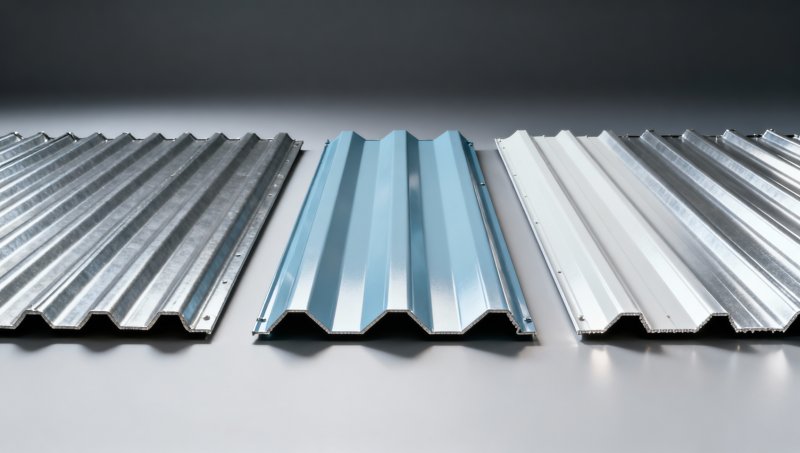
Panel profile dictates water-shedding capacity, thermal expansion behavior, and installation speed. Corrugated profiles remain popular for agricultural and light-industrial use due to their low-cost tooling and rapid roll-forming—but they offer minimal thermal break capability. Trapezoidal and standing seam profiles dominate commercial construction where air-tightness, condensation control, and wind-driven rain resistance are mandatory per ASCE 7-22.
Trapezoidal panels (e.g., 32–45 mm rib height) provide optimal stiffness-to-weight ratio for wide-span roofs (up to 12 m unsupported), reducing purlin spacing requirements by 25–30%. Standing seam systems add concealed fastening and thermal movement accommodation—critical for large-format roofs exceeding 5,000 m².
Hongteng Fengda supports all three profiles—including custom trapezoidal rib geometries—with precision roll-forming lines calibrated to ±0.15 mm tolerance, ensuring interlocking consistency across 100,000+ linear meters per production batch.
Why Global Buyers Choose Hongteng Fengda for Steel Roofing Sourcing
Sourcing steel roofing from China isn’t about lowest unit cost—it’s about balancing reliability, compliance, and total landed value. Hongteng Fengda operates ISO 9001-certified facilities with dedicated R&D labs for coating adhesion, salt fog, and thermal cycling validation. Every export shipment includes mill test reports (MTRs) traceable to EN 10204 3.1 certification and third-party SGS inspection upon request.
We support North American partners with: • 4–6 week lead time for standard PPGL orders (vs. industry average of 8–12 weeks) • OEM customization: embossed textures, proprietary rib heights, dual-color backside finishes • Pre-shipment documentation aligned with CBP ACE filing requirements • Container loading optimization—up to 28 tons per 40’ HC container for 0.5mm–0.7mm gauges
If your project requires ASTM-compliant, corrosion-resistant steel roofing with full traceability—or if you need help matching gauge, coating, and profile to local building codes (IBC, IRC, or provincial amendments), contact us today for a technical review and volume-based quote.
Please give us a message


Please enter what you want to find