How Laser Engraving on Stainless Steel Plates Prevents Fading in Industrial Labels
Industrial labels are expected to do a simple job: remain legible. In practice, that job can be difficult. Equipment plates are exposed to washdown chemicals, cutting fluids, heat cycles, forklift contact, vibration, outdoor moisture, and repeated cleaning. A faded serial number, missing warning, or unreadable tag can slow maintenance work and create a real safety concern. It can also break the traceability chain when an operator needs to identify a component quickly.
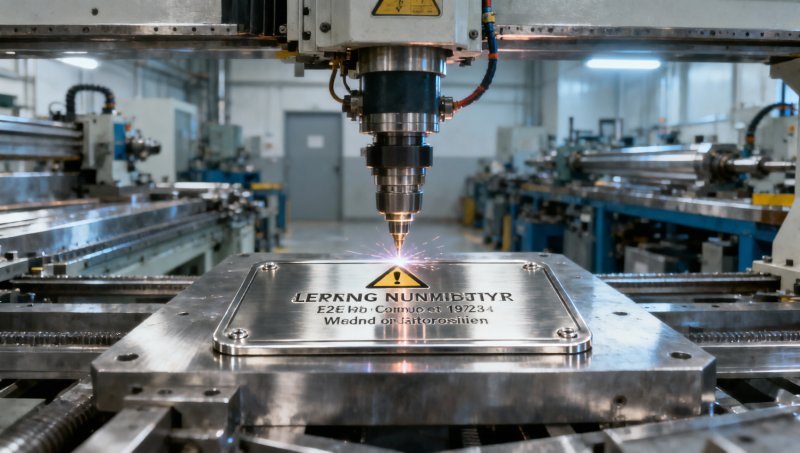
Laser processing offers a practical answer. Engraving stainless steel plate with a properly selected laser process creates a marking that is part of the metal surface rather than a separate layer sitting on top of it. Unlike ink, adhesive labels, or many coated markings, the identifier cannot peel away. For industrial users, that difference is most visible after months or years of handling: the code, arrow, equipment number, or instruction remains readable when it is needed.
Durability, however, is not achieved simply by choosing “laser engraved.” Stainless grade, surface finish, marking method, contrast requirement, label thickness, environment, and cleaning routine all affect the result. Understanding those choices helps operators specify a label that lasts instead of replacing one failure mode with another.
Why conventional industrial labels lose legibility
Printed labels fail in several familiar ways. Solvents can soften or dissolve inks. UV exposure can reduce contrast outdoors. Adhesives eventually lose grip when exposed to oil, moisture, high temperature, or poorly prepared surfaces. Painted markings may chip at edges and wear away where hands, tools, or moving guards make contact. Even anodized or coated tags can become difficult to read once their top layer is scratched.
A stainless steel plate already starts with advantages: it is mechanically robust, corrosion resistant in many industrial settings, and suitable for permanent attachment by screws, rivets, welding, or mechanical fixing. The weakness is usually not the plate itself, but the information applied to it. If the marking is only a fragile surface film, the label’s service life is determined by that film rather than by the steel.
This matters most where identification is operational rather than decorative. Pump and valve tags, control-panel plates, electrical enclosure labels, machine asset IDs, calibration references, hazardous-area instructions, rack location plates, and spare-part codes are all read under imperfect conditions. Operators may be wearing gloves, working in low light, or trying to confirm a number during an unplanned shutdown. Clear contrast and durable characters are not minor finishing details.
What a laser changes at the metal surface
Laser marking is a broad term. On stainless steel, the laser may create a shallow engraved recess, alter the surface texture, or produce a controlled heat-based color change. Each approach has a different appearance and level of resistance to wear. A specification should therefore describe the required outcome, not merely state that a laser must be used.
True laser engraving removes a small amount of material to form letters, numbers, or graphics. Because the mark has depth, ordinary rubbing and handling must wear the surrounding steel before it can erase the information. This makes engraving especially useful for labels likely to see abrasion. It can also produce a tactile mark, which may help when an operator needs to locate an identifier by touch or when visual contrast is temporarily reduced by dirt.
Laser etching is often used loosely to describe shallower surface treatment. It may be adequate for protected indoor panels, but it should not automatically be treated as equivalent to deep engraving. Laser annealing, meanwhile, can create dark, high-contrast marks through controlled oxidation without removing much material. It is useful where a smooth surface is preferred, but the selected process must be tested against the intended cleaning chemicals and abrasion level.
The practical point is straightforward: when fading is caused by ink loss or coating failure, moving the information into or permanently changing the steel surface removes that weak layer. When the concern is aggressive physical wear, deeper engraving generally provides a larger safety margin than a purely visual surface mark.
Contrast is as important as permanence
A mark can survive without being easy to read. This is a common specification mistake. Fine characters engraved into a bright, brushed stainless surface may remain physically present yet become hard to distinguish from certain viewing angles. Oil films, reflected light, dust, or condensation can make the problem worse. For labels that support daily operation, legibility should be evaluated under the lighting and contamination conditions likely to exist at the point of use.
Character height, stroke width, font selection, spacing, and the surface finish around the mark all influence readability. Simple sans-serif characters are often more dependable than decorative fonts. Confusing symbols and characters—such as O and 0, I and 1, or S and 5—deserve careful review in serial numbers. A data matrix or QR code can add traceability, but it should complement rather than replace a human-readable identifier where rapid manual verification is required.
Where exposure is especially demanding, a sample plate is worth more than an assumption. It can be checked after expected cleaning procedures, abrasion exposure, and visual inspection at working distance. The objective is not simply to produce a dark initial mark; it is to preserve contrast through the actual maintenance routine.
Matching the plate and marking process to the environment
Stainless steel is not a single material choice. Grade selection depends on the atmosphere, temperature, chloride exposure, contact media, fabrication method, and the requirements of the finished equipment. A plate that performs well in a dry indoor workshop may not be the right choice near marine air, process chemicals, or frequent chloride-containing cleaning agents. The marking process should be considered alongside the base material, since excessive heat input or unsuitable finishing can affect appearance and local corrosion behavior.
Surface preparation also deserves attention. Protective film residue, oil, fingerprints, scale, and inconsistent brushing can affect the uniformity of laser results. If tags will be formed, bent, or welded after marking, the sequence should be planned early. A deep engraving may remain readable after forming, but a code placed too close to a bend line can distort. Likewise, a label welded near the marked area may discolor the surface or reduce contrast.
For operators, the best location is not always the most convenient place to install the tag. It should be visible during normal access, protected from direct impact where possible, and separated from areas that collect standing liquid or abrasive debris. A permanent marking is valuable only if people can find and read it without unsafe positioning.
Traceability on structures and fabricated equipment
Permanent labels are also useful beyond finished machinery. In fabrication and construction work, component identification can support receiving checks, assembly control, inspection records, and later maintenance. The challenge is to apply information without confusing temporary production marks with final asset identification. A durable stainless tag may be appropriate for a completed unit, while the structural member itself may need a different marking method based on engineering and project requirements.
For example, industrial structures often combine stainless identification plates with carbon-steel support members. Beam selection is governed by load design, fabrication needs, and applicable project standards; label durability is a separate but related usability issue. Product ranges such as I Shaped Beams can be supplied in grades including Q195–Q235, Q345, SS400, A36, S235J0, S235J2, and St52, with dimensions tailored to structural requirements. When identification is needed on such assemblies, the plate location, fixing method, and marking content should be coordinated with the fabrication drawing rather than added as an afterthought.
Hongteng Fengda supplies structural steel products and customized components for construction, industrial, and manufacturing projects, including angles, channels, beams, and cold-formed profiles. For global projects, its work with ASTM, EN, JIS, and GB-related requirements reinforces a useful discipline: material documents, dimensions, fabrication instructions, and identification requirements need to align before production. A durable label cannot correct a mismatch in the underlying project information.
Questions to settle before ordering laser-marked plates
A clear label specification avoids expensive revisions and prevents the supplier from making assumptions. The following questions usually reveal what the label needs to withstand:
- Will the plate face solvents, alkaline washdown, salt exposure, oils, or high-temperature cleaning?
- Is the main risk chemical fading, mechanical abrasion, corrosion, impact, or glare?
- Must the text be readable by people, scanned by a machine, or both?
- What information is fixed, and what information changes by unit, batch, or serial number?
- How will the plate be attached, and could drilling, welding, bending, or installation damage the marked area?
- Do the governing equipment, customer, or local requirements specify character size, language, symbols, or traceability format?
It is also wise to define the acceptance standard before production. This may include approved artwork, plate dimensions and thickness, material grade, marking location, readable text height, barcode verification method if relevant, surface finish, and the number of sample approvals required. If a tag is intended for a regulated application, the relevant project specification or local requirement should be reviewed rather than inferred from a general industrial practice.
Avoiding common implementation mistakes
One mistake is specifying maximum depth without considering the plate thickness and the information density. Deep engraving on a thin plate can distort the back surface or make fine data difficult to reproduce cleanly. Another is demanding very small machine-readable codes while expecting reliable scanning after dirt accumulation. A larger code with suitable quiet space is often a safer operational choice than a compact code that works only in a clean inspection room.
Another issue is treating stainless as maintenance-free. Stainless labels are durable, but deposits from process media can obscure any marking. Regular cleaning methods should be compatible with the plate and marking type. Harsh tools may not remove the engraving itself, yet they can alter the surrounding finish and reduce visual contrast over time.
Finally, do not separate label design from the operator’s workflow. A long equipment ID that is difficult to transcribe, a warning placed behind a removable cover, or a QR code positioned where scanners cannot reach all undermine the purpose of permanent marking. The best label is one that remains readable and supports a quick, correct decision on the factory floor.
A durable label begins with a realistic service condition
Laser engraving on stainless steel plate prevents fading because it eliminates dependence on vulnerable inks, adhesives, and superficial coatings. Yet durability is not a single feature that can be selected from a catalogue. It is the result of matching engraving depth or marking type, stainless material, surface finish, information layout, attachment method, and working environment.
Before finalizing a label, define what the operator must read, where it will be read, and what the plate will encounter during its working life. For demanding industrial applications, reviewing a marked sample against the actual cleaning, abrasion, and lighting conditions is often the most reliable way to confirm that the identification will still be present—and still be useful—when the equipment is no longer new.
Please give us a message


Please enter what you want to find