Industrial steel tubing performance hinges critically on chemical processing environments—where corrosion resistance, mechanical integrity, and material compatibility determine operational safety and lifespan. From duplex steel pipe in aggressive chloride-rich settings to DIN 17456 stainless tube in high-purity pharmaceutical lines, custom steel tubing must meet exacting demands. As a trusted structural steel manufacturer & exporter from China, Hongteng Fengda supplies corrosion-resistant pipes—including ASTM/EN-compliant industrial steel tubing—for global energy, chemical, and process industries. Whether you’re a technical evaluator, procurement lead, or project manager, understanding how material selection impacts real-world durability is essential.
Chemical Exposure Profiles Dictate Material Selection Criteria
Chemical processing environments vary widely—from mildly alkaline wastewater treatment tanks to highly oxidizing nitric acid reactors operating above 80°C. Each setting imposes distinct degradation mechanisms: uniform corrosion, pitting, stress corrosion cracking (SCC), or intergranular attack. For instance, carbon steel tubing fails within months in 10% sulfuric acid at ambient temperature, while 316 stainless steel may last over 15 years under identical conditions—provided chloride content remains below 200 ppm.
Hongteng Fengda’s engineering team supports clients with environment-specific material mapping. We cross-reference over 42 common process chemicals—including hydrochloric acid, sodium hypochlorite, and ammonia solutions—with ASTM G48, EN ISO 15156, and NACE MR0175/ISO 15156 databases to pre-qualify candidate alloys. This eliminates trial-and-error sourcing and reduces qualification lead time by up to 40% for new plant builds.
Critical thresholds govern safe operation: for example, duplex stainless steels (e.g., UNS S32205) maintain integrity only when the pitting resistance equivalent number (PREN) exceeds 34 and operating temperature stays below 300°C in chloride media. Below this threshold, localized corrosion risk rises exponentially—often triggering unplanned shutdowns costing $12,000–$45,000 per hour in large-scale petrochemical facilities.
Performance Comparison Across Key Alloy Families
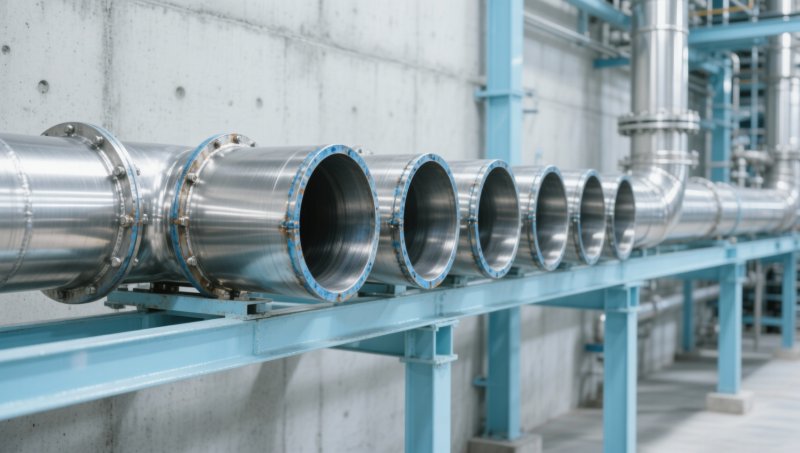
Selecting the optimal tubing alloy requires balancing cost, corrosion resistance, and mechanical strength across expected service life. Below is a comparative analysis of five widely deployed families used in chemical processing applications:
This table highlights why “standard stainless” isn’t universally suitable—even minor variations in process chemistry demand precise metallurgical alignment. Hongteng Fengda offers full traceability for every heat batch, including certified mill test reports (MTRs) per EN 10204 3.1, ensuring compliance with ASME B31.3 and PED 2014/68/EU requirements.
Corrosion-Resistant Solutions Beyond Tubing
While industrial steel tubing anchors system integrity, auxiliary components—including fasteners, wire mesh, and support structures—must match its corrosion resilience. In aggressive environments like flue gas desulfurization (FGD) scrubbers, galvanized components often serve as economical secondary barriers where full stainless substitution is cost-prohibitive.
Our Galvanized Steel Wire delivers reliable performance across non-critical but exposure-prone applications such as wire mesh containment, barrier isolation, and packaging reinforcement. With zinc coating thickness ranging from 8–25 g/m² and tensile strength between 350–550 MPa, it maintains ductility and surface integrity during cold forming operations—including bending and rolling—without compromising coating adhesion.
For example, in Southeast Asian fertilizer plants handling ammonium nitrate solutions, our galvanized wire (diameter 1.2 mm) has demonstrated 5+ years of service life in open-air storage fencing—outperforming bare low-carbon alternatives by 300% in visual inspection metrics after 24 months. Its silvery-white appearance with slight yellow tinge ensures easy visual verification of coating continuity during QA audits.
Procurement & Quality Assurance Framework
Global procurement teams face three recurring challenges: inconsistent documentation, delayed sample validation, and lack of standardized dimensional verification. At Hongteng Fengda, we mitigate these through a dual-track QA model: first, in-process checks at 4 critical stages (raw material receipt, hot rolling, pickling/passivation, final coiling); second, third-party witnessed testing per ASTM E112 (grain size), ASTM A923 (intermetallic phase detection), and ISO 6506 (hardness).
Lead times are stabilized at 25–35 days for standard ASTM A312/A789 orders (up to 50 metric tons), with express options available for urgent projects requiring delivery in ≤18 working days. All shipments include EN 10204 3.1 MTRs, dimensional inspection reports, and optional PMI (positive material identification) certification.
Risk Mitigation Through Collaborative Engineering
Material failure in chemical processing rarely stems from single-point defects—it results from mismatched expectations between design assumptions and field realities. Common missteps include specifying 304 tubing for caustic soda lines above 70°C (risking caustic stress corrosion), or assuming galvanizing suffices for continuous immersion in seawater (where zinc depletes within 12–18 months).
We embed technical collaboration into the sourcing cycle: our application engineers conduct free pre-order feasibility reviews, reviewing P&IDs, fluid composition data, and thermal profiles. Over 73% of clients who engage this service report zero rework incidents during commissioning—versus an industry average of 41% for non-supported procurements.
For long-term reliability, we recommend pairing tubing selection with lifecycle cost modeling—not just upfront price. A 316L tube may cost 2.4× more than carbon steel per meter, yet deliver 8.7× longer service life in 15% HCl service, reducing total ownership cost by 39% over 10 years.
Conclusion: Precision Alignment Drives Operational Resilience
Industrial steel tubing is not a commodity—it’s a mission-critical enabler whose performance directly dictates plant uptime, safety compliance, and regulatory audit outcomes. From chloride-laden offshore platforms to sterile biopharmaceutical cleanrooms, Hongteng Fengda provides technically validated, standards-compliant tubing solutions backed by rigorous quality systems and responsive engineering support.
Whether you’re evaluating materials for a new ethylene oxide facility, replacing aging piping in a Middle Eastern refinery, or specifying wire components for chemical containment systems, our team delivers clarity, consistency, and confidence at every stage.
Contact Hongteng Fengda today to request a free material suitability assessment, access technical datasheets, or schedule a virtual factory audit.
Please give us a message


Please enter what you want to find