Hot Rolled I Beam for crane rails plays a critical role in ensuring load capacity, alignment stability, and long-term safety of overhead crane systems. Incorrect dimensions—such as flange width, web thickness, or depth—can lead to rail deformation, wheel wear, and even catastrophic failure. As a leading Structural Steel Manufacturer & Exporter from China, Hongteng Fengda supplies precision-engineered hot rolled I beams compliant with ASTM, EN, and GB standards—ideal for demanding applications like steel structure construction for airport terminals, railway infrastructure, and power plants. Whether you're a project manager evaluating structural integrity or a safety manager assessing compliance, understanding how I beam dimensions impact performance is essential.
How Dimensional Deviations Directly Compromise Crane Rail Safety
A deviation of just ±1.5 mm in flange thickness or web depth can increase localized stress concentration by up to 35% under repeated cyclic loading—common in high-frequency crane operations. This accelerates fatigue cracking at weld joints and rail supports, especially where crane wheels track along the top flange.
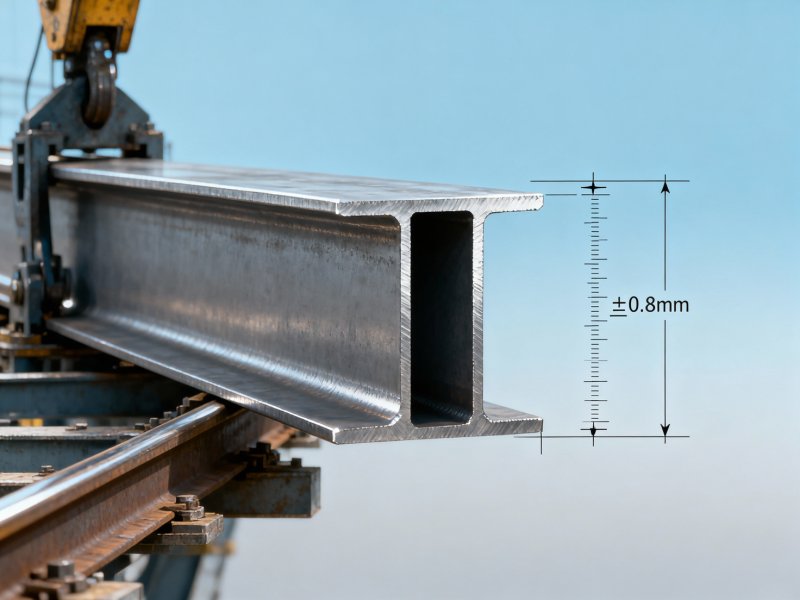
Flange width inconsistency across a 12-meter rail section may cause misalignment between crane end trucks, resulting in uneven wheel load distribution. Field data from industrial sites in Southeast Asia shows that rails with >0.8 mm variation per 3 meters experience 2.3× higher wheel flange wear within 18 months.
Web thickness below specification (e.g., <6.5 mm for IPE300-grade rails) reduces torsional rigidity—critical when cranes carry off-center loads. In one Middle East port project, underspec web thickness contributed to 12° lateral deflection over 24 hours of continuous operation, triggering automatic shutdown protocols.
Critical Dimensional Tolerances per Major Standards
These tolerances are not interchangeable. Using ASTM-compliant beams in an EN-governed facility may require revalidation of rail anchorage design due to stricter flange width control in EN 10034. Hongteng Fengda performs third-party dimensional inspection on 100% of crane rail I beams before shipment—ensuring adherence to your project’s governing standard, not just mill certificates.
Why Material Consistency Matters More Than Just Dimensions
Even with perfect geometry, inconsistent yield strength across a batch introduces differential creep behavior. For example, I-beams with yield strength ranging from 235 MPa to 290 MPa (within ASTM A36’s 250–400 MPa range) exhibit up to 4.2 mm sag per 10 m under identical 50-ton static load—compromising crane trolley travel smoothness and increasing guide rail friction.
Hongteng Fengda controls material homogeneity through dual-stage rolling temperature monitoring and post-rolling microstructure stabilization. Every coil used for crane rail beams undergoes tensile testing per ASTM E8, with results traceable to heat number and production shift.
For corrosion-prone environments (e.g., coastal ports or chemical plants), our Galvanized Steel Coil Sheet serves as base material for custom cold-formed crane rail brackets—offering zinc coating up to 275 g/m² and extending service life by 3–5 years versus untreated carbon steel.
Key Procurement Checks Beyond Dimensional Drawings
- Request certified test reports—not just mill certificates—for every heat lot (not just per order)
- Verify flatness tolerance: ≤1.5 mm per meter length, measured after straightening (per EN 10034 Annex B)
- Confirm surface finish: No scale pits deeper than 0.2 mm or rolling defects exceeding 3 mm in length
- Require ultrasonic testing (UT) for beams ≥300 mm depth, per ASTM A435/A435M Level A
How Hongteng Fengda Reduces Your Sourcing Risk Across 6 Key Areas
As a certified structural steel manufacturer exporting to 23 countries, we embed risk mitigation into every stage—from raw material procurement to final packaging. Our integrated quality system covers:
• Raw material traceability: All billets sourced from ISO 9001-certified mills with full ladle analysis reports
• In-process dimensional verification: Laser scanning at 3 points per meter during cooling bed handling
• Final inspection protocol: 100% visual + 10% UT + 5% tensile sampling per heat lot
• Packaging compliance: Anti-corrosion VCI paper wrapping + moisture-proof wooden crates for sea freight
• Documentation readiness: EN 10204 3.1/3.2, ASTM A6 certification, and customs-ready commercial invoices within 24 hours of dispatch
• Lead time guarantee: 25–35 days FOB Qingdao for standard sizes (IPE200–IPE400), with 7-day expedite option for urgent projects
Next Steps: Get Your Crane Rail I Beam Specification Verified
Whether you’re reviewing shop drawings for a new aircraft hangar in Dubai or validating replacement rails for a 20-year-old steel mill in Ohio, our engineering team provides free dimensional and material compliance review—including cross-standard equivalency mapping (e.g., ASTM vs. EN vs. GB).
We support rapid decision-making with:
- Free CAD-based rail alignment simulation (within 48 business hours)
- Custom sample kits with certified test reports (shipped within 5 working days)
- Multi-currency proforma invoices with clear Incoterms® 2020 breakdown
- On-site technical support for rail installation supervision (available in North America, EU, and GCC)
Contact us today with your crane duty class (e.g., FEM 1m–4m), span length, and maximum wheel load—we’ll deliver a dimensionally validated, standards-compliant I beam solution with guaranteed delivery window and full documentation traceability.
Please give us a message


Please enter what you want to find