How H-beam manufacturer China Ensures Dimensional Tolerance Compliance for High-Rise Buildings
For quality control and safety professionals responsible for structural integrity in tall buildings, dimensional tolerance compliance isn’t a checklist item—it’s the bedrock of load path continuity, connection performance, and long-term serviceability. As a trusted H-beam manufacturer China partners with for critical infrastructure, Hongteng Fengda delivers certified dimensional accuracy—not through isolated inspections, but via an integrated, traceable, standards-aligned production ecosystem.
Why ±0.5 mm Matters More Than You Think
In high-rise construction, cumulative tolerance deviations across hundreds of H-beams directly impact column alignment, floor slab bearing, and bolted joint stiffness. A 1.2 mm flange thickness variance—within some generic mill specs—can reduce moment capacity by up to 7% in composite floor systems. For QC and safety teams, inconsistent dimensions mean rework delays, field welding compromises, or even rejection at site inspection. That’s why Hongteng Fengda anchors its process not to “acceptable range,” but to project-specific tolerance bands validated against ASTM A6/A6M (Section 9), EN 10034 (Table 1), and GB/T 11263 (Class B).
Four-Stage Dimensional Control: From Billet to Certification
Our tolerance assurance begins before rolling starts. Raw billets undergo ultrasonic testing and chemical composition verification (OES analysis) to ensure uniform metallurgical response during hot rolling—critical for predictable shrinkage and straightness.
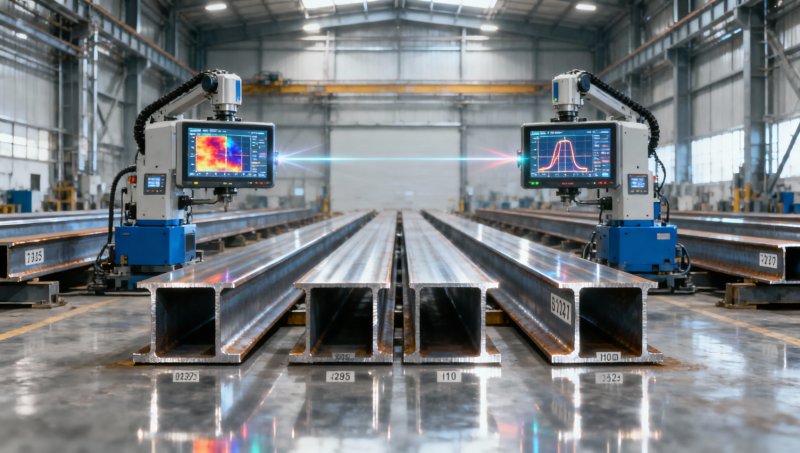
During hot rolling, CNC-controlled stands with real-time hydraulic gap adjustment maintain cross-section consistency within ±0.3 mm on web thickness and ±0.4 mm on flange width—tighter than EN 10034 Class A limits. Each beam passes through a dual-laser profilometer that captures 1,200+ sectional points per meter, generating full-profile deviation heatmaps for immediate feedback and automatic line correction.
Post-rolling, beams undergo stress-relieving and controlled cooling to minimize residual distortion. Final dimensional verification uses coordinate measuring machines (CMMs) calibrated to ISO 17025 standards—with traceable certificates issued per batch. Every report includes actual vs. nominal values for depth, flange width/thickness, web thickness, taper, and straightness (measured over 1 m and 10 m lengths).
Third-Party Validation & Project-Specific Protocols
We don’t rely solely on internal data. For high-rise projects exceeding 150 m or requiring seismic certification, Hongteng Fengda engages independent labs—including SGS and Bureau Veritas—to perform blind sampling and metrological audit. Their reports are shared pre-shipment and archived for 10 years.
More importantly, we co-develop tolerance protocols with your QA team. If your structural engineer specifies tighter flange parallelism (e.g., ≤0.5° instead of EN’s 1.0°), our production planning adjusts roll pass design and cooling profiles accordingly—and documents the change in the Mill Test Report (MTR). This collaborative approach eliminates assumptions and aligns manufacturing precision with your building’s performance envelope.
How We Support Your On-Site Quality Workflow
Dimensional compliance means little if it doesn’t translate into efficient erection. That’s why every shipment includes digital twin files: IFC-compatible geometry models with annotated tolerance zones, plus QR-coded physical tags linking each beam to its full metrology report, heat number, and non-destructive test logs.
For safety managers auditing bolted connections, our reports flag any beam where flange flatness exceeds 0.8 mm/m—flagging potential gasket compression issues before hoisting. For QC leads managing multiple suppliers, our standardized MTR format enables side-by-side comparison across vendors—no manual data reformatting required.
Beyond H-Beams: Consistent Precision Across Structural Profiles
Dimensional discipline extends across our entire structural portfolio. For example, our C Sections Steel—used extensively in purlins and wall framing for high-rise curtain walls and mezzanine decks—maintains ±1% thickness tolerance (per GB/T 2518) across all gauges from 1 mm to 12 mm. Whether hot-rolled, cold-formed, or galvanized, each C-section is verified using laser triangulation scanners calibrated to NIST-traceable standards—ensuring consistent fit-up when integrated with H-beam frames.
What Sets Our QC System Apart
Many mills meet minimum specs—but few embed tolerance control into their organizational DNA. At Hongteng Fengda, every operator is trained in GD&T fundamentals; every shift logs metrology trends in our cloud-based QMS; and every deviation triggers a root-cause review within 4 hours. Our ISO 9001:2015-certified system is audited quarterly—not annually—and integrates seamlessly with clients’ ERP platforms for real-time quality dashboard access.
We also offer pre-shipment joint inspections at our facility—where your QC team can witness live CMM measurements, review raw data exports, and approve release criteria before loading. No black-box reporting. No delayed findings. Just transparent, actionable evidence.
Conclusion: Tolerance Compliance as Risk Mitigation
For quality control and safety professionals, dimensional tolerance isn’t about perfection—it’s about predictability, accountability, and risk containment. Choosing an H-beam manufacturer China that treats tolerances as engineered parameters—not afterthoughts—means fewer field adjustments, faster assembly cycles, and verifiable confidence in structural behavior under wind, seismic, and dead loads.
Hongteng Fengda delivers that confidence—not through marketing claims, but through documented, repeatable, standards-verified processes backed by decades of high-rise project experience across North America, Europe, and Southeast Asia. When lives depend on millimeter-level consistency, trust matters less than evidence. And ours is measured—not promised.
Please give us a message


Please enter what you want to find