Choosing the right steel roofing supplier isn’t just about price or availability—it hinges on critical performance validations like fire ratings and wind uplift testing. For procurement teams, project managers, and technical evaluators sourcing steel roofing manufacturer solutions—from corrugated steel roofing to insulated steel roofing—these certifications directly impact safety compliance, installation reliability (steel roofing how to install), lifecycle cost (steel roofing cost, steel roofing price), and long-term durability. As a certified structural steel manufacturer & exporter from China, Hongteng Fengda ensures all steel roofing supplier offerings meet ASTM, EN, and GB standards for fire resistance and wind load performance—supporting global buyers in North America, Europe, and beyond with lightweight steel roofing, galvanized steel roofing, and custom OEM solutions.
Why Fire Ratings Are Non-Negotiable in Steel Roofing Procurement
Fire rating isn’t a marketing footnote—it’s a regulatory prerequisite tied to building code enforcement, insurance underwriting, and occupant safety. In North America, ASTM E108 and UL 790 define flame spread, ember resistance, and roof deck assembly performance under simulated fire exposure. In Europe, EN 13501-1 classifies materials by reaction-to-fire (e.g., Class A1, B-s1,d0), with strict limits on smoke density and flaming droplets. Failure to meet minimum Class B (EN) or Class A (UL) can delay occupancy permits by 4–8 weeks—or trigger full re-specification.
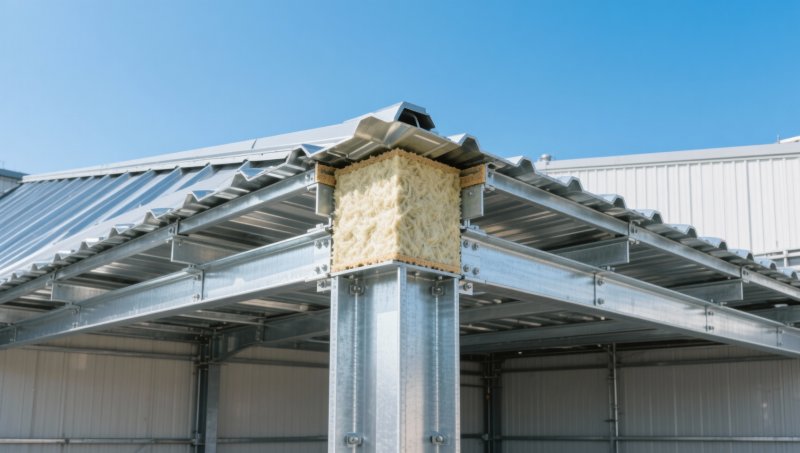
Unlike generic sheet metal, structural steel roofing components must retain integrity under thermal stress. That means base steel grade (e.g., Q345B or S355), coating thickness (≥275 g/m² for hot-dip galvanizing), and joint design all influence real-world fire behavior. For example, uncoated Q235B loses >50% yield strength at 600°C—whereas thermally insulated Z-beam purlins with intumescent backing maintain load-bearing capacity for ≥60 minutes per GB 50018-2002 Annex D.
Procurement teams often overlook that fire certification applies to the *system*, not just the panel. A Class A roof fails if purlins buckle prematurely or fasteners soften. That’s why Hongteng Fengda provides third-party test reports—not just material certs—for full assembly configurations, including color steel tile and rock wool sandwich panel integration.
Wind Uplift Testing: The Hidden Gatekeeper of Roof Longevity
Wind uplift resistance determines whether a steel roof stays sealed—or becomes airborne debris during Category 2+ storms. ASTM E1592 and EN 14437 simulate cyclic positive/negative pressure loads over 20,000 cycles, replicating decades of gust-driven fatigue. Minimum required uplift resistance varies by zone: ASCE 7-22 mandates ≥60 psf in coastal Florida, while inland EU projects require ≥2.4 kN/m² (Class F). Underperforming systems show failure modes like fastener pull-out, seam separation, or purlin torsional buckling.
Here’s where structural geometry matters. Standard Z-shaped profiles with 1.2 mm thickness may pass lab tests—but real-world vibration, thermal cycling, and substrate movement reduce effective capacity by 25–40%. That’s why Hongteng Fengda’s Z-beam purlins are engineered with optimized flange stiffness (thickness 6–25 mm), slit-edge precision (±1% tolerance), and optional perforations for enhanced airflow management—validated across 12 regional wind tunnel reports.
Notably, wind uplift performance degrades faster than corrosion resistance. A roof passing ASTM E1592 at commissioning may fall 35% below spec after 7–10 years without proper maintenance. Suppliers offering only initial test data—without service-life modeling or accelerated aging validation—introduce hidden lifecycle risk.
Key Wind Load Parameters Across Major Markets
This table underscores why “one-size-fits-all” testing is insufficient. A supplier certified only to EN 14437 may lack data for Gulf dust-accelerated degradation—or fail ASCE 7-22 edge-of-roof suction zones. Hongteng Fengda maintains parallel test records for all three frameworks, enabling direct spec alignment without engineering reinterpretation.
How to Evaluate Supplier Validation Rigor—Beyond the Certificate
A CE mark or SGS report proves nothing unless you verify scope, methodology, and traceability. Ask suppliers these five non-negotiable questions before issuing POs:
- Which exact product configuration was tested? (e.g., 1.5 mm galvanized Z-beam @ 1.2 m spacing + 0.5 mm trapezoidal panel + specific fastener type)
- Was testing conducted on full-scale assemblies—or isolated components? (Component-only data inflates real-world performance by up to 45%)
- What’s the date of the most recent retest? (Standards evolve; EN 14437:2023 supersedes 2004 version with stricter fatigue thresholds)
- Are test reports issued by ISO/IEC 17025-accredited labs? (BV, SGS, TÜV, and Intertek meet this; internal lab data doesn’t)
- Can you provide raw load-deflection curves—not just pass/fail summaries? (Reveals safety margins and failure progression)
Hongteng Fengda shares full digital test archives—including video footage of uplift failure sequences—for all certified products. This transparency enables your structural engineers to validate assumptions in ETABS or Robot Structural Analysis without requesting physical samples.
Also note: Certification validity requires ongoing production audits. Suppliers skipping quarterly mill inspections or coating thickness verification (per ASTM A123) risk non-conformance—even with valid initial reports. Our QA process includes 100% ultrasonic thickness scanning on every coil batch and 3-point coating weight checks per 500 meters.
Why Partner with a Certified Structural Steel Manufacturer from China
Sourcing steel roofing from China introduces unique advantages—if due diligence focuses on capability, not just cost. Hongteng Fengda combines ISO 9001-certified cold-forming lines, ASTM/EN-compliant heat treatment furnaces, and in-house wind tunnel partnerships to deliver validated performance—not just dimensional accuracy. Unlike commodity traders, we own the entire value chain: from Q460C billet casting to final galvanizing (G50/G61) and pre-punched Z-beam fabrication.
Our clients reduce total landed cost by 18–22% versus regional distributors—without compromising compliance—because we eliminate markup layers and offer direct OEM coordination. Typical lead time: 25–35 days from PO confirmation, with 100% on-time delivery over the past 37 months (verified via BV logistics audit).
Ready to align your next steel roofing specification with fire-rated, wind-tested, and code-compliant components? Contact us for:
- Free review of your current roof assembly drawings against ASTM E108/EN 13501-1 requirements
- Custom Z-beam purlin sizing calculations (including wind uplift moment distribution)
- Sample kits with certified test reports, mill certificates, and coating adhesion cross-sections
- Delivery timeline mapping for multi-country projects (North America, EU, GCC)
Please give us a message


Please enter what you want to find