In chemical plants, material performance directly affects safety, uptime, and maintenance costs. ASTM stainless steel for chemical processing is widely valued for its corrosion resistance, strength, and compliance with recognized standards, making it a practical choice for operators and plant users. Understanding how it performs under aggressive media and demanding conditions helps teams select reliable steel solutions that support stable, efficient production.
Why ASTM stainless steel for chemical processing is gaining stronger attention
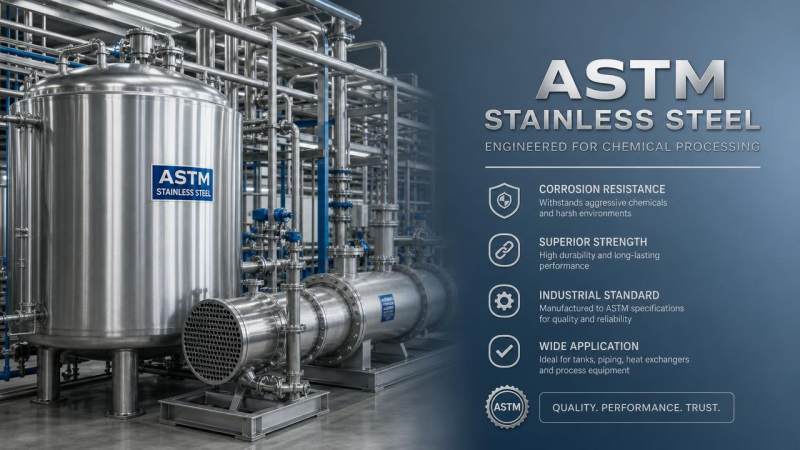
Chemical processing environments are becoming more severe. Higher purity requirements, mixed media, and longer operating cycles are raising the performance bar for metallic materials.
As a result, ASTM stainless steel for chemical processing is receiving more attention across tanks, piping, heat exchangers, and support structures.
The trend is not only about corrosion resistance. It also reflects tighter risk control, lifecycle cost awareness, and stronger demand for internationally recognized steel standards.
In many projects, engineers now compare not just purchase price, but inspection consistency, welding behavior, and durability under cyclic thermal and chemical exposure.
The operating conditions shaping material choices are changing fast
Several signals explain why ASTM stainless steel for chemical processing is becoming a more deliberate specification rather than a default selection.
- More aggressive acids, chlorides, and cleaning chemicals are used in production lines.
- Plants are extending service intervals and expecting lower unplanned shutdown rates.
- Global projects increasingly require ASTM, EN, JIS, or GB aligned compliance documents.
- Fabricated systems must balance corrosion resistance, weldability, and structural strength.
- Owners are evaluating total cost over service life, not only initial procurement.
These shifts make material traceability and standard-based procurement more important. In this context, ASTM stainless steel for chemical processing supports better technical comparison across suppliers.
How ASTM stainless steel performs under chemical exposure and plant stress
Performance depends on grade selection, process chemistry, temperature, and fabrication quality. Still, ASTM stainless steel for chemical processing offers several practical strengths.
Corrosion resistance remains the first decision factor
Its chromium-rich passive layer helps resist oxidation and many corrosive media. This is especially useful in wet, vapor, and intermittent splash zones.
Different stainless grades respond differently to chloride attack, reducing acids, or oxidizing solutions. Correct ASTM grade matching is therefore essential.
Mechanical reliability supports continuous operation
Chemical plants often face pressure variation, vibration, and thermal cycling. ASTM stainless steel for chemical processing maintains useful strength while limiting premature deformation or cracking.
This makes it suitable for pressure-containing parts, process skids, structural supports, and fabricated assemblies exposed to complex loading conditions.
Fabrication behavior affects actual field performance
Good material can underperform after poor welding, cutting, or surface contamination. ASTM-based stainless products simplify control through known chemistry, tolerances, and test expectations.
Proper pickling, passivation, and weld procedure qualification remain necessary to preserve corrosion resistance in service.
The main forces behind wider ASTM stainless steel use
Where performance differences become visible across plant systems
The impact of ASTM stainless steel for chemical processing is not identical across every system. Some equipment categories benefit more directly than others.
- Tanks and vessels benefit from cleaner surfaces and better resistance to chemical attack.
- Piping systems gain from stable corrosion performance and dependable weld integration.
- Heat exchangers require closer attention to temperature, media concentration, and pitting risk.
- Structural supports need both corrosion control and sufficient load-bearing performance.
This is also where complementary steel products can play a supporting role. For example, non-process utility or support applications may use Hot diped-Galvanized Pipe.
Such galvanized pipe options, including DX52D-based solutions, are widely used for low pressure fluids, trestle supports, and industrial frames where broad corrosion protection is needed.
They are typically supplied in lengths from 1 to 12 meters, with multiple width and thickness ranges, and can comply with ASTM and other international standards.
What should be checked before specifying ASTM stainless steel for chemical processing
Because performance is application-specific, the most important task is not choosing stainless steel in general. It is defining the exact service condition in detail.
Key points that deserve closer attention
- Chemical composition of the process media, including trace contaminants.
- Operating and cleaning temperatures across normal and upset conditions.
- Flow velocity, erosion risk, and stagnant areas where deposits may form.
- Welding method, filler compatibility, and post-fabrication surface treatment.
- Required ASTM standard, test reports, and dimensional tolerance consistency.
- Expected maintenance interval and inspection accessibility.
These points help prevent a common mistake. A material may meet a standard on paper, yet still fail early if the service environment was underestimated.
How steel supply strategies are evolving with chemical industry expectations
Material selection is increasingly linked to supply reliability. Buyers are paying more attention to factory capability, consistency, and documentation readiness.
For structural and industrial steel applications, dependable exporters with broad standard coverage can reduce sourcing risk and simplify cross-border project execution.
Hongteng Fengda, a structural steel manufacturer and exporter from China, supports global projects with angle steel, channels, beams, cold formed profiles, and customized steel components.
Its production and quality control systems support ASTM, EN, JIS, and GB requirements, helping projects align steel supply with practical engineering standards.
This matters in chemical processing environments, where procurement decisions increasingly combine technical fit, quality stability, and lead time reliability.
A practical way to judge the next material decision
The direction is clear: performance must match real chemical duty
ASTM stainless steel for chemical processing remains a strong choice because it combines recognized standards with durable performance under demanding industrial conditions.
Its real value appears when grade selection, fabrication control, and operating data are aligned from the beginning. That is where safety and service life improve most clearly.
The next step is simple. Review the actual media, temperature, and maintenance targets of each system, then match them with compliant steel solutions and dependable supply support.
Please give us a message


Please enter what you want to find