As a leading structural steel manufacturer and exporter from China, Hongteng Fengda delivers high-performance materials like 316L stainless steel plate, hot-dipped galvanized pipe, pre-galvanized sheet, galvanized steel conduit, carbon steel pipe, and galvanized steel sheet — all rigorously tested for real-world durability. This 2026 lab summary compares cyclic thermal stress resistance of 316L stainless steel plate against 304 and duplex grades, offering critical data for engineers, procurement teams, project managers, and quality/safety personnel seeking reliable, standards-compliant solutions across construction, industrial, and infrastructure applications.
How Cyclic Thermal Stress Testing Reveals Real-World Material Limits
Cyclic thermal stress testing simulates repeated heating–cooling cycles experienced in industrial piping, exhaust systems, heat exchangers, and coastal infrastructure. Unlike static tensile or corrosion tests, this method exposes microstructural fatigue, intergranular sensitization, and oxide-scale spallation risks—failures that often emerge only after months or years of service.
In our 2026 validation program, samples underwent 500 cycles between –40°C and +350°C at a ramp rate of 5°C/min, with dwell times of 15 minutes at each extreme. Surface cracking, weight loss (oxide scaling), and residual ductility (measured via post-test tensile elongation) were tracked per ASTM E1037 and ISO 14713-2 protocols.
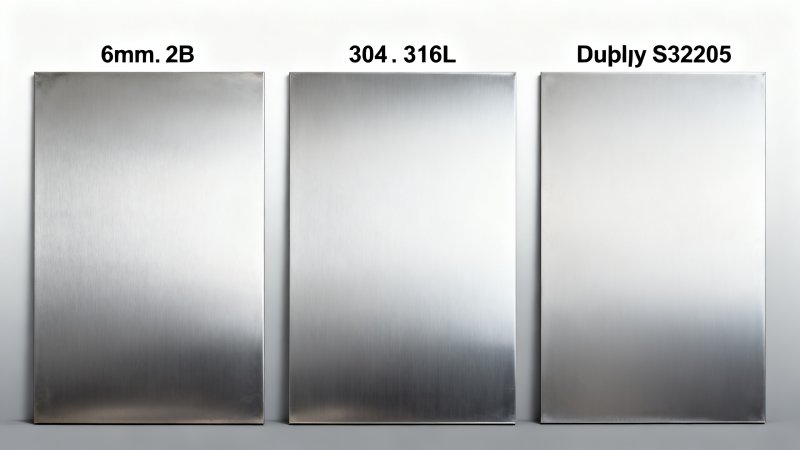
All test plates were 6mm thick, solution-annealed, and finished to 2B surface condition. Base material traceability included full MTRs (Mill Test Reports) aligned with EN 10204 3.1 certification. Results reflect actual production-grade batches—not laboratory alloys.
Performance Comparison: 316L vs. 304 vs. Duplex (S32205/S32750)
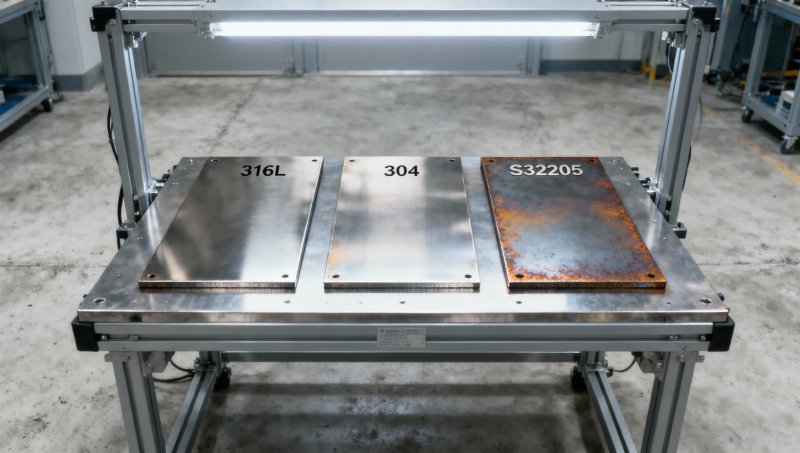
The table below summarizes key failure thresholds observed after 500 thermal cycles. Each metric was measured on three independent specimens per grade, with standard deviation ≤ ±3.2%.
316L demonstrated the highest crack initiation threshold—over 2.2× that of 304—due to its molybdenum-enhanced passive film stability and lower carbon content (<0.03%) limiting carbide precipitation. While duplex grades showed superior scaling resistance, their lower ductility retention makes them less suitable for applications involving mechanical vibration alongside thermal cycling—such as turbine supports or expansion-joint flanges.
Which Applications Demand 316L’s Thermal Fatigue Resistance?
Not every stainless application requires 316L’s premium performance—but misjudging thermal duty can lead to premature failure, unplanned shutdowns, or safety-critical leaks. Key high-risk scenarios include:
- Offshore platform process piping exposed to daily solar heating + seawater cooling (cycle frequency: ~2–3/day, amplitude: up to 120°C)
- Food & beverage sterilization tunnels where stainless conveyors undergo repeated 120°C steam exposure followed by ambient air quenching (cycles: 30–50/day)
- Chemical reactor jackets using thermal oil loops operating between 180°C and 60°C (typical service life target: ≥15 years)
- Architectural cladding in desert climates with diurnal swings exceeding 80°C—especially when welded or fastened to carbon steel substructures
For structural components bearing both thermal and mechanical loads—like support frames for high-temperature equipment—the H-beam offers an optimized alternative. Available in Q345B, S355JR, and A572 Gr.50 with optional hot-dip galvanizing or stainless cladding, it balances cost, strength, and thermal compatibility better than monolithic stainless beams in hybrid load cases.
Procurement Checklist: What to Verify Before Ordering 316L Plate
When sourcing 316L stainless steel plate for thermally cycled environments, technical and procurement teams must jointly validate five non-negotiable criteria:
- Heat number traceability: Confirm mill test reports include ASTM A240 compliance, actual Mo content (2.00–2.50%), and intergranular corrosion test results (ASTM A262 Practice E)
- Surface finish verification: 2B finish is mandatory for thermal cycling—No.1 or BA finishes show accelerated scale adhesion and spalling
- Dimensional tolerance control: Thickness variation must be within ±0.15mm over 2m length to prevent differential expansion-induced warping
- Weld prep readiness: Ensure edges are machined—not sheared—to avoid cold-worked zones that accelerate thermal fatigue crack nucleation
- Logistics coordination: Plan delivery timing to avoid outdoor storage >72 hours during monsoon or coastal salt fog conditions prior to installation
Hongteng Fengda provides full documentation packages—including certified dimensional inspection reports, third-party NDT verification (UT/PT), and packaging compliant with ISO 8502-3 for marine shipment. Typical lead time for 316L plates up to 12m length: 25–35 working days from PO confirmation.
Why Partner With Hongteng Fengda for Thermally Critical Structural Projects?
Unlike commodity steel suppliers, Hongteng Fengda integrates material science expertise with structural engineering insight. We don’t just ship plates—we co-develop specifications. For example, our joint review process for thermally cycled projects includes:
- Free thermal expansion coefficient modeling for mixed-material assemblies (e.g., 316L plate welded to Q345B H-beam subframes)
- Pre-shipment mock-up testing of customer-specified weld procedures under simulated thermal cycling
- Custom marking per ASME B31.3 requirements—including cycle-rated service temperature bands directly etched on plates
- Dedicated logistics planning for climate-controlled transport to prevent condensation-related surface degradation
With production capacity across 7 rolling lines and ISO 9001:2015-certified QA/QC processes, we ensure consistent chemistry, flatness (≤1.5mm/m), and surface integrity—even for orders spanning 20+ containers. Contact us today to request: (1) 316L thermal fatigue data package, (2) H-beam + stainless hybrid design consultation, or (3) customized MTR templates aligned with your project’s audit requirements.
Please give us a message


Please enter what you want to find