In modern industry, 304 stainless steel coil for manufacturing plays a vital role in improving product durability, processing efficiency, and cost control.
For business decision-makers seeking reliable materials, understanding how this versatile steel supports production across construction, industrial, and fabrication applications can help reduce sourcing risks and strengthen long-term project performance.
Material overview and core performance characteristics
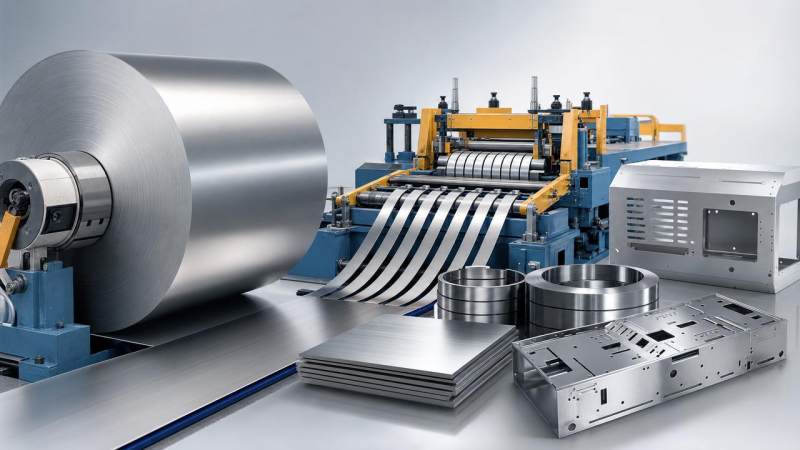
304 stainless steel coil for manufacturing is an austenitic stainless material widely used in modern steel processing and component production.
It contains chromium and nickel, giving it strong corrosion resistance, good formability, and stable mechanical performance.
These properties make 304 stainless steel coil for manufacturing suitable for cutting, bending, stamping, rolling, and welding operations.
Compared with many ordinary carbon steels, it performs better in humid, chemically exposed, or hygiene-sensitive environments.
This is important in projects where surface quality, service life, and dimensional consistency directly affect downstream assembly.
Why the coil form matters
Coil supply improves feeding efficiency in automated production lines and helps reduce interruption during continuous processing.
It also supports flexible slitting and customized sizing, which helps lower material waste in complex fabrication plans.
- Stable thickness and width control
- Better compatibility with automated equipment
- Improved inventory efficiency
- Lower scrap rates in repeat production
Industry background and current selection priorities
Global manufacturing continues to face pressure from quality expectations, cost volatility, supply risk, and stricter technical standards.
Under these conditions, 304 stainless steel coil for manufacturing remains a preferred material for balanced performance and broad usability.
It is commonly chosen when projects need corrosion resistance without moving to more expensive specialty grades.
In steel-related supply chains, traceability and standard compliance are becoming as important as price per ton.
That is why buyers often review source stability, processing support, and export experience before confirming supply.
How 304 stainless steel coil supports manufacturing value
The value of 304 stainless steel coil for manufacturing is not limited to corrosion resistance alone.
Its real advantage comes from how it supports multiple production goals at the same time.
Processing efficiency
It can be processed into panels, housings, brackets, covers, and formed parts with reliable surface quality.
This helps reduce rework and supports smoother downstream machining or assembly.
Lifecycle cost control
Although initial material cost may be higher than plain steel, service life is often much longer.
This lowers replacement frequency, coating demand, and maintenance cost over time.
Quality assurance in fabrication systems
Where projects involve mixed steel components, reliable matching materials are essential.
For some support structures or outdoor assemblies, galvanized products remain practical complementary options.
A useful example is Galvanized Round Steel, applied in towers, highways, marine components, appliances, and precision parts.
With DC01 material, galvanized surface protection, and tensile strength of 570 -820 MPa, it fits many structural and fabricated uses.
Its diameter range of 16-250mm, custom lengths, and standards such as ASTM, EN, JIS, and GB support broad project compatibility.
In combined sourcing strategies, stainless coil and galvanized round steel can help balance corrosion resistance, cost, and structural function.
Typical application paths across industrial sectors
304 stainless steel coil for manufacturing serves a wide range of products in the steel and industrial processing chain.
Its flexibility allows use in both heavy-duty and precision-oriented production environments.
- Suitable for fabrication lines requiring frequent bending and forming
- Useful where hygiene and cleanability affect product acceptance
- Preferred in export projects with standard-driven specifications
- Effective in environments exposed to moisture and mild chemicals
Practical sourcing and processing considerations
Choosing 304 stainless steel coil for manufacturing should involve more than a basic grade comparison.
Reliable project outcomes depend on several technical and supply factors.
Key checks before ordering
- Confirm thickness, width, and surface finish requirements
- Review tolerance expectations for downstream forming
- Check coil weight suitability for equipment capacity
- Verify standard compliance and mill documentation
- Assess packaging quality for export transport protection
Processing notes
Tooling condition matters because stainless surfaces can show scratches more clearly than coated carbon steel.
Welding procedures should match thickness and finish needs to avoid discoloration or distortion.
Storage should also prevent contamination from ordinary steel particles, which may affect appearance or corrosion behavior.
Supply reliability and next-step planning
For long-term manufacturing programs, material quality must be matched by dependable production and export coordination.
A capable structural steel partner can support this through stable capacity, customized processing, and standard-based quality control.
Hongteng Fengda, a structural steel manufacturer and exporter from China, supplies steel products and tailored solutions for global projects.
Its product range includes angle steel, channel steel, steel beams, cold formed profiles, and customized structural steel components.
With compliance to ASTM, EN, JIS, and GB, the company supports buyers seeking consistent quality and dependable lead times.
When evaluating 304 stainless steel coil for manufacturing, compare not only price, but also processing support, documentation, and delivery stability.
That approach helps reduce sourcing risks, improve production continuity, and strengthen total project value over the long term.
The next practical step is to align material specifications with application conditions, then confirm supply capability against your actual production schedule.
Please give us a message


Please enter what you want to find