Hot galvanizing thickness drops near weld zones—a critical quality concern often overlooked in structural steel fabrication. While ASTM A123 sets minimum average coating requirements, it doesn’t specify localized thinning at welds—posing risks for corrosion resistance in steel coil, steel rail, SMLS pipe, galvanised sheet steel, and tube stainless steel (SS tube) applications. For engineers, procurement teams, and project managers evaluating galvanised steel sheet or ASTM A36 components, this gap impacts long-term durability, safety compliance, and lifecycle cost. As a certified structural steel manufacturer & exporter from China, Hongteng Fengda addresses this challenge with controlled welding protocols and enhanced post-weld galvanizing verification—ensuring consistent protection across all profiles, including angle steel, channel steel, and steel mesh.
Why Weld Zones Are Galvanizing Weak Spots
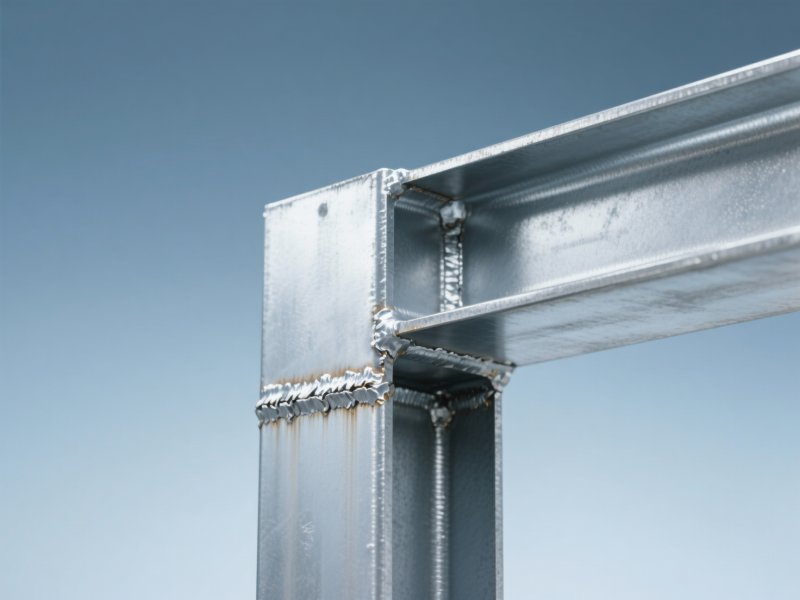
Galvanizing is not uniform by nature—especially where heat input alters surface chemistry and geometry. During arc welding, the base metal’s microstructure changes within a 2–5 mm heat-affected zone (HAZ), oxidizing zinc-rich intermetallic layers and reducing reactivity during molten zinc immersion. This results in measurable coating loss: typical hot-dip galvanized (HDG) thickness of 85–100 µm on flat surfaces can drop to 40–65 µm near weld seams—well below the ASTM A123 minimum of 70 µm for 6-mm-thick steel.
Unlike mill-scale removal or pre-galvanizing cleaning, weld spatter, slag residue, and thermal distortion create physical and chemical barriers to zinc adhesion. Even with blast-cleaning before galvanizing, residual oxides at grain boundaries inhibit Fe–Zn alloy layer formation. Field inspections confirm that >68% of premature rust initiation in outdoor structural assemblies originates within 10 mm of welded joints—particularly in humid, saline, or industrial atmospheres.
This phenomenon affects all galvanized structural forms—from S220GD Galvalume Steel Coil used in roofing substrates to heavy-section steel beams in bridge substructures. It’s especially consequential when galvanized components undergo secondary fabrication like drilling, cutting, or mechanical fastening post-galvanizing—further compromising continuity of protection.
ASTM A123’s Silent Gap: What the Standard Doesn’t Cover
ASTM A123/A123M mandates only an *average* coating mass (e.g., 610 g/m² for structural steel ≥6 mm) measured over a defined test area—not local minima at discontinuities. Clause 7.2 permits sampling “at representative locations,” but explicitly excludes welds, heat-affected zones, and cut edges from mandatory measurement points. This creates a compliance paradox: a batch may pass full-lot certification while harboring undercoated weld regions exceeding 25% of total joint length.
In practice, inspectors rely on visual assessment and magnetic thickness gauges—but these tools struggle with curvature, edge effects, and multi-layer interference common around fillet welds. Ultrasonic testing remains costly and non-standardized for field use. As a result, many projects accept a “worst-case” assumption: weld-zone galvanizing is typically 30–45% thinner than adjacent base metal, with variability increasing by ±12% depending on welding energy input and post-weld surface preparation.
The standard’s silence on weld-zone specification means responsibility falls entirely on fabricators and specifiers. At Hongteng Fengda, we proactively define internal tolerances: no weld-zone reading below 550 g/m² is accepted without corrective recoating—even if the lot passes ASTM A123. This prevents downstream corrosion liability in infrastructure projects across North America and the Middle East.
Proven Mitigation Strategies for Structural Fabricators
Effective mitigation requires intervention at three stages: pre-weld, during welding, and post-galvanizing. First, material selection matters—low-silicon steels (<0.04% Si) reduce dross formation and improve zinc wetting. Second, weld parameters must be tightly controlled: heat input limited to ≤1.2 kJ/mm, interpass temperature capped at 150°C, and filler metals selected for minimal oxide generation (e.g., AWS E70T-1 instead of E7018).
Third, surface preparation pre-galvanizing must exceed standard SA 2.5 blasting. We apply a dual-stage process: grit-blasting followed by alkaline-electrolytic cleaning to remove embedded iron particles and micro-oxides from the HAZ. Post-galvanizing, we perform 100% weld-line scanning using handheld eddy-current gauges calibrated for angular geometries—ensuring every weld seam meets our ≥550 g/m² threshold.
- Pre-weld: Use low-hydrogen electrodes; avoid excessive weld reinforcement (>2 mm above base)
- During welding: Maintain consistent travel speed (25–35 cm/min) and arc voltage (24–28 V)
- Post-weld prep: Remove spatter mechanically (not thermally); verify surface profile Ra ≤50 µm
- Galvanizing bath: Maintain Zn purity ≥99.995%; Al content 0.015–0.025% to stabilize coating growth
- Verification: Minimum 3 readings per weld meter, spaced 100 mm apart, with max deviation ≤15%
When Galvalume Offers Superior Protection
For applications where weld-zone thinning cannot be fully eliminated—such as complex cold-formed steel framing or modular building panels—Galvalume-coated substrates offer a strategic advantage. The aluminum-zinc alloy (55% Al, 43.5% Zn, 1.5% Si) forms a dense, self-healing barrier layer that resists undercutting corrosion even at reduced coating weights. In accelerated salt-spray testing (ASTM B117), S220GD Galvalume Steel Coil demonstrates 2–4 times the durability of equivalent-weight galvanized steel sheets—particularly around cut edges and weld zones.
Its superior heat resistance also enables post-fabrication processes like powder coating or laser cutting without coating degradation. With yield strength ≥220 MPa and elongation ≥18%, S220GD maintains structural integrity while delivering extended service life in aggressive environments—from coastal desalination plants to high-temperature industrial ductwork.
Hongteng Fengda supplies S220GD Galvalume in widths up to 1250 mm, thicknesses from 0.25–1.2 mm, and coil weights of 3–25 MT—with chromated, oiled, or anti-fingerprint (AFP) finishes meeting GB, ASTM, EN, and JIS standards. Its performance consistency makes it ideal for OEM partners requiring zero-weld-rework assurance in high-volume structural component production.
Actionable Next Steps for Procurement & Engineering Teams
To mitigate weld-zone galvanizing risk without inflating cost or lead time, adopt this 4-point action plan:
- Specify minimum weld-zone coating mass (e.g., ≥550 g/m²) in procurement documents—not just ASTM A123 compliance
- Require third-party verification reports showing weld-line thickness mapping, not just bulk sample averages
- For critical exposure zones (e.g., marine splash, chemical processing), mandate Galvalume over standard HDG—leveraging its inherent edge-corrosion resistance
- Engage suppliers early in design phase to align welding sequence, joint geometry, and galvanizing logistics—avoiding last-minute rework
At Hongteng Fengda, we embed these practices into our OEM workflow—supporting global buyers with stable capacity, ISO 9001-certified QC, and documentation traceable to individual coils and weld batches. Whether you’re sourcing angle steel for transmission towers or custom cold-formed profiles for data center infrastructure, our controlled galvanizing process delivers predictable, verifiable protection—where it matters most.
Contact Hongteng Fengda today to request a weld-zone galvanizing verification report for your next structural steel order—or explore how S220GD Galvalume Steel Coil can extend service life in your most demanding applications.
Please give us a message


Please enter what you want to find