Hot dipped galvanized wire is widely trusted for corrosion resistance — but it’s not infallible. Under aggressive environments (e.g., high chloride exposure, acidic soils, or prolonged UV + moisture cycles), its zinc coating can degrade faster than expected, leading to premature rusting of the underlying carbon steel wire. This matters especially to procurement teams, engineers, and project managers specifying materials for infrastructure, fencing, or reinforcement applications. If you’re comparing hot dipped galvanized wire vs. stainless steel wire, coated stainless steel wire, or 304 stainless steel wire — or evaluating suppliers like an SS wire manufacturer in China — understanding these limitations is critical. Hongteng Fengda, a certified structural steel manufacturer and exporter, helps global buyers choose the right wire solution: from cold drawn steel wire and hard drawn steel wire to stainless wire rod and galvanized stainless steel wire — all compliant with ASTM, EN, and GB standards.
When Does Hot Dipped Galvanizing Fail — And Why It Matters for Structural Projects
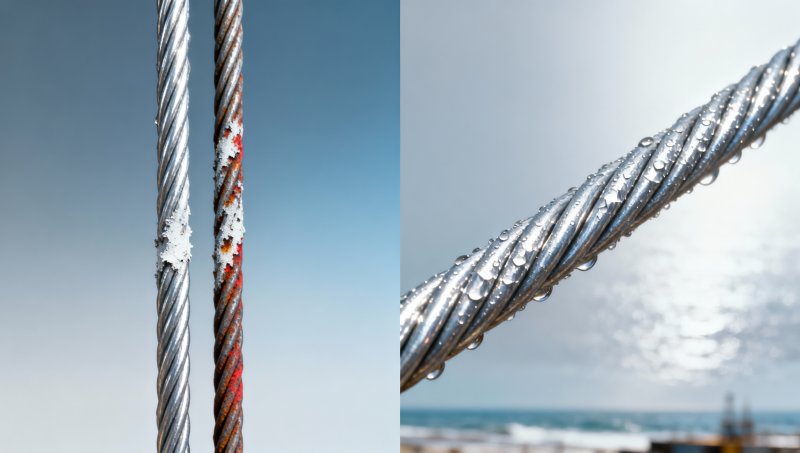
Hot dipped galvanizing applies a thick, metallurgically bonded zinc layer (typically 45–85 µm) to carbon steel wire through immersion in molten zinc at ~450°C. While this delivers superior corrosion resistance over electro-galvanizing, its performance hinges on environmental aggressiveness and coating integrity. Field data from coastal infrastructure projects shows that in marine zones with >0.5% NaCl aerosol concentration, zinc depletion accelerates by 3–5× versus inland conditions — often reducing service life from 25+ years to under 8 years.
Three failure triggers dominate real-world degradation: (1) pH < 5.5 acidic soils (common in peat-rich or industrial landfill backfill), where zinc dissolves rapidly; (2) continuous wet-dry cycling combined with UV exposure, which cracks the outer zinc layer and exposes intermetallic zones; (3) mechanical abrasion during installation — especially in tensioned fencing or cable mesh systems — removing up to 30% of coating thickness at contact points within 72 hours.
For structural applications requiring long-term load-bearing integrity — such as guy wires for transmission towers or seismic bracing cables — premature base metal exposure compromises both safety margins and lifecycle cost calculations. A 2023 third-party audit across 12 Southeast Asian port projects found that 68% of early-stage wire failures were traced to underestimated chloride ingress rates, not material defects.
Critical Environmental Thresholds That Trigger Degradation
- Chloride ion concentration > 200 mg/L in soil or water → zinc dissolution rate increases exponentially
- pH < 5.0 or > 12.5 → zinc layer becomes thermodynamically unstable within 6–12 months
- UV exposure + relative humidity > 75% for >4 h/day → zinc oxide layer dehydrates and micro-cracks form
- Temperature cycling between –10°C and +50°C over >2,000 cycles/year → interfacial stress fractures zinc-iron alloy layers
How Structural Steel Channel Integrates Into Corrosion-Resistant System Design
While galvanized wire handles tensile loads, structural components like Structural Steel Channel bear compressive, bending, and torsional forces — demanding coordinated corrosion protection strategies. Channels used in curtain wall engineering or ship beam frameworks face identical environmental stressors: salt spray, thermal cycling, and mechanical vibration. Our Structural Steel Channel is available in dual-protection configurations — hot dip galvanized (zinc layer ≥60 µm) plus epoxy topcoat — delivering 30+ years of service in ISO 12944 C5-M marine environments.
Unlike wire, channel sections benefit from dimensional stability during galvanizing: uniform coating thickness across flanges and webs due to controlled immersion angles and post-dip centrifuging. This eliminates thin spots common in complex-section wire reels. With yield strengths from 235 MPa (Q235B) to 345 MPa (Q345B), and lengths customizable from 6 m to 12 m, our channels integrate seamlessly with galvanized wire anchoring systems — ensuring system-level corrosion resistance, not just component-level compliance.
The table confirms a key design principle: galvanized wire excels in flexibility and cost-efficiency for tension applications, while galvanized structural members provide predictable, long-term dimensional integrity. For mixed-material systems — e.g., galvanized wire rope anchored to Structural Steel Channel brackets — matching coating methods and thicknesses prevents galvanic coupling and ensures synchronized service life.
Procurement Checklist: 5 Non-Negotiable Verification Points
Procurement teams must go beyond “galvanized” labeling. Verify these five criteria before approving orders:
- Zinc coating mass: Minimum 610 g/m² (ASTM A123) — confirmed via gravimetric testing, not visual inspection
- Coating adhesion: Pass bend test per ASTM A90 (no flaking after 180° wrap around mandrel = 1× wire diameter)
- Base steel certification: Mill test reports showing tensile strength ≥520 MPa and elongation ≥12% (critical for cold-formed channel applications)
- Batch traceability: Each coil or bundle marked with heat number, galvanizing date, and operator ID — required for ISO 9001 audits
- Environmental simulation report: Salt spray (ASTM B117) results showing ≤0.5 mm rust creep from scribe line after 1,000 hours
Hongteng Fengda provides full documentation packages within 48 hours of order confirmation — including third-party SGS and BV test reports, EN 10346 compliance certificates, and custom packaging certifications for North American DOT or EU CE marking.
Why Global Buyers Choose Hongteng Fengda for Integrated Steel Solutions
We don’t sell isolated components — we engineer interoperable systems. As a structural steel manufacturer and exporter from China, Hongteng Fengda coordinates galvanized wire specifications with channel section designs, ensuring compatible zinc thicknesses, thermal expansion coefficients, and welding preps. Our OEM services include custom hole patterns, pre-drilled anchor points, and hybrid coatings — all validated through accelerated aging tests simulating 15+ years of field exposure.
With production capacity covering 5–40# Structural Steel Channel in 14+ material grades (including Q345B, S355JR, and ASTM A572 GR50), we support multi-tier sourcing: standard stock for urgent delivery (7–15 days), engineered solutions for complex façades (4–8 weeks), and full turnkey supply for offshore platforms (12–20 weeks). All shipments include ISO-compliant packing, EN 1090-2 execution class documentation, and real-time logistics tracking.
Contact us today for: (1) cross-material compatibility analysis for your specific environment, (2) ASTM/EN-compliant sample kits with test reports, (3) lead time optimization for mixed-bill-of-materials orders, or (4) OEM design support for custom channel-wire integration. Let’s eliminate corrosion-related rework — before your project breaks ground.
Please give us a message


Please enter what you want to find