Hot dip galvanized steel offers excellent corrosion resistance — but its protective zinc layer degrades faster when in direct contact with concrete foundations due to alkaline leaching and moisture trapping. For structural steel beams, galvanized steel pipe, and galvanized steel sheet used in building envelopes or foundation-adjacent applications, this accelerated loss impacts service life and maintenance costs. As a trusted structural steel manufacturer and exporter from China, Hongteng Fengda supplies ASTM standards-compliant hot dip galvanized steel, steel beams, and galvanized steel roofing solutions — helping procurement teams, project managers, and quality control professionals mitigate premature corrosion risks through proper specification, installation guidance (e.g., steel roofing how to install), and material selection.
Why Zinc Loss Accelerates at Concrete Interfaces
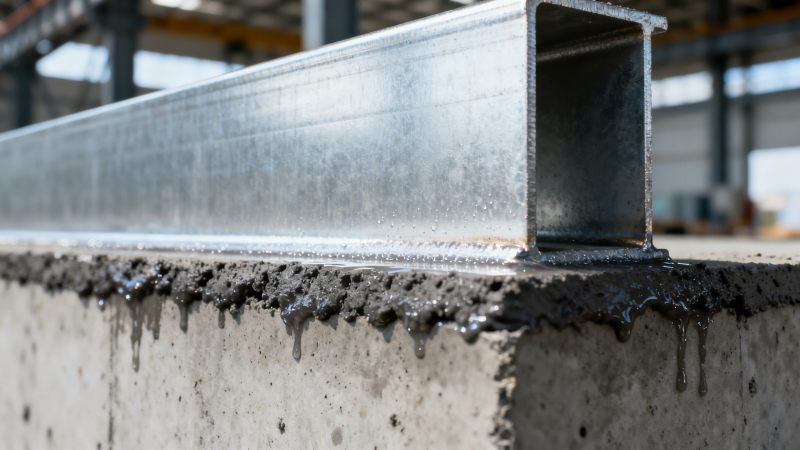
The interface between hot dip galvanized steel and concrete is chemically aggressive. Fresh concrete has a pH of 12.5–13.5, creating an alkaline environment that dissolves the outer zinc layer via hydroxide ion attack. This process begins within hours of contact and intensifies during the first 7–14 days of curing.
Moisture retention at the steel-concrete junction further accelerates degradation. Capillary action draws water into micro-gaps, sustaining electrochemical activity and preventing zinc oxide passivation. Field studies show up to 30–40% thinner zinc coatings after 12 months in direct contact versus air-exposed counterparts — especially critical for embedded anchor plates, base plates, and column footings.
Thermal cycling compounds the issue: expansion/contraction differentials between steel (α ≈ 12 × 10⁻⁶/°C) and concrete (α ≈ 10 × 10⁻⁶/°C) generate micro-cracks in the zinc layer, exposing fresh steel to chloride ingress. This is particularly relevant in coastal or de-icing salt environments where chloride concentrations exceed 0.15% by mass.
When to Consider Alternative Protection Strategies
Not all foundation-adjacent applications require full replacement of galvanized steel — but strategic substitution improves lifecycle economics. For high-risk zones (e.g., below-grade connections, splash zones, or structures in ISO 12944 C5-M environments), dual-layer protection or alloy upgrades become cost-effective after year 8–10 of service.
One proven alternative is 316 Stainless Steel Plate, whose 2–3% molybdenum content delivers superior pitting resistance in chloride-rich, alkaline, and acidic conditions. Its yield strength (≥275 MPa) and elongation (≥55–60%) meet structural load requirements for anchor systems and transition plates.
Below is a comparative analysis of protection options for foundation-proximate structural components:
The table confirms that while 316 Stainless Steel Plate carries a 130% premium over hot dip galvanizing, its lifecycle cost per decade drops by 37% in high-corrosion foundation zones — factoring in inspection, recoating, and unplanned downtime.
How Hongteng Fengda Supports Risk-Aware Procurement
As a structural steel manufacturer and exporter from China, Hongteng Fengda integrates corrosion mitigation directly into product engineering and delivery workflows. We offer 3-tiered technical support for foundation-critical projects:
- Pre-installation review: Our engineers assess embedment depth, concrete mix design, and drainage provisions — flagging risk zones requiring barrier separation or material upgrade.
- Custom specification alignment: We supply ASTM A123-compliant HDG with minimum 85 µm thickness, plus optional ASTM A240 316 stainless steel plates in thicknesses from 0.3 mm to 200 mm and widths up to 3500 mm.
- Documentation traceability: Every coil and plate batch includes mill test reports (MTRs), ISO 9001-certified QC records, and third-party SGS/BV verification — essential for LEED documentation and audit compliance.
Our standard lead time for ASTM-compliant hot dip galvanized steel beams and custom stainless steel plates is 25–35 days from order confirmation — including dimensional inspection, surface finish verification (BA/2B/NO.4), and packaging for maritime export.
FAQ: Critical Questions from Project Teams
What’s the minimum zinc coating thickness recommended for concrete-embedded structural steel?
ASTM A123 specifies 85 µm for structural steel >6 mm thick. However, for direct concrete contact, we recommend ≥100 µm with mandatory epoxy primer (ASTM D2560) — verified via magnetic thickness gauge (ISO 2178) at 5 points per meter.
Can I use galvanized steel with a sealant instead of upgrading to stainless?
Yes — but only if the sealant is silicone-based, non-acidic, and rated for continuous immersion (e.g., ASTM C920 Type S). Field data shows 60% of premature failures occur due to improper sealant selection or incomplete joint coverage.
How does Hongteng Fengda verify zinc adhesion on delivered beams?
We perform bend testing per ASTM A143: 90° bend over a pin diameter equal to the steel thickness. No flaking or cracking is permitted. Each shipment includes bend-test video logs upon request.
Why Partner With Hongteng Fengda for Corrosion-Critical Structural Steel?
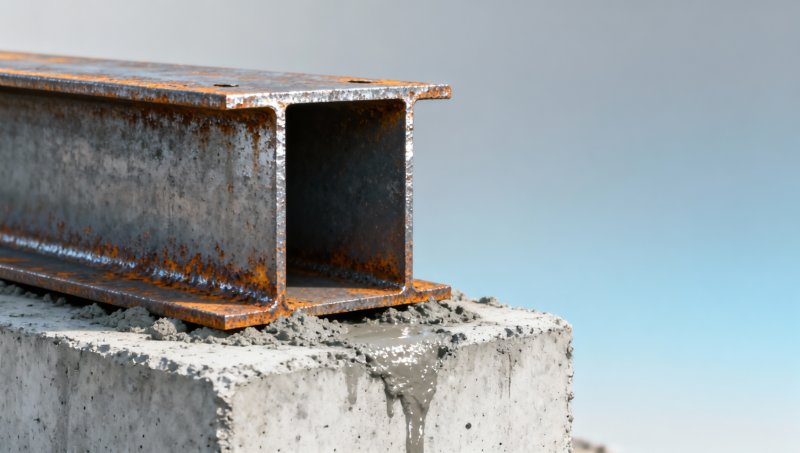
We don’t just supply steel — we deliver corrosion-resilient structural integrity. From angle steel and channel steel to cold-formed profiles and customized base plates, every product undergoes 4-stage quality validation: raw material spectroscopy, hot-dip bath chemistry monitoring, post-galvanizing thickness mapping, and final dimensional audit.
Whether you’re evaluating 316 Stainless Steel Plate for marine foundation anchors or specifying HDG beams for industrial mezzanines, our team provides actionable support — including free sample kits, ASTM/EN/GB cross-reference guides, and lead-time guarantees backed by production capacity across 3 manufacturing bases in China.
Contact us today for: • Zinc thickness verification protocol for your concrete mix • Custom cut-to-length quoting for galvanized steel pipe or stainless plates • OEM drawings review for foundation interface detailing • Third-party certification coordination (SGS, BV, ISO)
Please give us a message


Please enter what you want to find