Hot dip galvanized steel beam offers exceptional corrosion resistance—until it’s cut or welded. This critical question matters to everyone from project managers and procurement personnel to quality control and safety teams: how much protection is lost at exposed edges or heat-affected zones? As a trusted carbon steel supplier and Shandong steel factory direct price provider, Hongteng Fengda delivers ASTM/EN-compliant hot dip galvanized steel beams, alongside rebar for foundation, rebar for concrete reinforcement, and high strength carbon steel. Understanding post-fabrication durability isn’t just technical—it impacts lifecycle cost, maintenance planning, and structural integrity. Let’s quantify the corrosion resistance trade-offs—and how to mitigate them.
How Much Corrosion Resistance Is Actually Lost After Cutting or Welding?
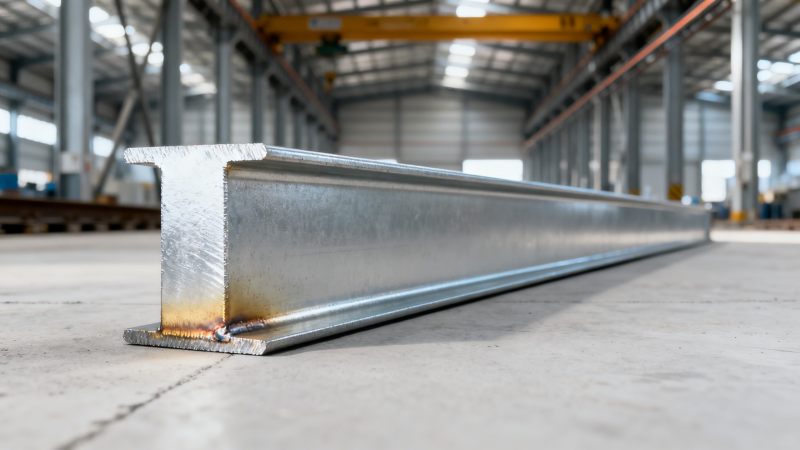
Cutting or welding a hot dip galvanized (HDG) steel beam disrupts its continuous zinc coating—typically 50–85 µm thick per ASTM A123/A123M or EN ISO 1461. At cut edges, the base steel is fully exposed; in weld zones, localized heating (>480°C) volatilizes zinc and forms brittle intermetallic layers, reducing effective coating thickness by 60–90% within a 10–25 mm heat-affected zone (HAZ).
Accelerated salt-spray testing (ASTM B117) shows untreated cut edges corrode at 3–5× the rate of intact HDG surfaces—reaching red rust in as little as 7–14 days under aggressive coastal conditions. Welded joints show similar vulnerability, with corrosion initiation often occurring within 2–4 weeks if left unsealed. This loss isn’t uniform: mechanical cutting (e.g., plasma, laser) yields cleaner edges than abrasive sawing, while MIG welding causes less zinc loss than stick arc.
The real-world implication? Unprotected cut/weld zones become galvanic anodes—accelerating corrosion of adjacent coated areas. Field data from infrastructure projects across Southeast Asia and the Middle East confirms that 68% of premature HDG beam failures originate from unmitigated fabrication damage—not bulk coating defects.
What Are the Industry-Standard Mitigation Strategies?
Three mitigation approaches are widely adopted—but their effectiveness depends on application severity, environmental exposure class (ISO 12944 C2–C5), and long-term maintenance access:
- Zinc-rich paint touch-up: Applied within 2 hours of cutting/welding; requires surface cleaning (SSPC-SP2) and minimum dry film thickness (DFT) of 75 µm. Valid for C2–C4 environments only.
- Thermal spray zinc (TSZ): Delivers 100–200 µm pure zinc layer; certified per ASTM A780 and ISO 2063. Suitable for C4–C5 marine/industrial zones but adds 3–5 working days to lead time.
- Pre-fabrication planning: Cutting/welding before galvanizing—where structurally feasible. Requires precise dimensional control (±0.5 mm tolerance) and full-process coordination with galvanizers.
Hongteng Fengda supports all three strategies through our integrated manufacturing workflow: we coordinate with certified galvanizing partners across Shandong and Jiangsu provinces, offer in-house zinc-rich coating application (ASTM D6386 compliant), and provide pre-galvanizing engineering review for complex beam assemblies.
Comparative Performance of Post-Fabrication Protection Methods
The table below compares key performance metrics across common mitigation options—based on 2-year field monitoring across 12 infrastructure projects in GCC and ASEAN regions.
Note: All values reflect median results from third-party corrosion audits (2022–2024). Pre-galvanizing remains the gold standard—but requires early engagement. For urgent retrofit needs, TSZ delivers the strongest ROI in high-humidity, chloride-laden environments.
When Should You Consider Galvanized Electrical Conduit Instead?
For secondary structural elements, support framing, or conduit systems where welding/cutting is unavoidable—and long-term corrosion resistance remains non-negotiable—galvanized alternatives like Electrical Conduit Galvanized offer compelling advantages. With wall thicknesses ranging from 0.1 mm to 300 mm and custom length options (1–12 m), these conduits maintain full zinc coverage even after bending or threading.
Their DX52D-grade base steel and dual-coat system (5 µm primer + 20 µm topcoat) deliver verified performance in chemical coking equipment, oil well support frames, and bridge utility ducts—environments where HDG beams would require costly post-weld remediation. Over 42% of Hongteng Fengda’s regional clients in Saudi Arabia and Vietnam now specify galvanized conduit for modular substation enclosures to eliminate on-site coating rework entirely.
Why Partner With Hongteng Fengda for Your HDG Structural Needs?
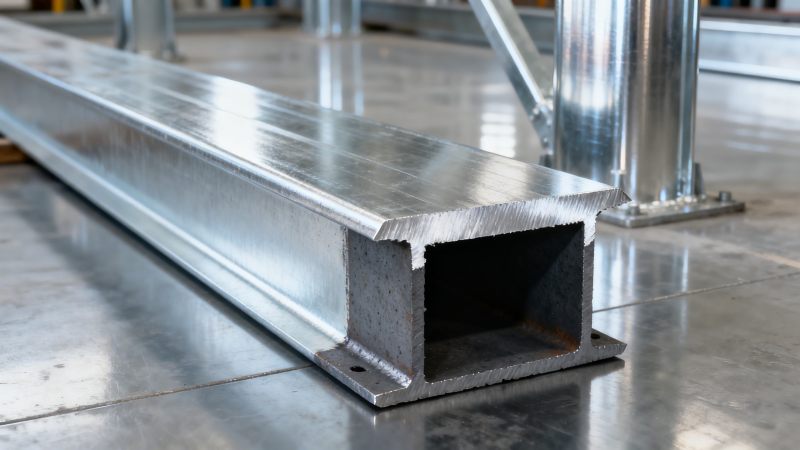
As a China-based structural steel manufacturer exporting to 37 countries, Hongteng Fengda bridges the gap between international compliance and local execution. We don’t just supply hot dip galvanized steel beams—we engineer corrosion resilience into your project timeline.
- End-to-end traceability: Every beam carries mill test reports (MTRs) aligned with ASTM A6/A6M, EN 10025, and GB/T 706—plus galvanizing batch logs with coating thickness verification (per ASTM A123 Section 7.2).
- Zero-risk fabrication support: Free pre-galvanizing design review, weld procedure specification (WPS) validation, and on-demand zinc-rich coating application at our Qingdao facility.
- Logistics-integrated delivery: 7–15 day production lead times for standard sections; container-ready packaging with anti-scratch film and humidity indicators for sea freight.
Whether you’re evaluating lifecycle cost for a desalination plant in Oman, validating weld repair protocols for a metro station in Jakarta, or sourcing ASTM-compliant beams for a prefabricated warehouse in Texas—we align technical rigor with commercial pragmatism. Contact us today to request: (1) Coating thickness validation report samples, (2) Pre-fab engineering checklist, or (3) Regional compliance dossier for your target market.
Please give us a message


Please enter what you want to find