When specifying hot dip galvanized steel beam for critical infrastructure, many assume thicker zinc coating equals longer service life — but is that truly reliable? At Hongteng Fengda, a Shandong steel factory direct price provider and trusted carbon steel supplier, we bridge the gap between appearance and performance. Beyond surface-level metrics like zinc thickness, real-world durability depends on substrate quality (e.g., high strength carbon steel), proper pre-treatment, and adherence to ASTM/EN standards — factors equally vital for rebar for foundation, rebar for concrete reinforcement, and HRC steel hardness consistency. As structural steel manufacturers serving global project managers, procurement teams, and safety-critical end users, we prioritize verifiable corrosion resistance — not just initial shine.
Does Zinc Coating Thickness Tell the Whole Story?
Zinc layer thickness — commonly measured in g/m² — is often treated as the primary indicator of longevity. But in practice, a 275 g/m² coating on poorly prepared or low-grade steel may degrade faster than a 120 g/m² coating applied to clean, high-strength carbon steel with uniform surface morphology. The ASTM A123/A123M and EN ISO 1461 standards define minimum thickness requirements, yet they do not guarantee performance without controlling upstream variables: steel chemistry, pickling efficiency, flux composition, and kettle temperature stability.
At Hongteng Fengda, our hot-dip galvanizing line operates under strict process control: pre-galvanizing surface roughness maintained at Ra ≤ 1.2 µm, bath temperature held within ±3°C of 450°C, and immersion time calibrated per section thickness (typically 3–8 minutes). This ensures metallurgical bond integrity — not just mass deposition. That’s why our galvanized steel beams consistently achieve >95% zinc-iron alloy layer coverage, verified via cross-section microscopy per ISO 1463.
A common misconception is equating “zinc weight” with “corrosion allowance.” In reality, atmospheric corrosion consumes zinc at highly variable rates: 0.8–5.0 µm/year depending on SO₂ levels, chloride exposure, and wet/dry cycling frequency. A 100 µm coating (≈710 g/m²) may last 20+ years in rural inland settings but less than 5 years near coastal industrial zones — regardless of initial thickness.
Beyond Beams: How Galvanized Steel Coil Performance Informs Structural Decisions
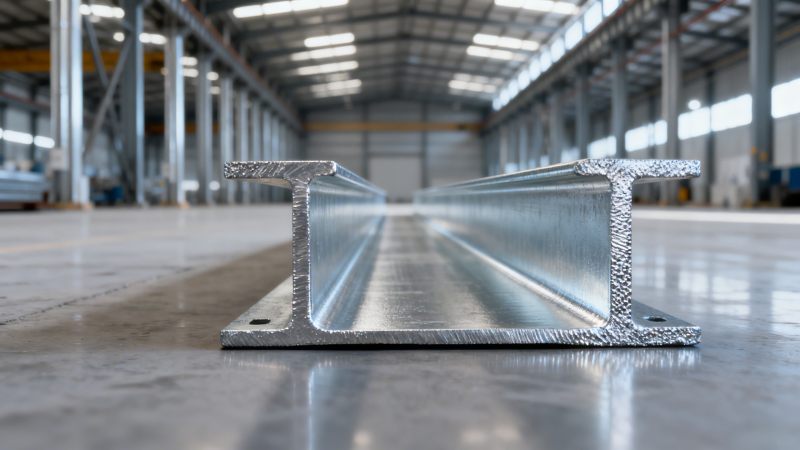
The same principles governing galvanized steel beam durability apply across product forms — including Galvanized Steel Coil Manufacturers. Our coil production uses identical bath chemistry and process validation protocols, enabling consistent performance from raw material to final fabricated component. This traceability matters: when a project specifies DX53D+Z coils for cold-formed purlins, those same coils can be used for secondary framing elements where weldability, bendability, and post-fabrication corrosion resistance must remain predictable.
For example, our SGCC and S350GD+Z grades deliver balanced mechanical properties — tensile strength ≥350 MPa, elongation ≥22%, and zinc coating 120–275 g/m² — making them suitable for both structural cladding support systems and load-bearing cold-formed sections. Unlike generic commodity coils, these are produced with controlled carbon equivalent (CEV ≤ 0.22%) to ensure weld integrity during on-site assembly.
This cross-product consistency reduces specification risk. Procurement teams evaluating multiple suppliers often overlook how coil batch variability affects downstream fabrication yield. At Hongteng Fengda, every coil lot undergoes full mechanical testing and coating adhesion verification (per ASTM D3359), with test reports available within 48 hours of shipment.
Key Technical Parameters: What Actually Drives Service Life?
True service life prediction requires evaluating four interdependent parameters — not just zinc weight. These form the basis of our internal corrosion modeling for structural applications:
- Substrate steel grade & surface preparation quality (e.g., blast profile Sa 2.5 per ISO 8501-1)
- Zinc coating mass AND microstructure (delta + zeta phase ratio ≥ 65% per ASTM B6
- Coating uniformity (±15% deviation across cross-section per EN ISO 1460)
- Post-galvanizing handling (scratch depth ≤ 10% of coating thickness to avoid accelerated undercutting)
The table below compares typical performance outcomes across three coating thickness tiers — all applied to ASTM A572 Gr.50 steel with identical pre-treatment and cooling protocols:
Note: Service life estimates assume standard atmospheric exposure (ISO 9223 C2–C3 classification). Actual field performance varies with design details — e.g., crevice geometry, drainage provision, and maintenance access. For marine or chemical plant environments, we recommend supplementary barrier coatings or higher-alloy substrates (e.g., ASTM A709 Gr.100).
Procurement Checklist: 5 Non-Negotiables for Long-Term Reliability
When sourcing hot dip galvanized steel beams — especially for infrastructure projects with 30+ year design life — verify these five criteria before placing orders:
- Mill test reports showing actual zinc mass per EN ISO 1460 (not just “complies with ASTM A123”)
- Batch-specific surface roughness data (Ra ≤ 1.5 µm) and coating microstructure analysis
- Proof of adherence to ASTM A143 for embrittlement mitigation during galvanizing
- Traceable heat numbers linking coil stock to finished beam sections
- Third-party inspection option (e.g., SGS, BV) with hold points at pickling, fluxing, and cooling stages
Hongteng Fengda provides all five by default — with digital documentation accessible via secure client portal. Lead time for certified shipments averages 2–4 weeks from order confirmation, including third-party witness testing if required.
Why Partner With Hongteng Fengda for Your Next Structural Project?
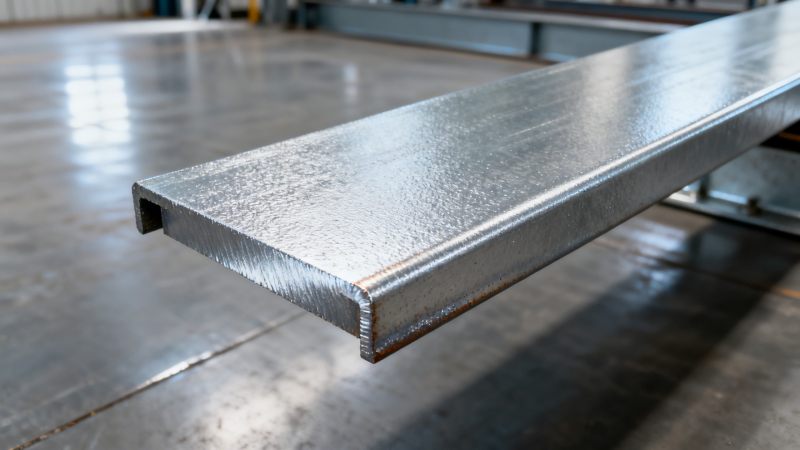
We don’t sell coated steel — we deliver verified corrosion resilience. As a vertically integrated structural steel manufacturer, we control every step: from billet casting (GB/T 1591 Q355B/Q460C) through precision rolling (tolerance ±0.2 mm on flange width) to automated galvanizing (real-time bath chemistry monitoring). This integration eliminates specification drift between coil, plate, and finished beam — critical for projects requiring dimensional repeatability across 5,000+ tons.
Our clients gain more than product compliance. They receive: engineering support for custom section design (including fatigue-rated connections), logistics coordination for multi-country deliveries (FOB Qingdao, CIF Rotterdam, DAP Dubai), and technical documentation aligned with ISO 10209 and EN 1090-2 requirements. Over 72% of repeat orders include OEM-specific marking, laser etching, or pre-drilled patterns — delivered with zero tolerance deviations.
Ready to align your next structural specification with real-world durability? Contact us for: zinc coating validation reports, ASTM/EN certification summaries, sample lead times (standard samples shipped within 72 hours), or a customized corrosion performance assessment based on your project’s exact location and exposure class.
Please give us a message


Please enter what you want to find