Selecting the right Hot Rolled I Beam for bridge construction is critical to structural safety, load efficiency, and long-term durability.
Steel grade, dimensional tolerance, mechanical performance, weldability, and standards compliance directly affect bridge reliability and procurement risk.
Hongteng Fengda supplies quality-controlled structural steel from China, supporting global bridge projects with stable production and export experience.
Why Checklist Evaluation Matters for Hot Rolled I Beam Use
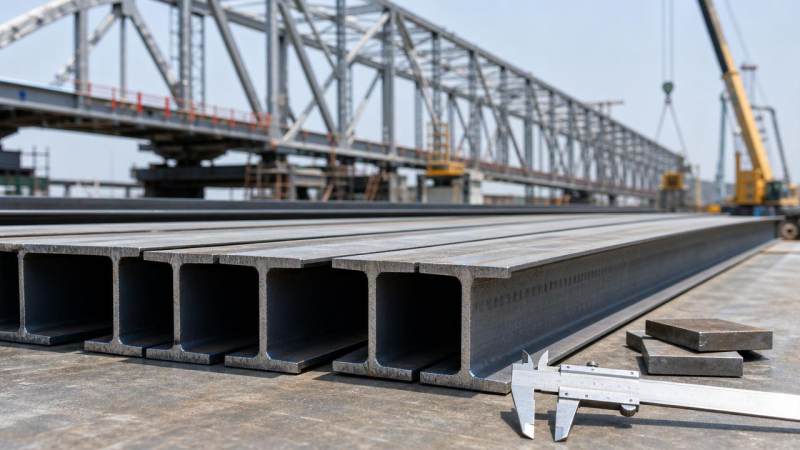
Bridge structures face repeated traffic loads, vibration, temperature movement, corrosion exposure, and strict inspection requirements.
A checklist approach helps compare Hot Rolled I Beam for bridge construction beyond price, focusing on measurable engineering performance.
It also reduces sourcing errors when drawings, standards, quantities, coating needs, and delivery schedules are reviewed together.
Core Checklist for Hot Rolled I Beam for Bridge Construction
- Verify the design standard first, then match ASTM, EN, JIS, or GB requirements with the specified bridge loading conditions.
- Confirm the steel grade, yield strength, tensile strength, elongation, and impact toughness required for the bridge location.
- Check flange width, web thickness, section height, unit weight, and tolerance against approved structural drawings.
- Review mill test certificates and confirm heat number traceability before accepting Hot Rolled I Beam for bridge construction.
- Evaluate weldability, carbon equivalent, and preheating requirements when beams will connect with stiffeners or cross frames.
- Inspect straightness, surface defects, end cutting quality, and rolling marks before fabrication or shipment approval.
- Define corrosion protection needs, including primer, galvanizing, paint system, or weathering steel alternatives.
- Confirm packaging, lifting points, bundle marking, and export documentation to prevent damage during international transport.
Material Grade and Mechanical Performance Checks
A Hot Rolled I Beam for bridge construction must provide predictable strength, ductility, and toughness under dynamic load conditions.
For carbon structural steel, common references include ASTM A36, ASTM A572, EN S355, JIS SS400, and GB Q235 or Q355.
Higher strength is not always the best option if welding, fatigue behavior, or local code approval becomes more complex.
Always compare the beam grade with span length, design load, connection method, and expected service environment.
Dimensional Accuracy and Fabrication Readiness
Dimensional accuracy is essential when a Hot Rolled I Beam for bridge construction is used in repetitive girder layouts.
Small deviations can accumulate across cross beams, diaphragms, bracing members, and bearing seats.
Measure section height, flange thickness, web thickness, flange slope, and camber before releasing material to fabrication.
If cutting, drilling, or welding is outsourced, share tolerance requirements before processing begins.
Recommended Fabrication Review Steps
- Compare actual beam dimensions with project drawings and approved material standards before workshop processing.
- Mark heat numbers on each bundle and maintain traceability through cutting, drilling, welding, and coating.
- Use trial assembly for critical connection zones where bolted diaphragms or welded stiffeners require precise alignment.
- Inspect weld edges, cut faces, and hole positions before applying corrosion protection or packing beams for delivery.
Complementary Steel Materials in Bridge Fabrication
Bridge fabrication often requires more than Hot Rolled I Beam for bridge construction.
Round bars, angles, channels, plates, and custom profiles may be used for bracing, supports, handrails, anchors, and auxiliary components.
For related fabrication needs, Hongteng Fengda also supplies A36 Carbon Steel Round Bar for construction and engineering applications.
This product offers high strength, wear resistance, and diameter options from 5mm to 2500mm, with lengths including 2m, 5m, 6m, and 12m.
Available surface treatments include oiling, passivation, galvanizing, painting, transparent oil, anti-rust oil, and other project-specific finishes.
Relevant standards include AISI, ASTM, DIN, JIS, GB, SUS, and EN, helping maintain consistency across multi-material procurement.
Application Notes for Different Bridge Scenarios
Road and Highway Bridges
Road bridges require strong fatigue resistance because traffic creates repeated stress cycles throughout the service life.
When selecting Hot Rolled I Beam for bridge construction, review axle loads, span arrangement, deck type, and vibration behavior.
Pedestrian and Utility Bridges
Pedestrian bridges often prioritize appearance, corrosion protection, easy installation, and controlled deflection.
A lighter beam may be acceptable, but stiffness and coating quality still need careful verification.
Temporary and Modular Bridges
Temporary bridges need fast supply, repeatable dimensions, and reliable bolted connections for rapid assembly.
A standardized Hot Rolled I Beam for bridge construction can reduce fabrication time and simplify replacement planning.
Commonly Overlooked Risks
Ignoring impact requirements. Low-temperature regions may need verified Charpy impact values, not only basic yield and tensile strength.
Accepting incomplete certificates. Missing heat numbers, chemical composition, or mechanical test data can create inspection delays.
Underestimating corrosion exposure. Coastal, industrial, and deicing salt environments require stronger coating systems and maintenance planning.
Overlooking transport deformation. Long beams need proper bundling, spacing, lifting support, and moisture protection during export shipping.
Choosing price before suitability. Low-cost material may increase welding repairs, rework time, or project approval risk.
Practical Execution Guide for Procurement and Inspection
- Prepare drawings, standards, grade requirements, tolerance needs, coating specifications, and shipment destination before requesting quotation.
- Ask for mill test certificates, production photos, size confirmation, and packing plans before final order approval.
- Define inspection points for raw material, cutting, drilling, welding, surface treatment, packing, and container loading.
- Reserve enough lead time for rolling, processing, coating, customs documents, vessel booking, and destination clearance.
- Use one supplier for beams and related structural steel when consistency, documentation, and schedule control are important.
Hongteng Fengda manufactures and exports angle steel, channel steel, steel beams, cold formed profiles, and customized structural components.
Products can comply with ASTM, EN, JIS, and GB standards, supporting projects across North America, Europe, the Middle East, and Southeast Asia.
For Hot Rolled I Beam for bridge construction, stable production capacity and strict quality control help reduce sourcing uncertainty.
Summary and Next-Step Action
A reliable bridge beam decision starts with grade verification, dimensional control, mechanical testing, weldability review, and corrosion planning.
Use a structured checklist before placing orders, especially when importing steel for time-sensitive infrastructure projects.
For Hot Rolled I Beam for bridge construction, share drawings, standards, quantities, and delivery requirements with Hongteng Fengda.
The team can support specification review, customized supply, export documentation, and coordinated structural steel procurement.
Please give us a message


Please enter what you want to find