Hot galvanizing remains one of the most widely specified corrosion-control methods for structural steel.
For project evaluation, the process matters as much as the final silver-gray appearance.
Coating adhesion, thickness, uniformity, and defect risk all begin long before steel enters molten zinc.
A clear understanding of hot galvanizing helps determine whether steel components will perform reliably in transport, storage, fabrication, and long-term service.
What hot galvanizing really does for steel
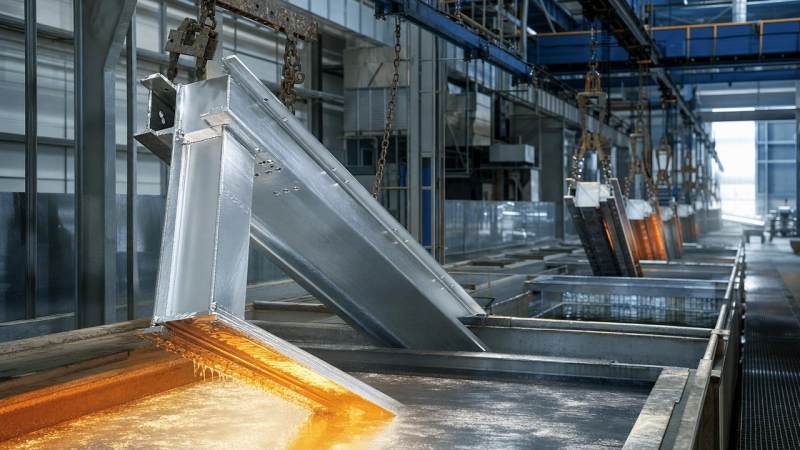
The image usually highlights the zinc bath stage, where the protective layer is formed.
Hot galvanizing is a metallurgical coating process, not simply a surface paint.
Steel is cleaned, fluxed, immersed in molten zinc, and then cooled.
During immersion, iron and zinc react to create alloy layers.
That reaction is why the coating can resist impact better than many organic systems.
In construction, transmission, industrial platforms, and outdoor fabrication, this matters because steel often faces moisture, chlorides, and mechanical handling at the same time.
The result is not just corrosion resistance.
It is also more predictable maintenance planning and lower coating failure risk in exposed environments.
How the hot galvanizing process works step by step
Process control is the key point when judging galvanizing quality.
A visually bright coating can still hide preparation problems.
1. Surface preparation
Degreasing removes oil, shop dirt, and fabrication residue.
Pickling removes rust and mill scale, usually with acid treatment.
Rinsing prevents chemical carryover into the next stage.
If cleaning is incomplete, bare spots and weak adhesion become much more likely.
2. Fluxing and drying
Flux protects the prepared steel from oxidation before immersion.
Drying is not a minor detail.
Residual moisture may cause splash, uneven reaction, or surface contamination in the zinc kettle.
3. Zinc immersion
The steel is dipped into molten zinc, typically around 445°C to 465°C.
Immersion time, steel chemistry, section thickness, and bath composition influence final coating growth.
Silicon and phosphorus levels in the base steel often have a strong effect.
4. Withdrawal, drainage, and cooling
When the steel leaves the bath, excess zinc drains off.
Withdrawal speed and orientation affect runs, spikes, and uneven build-up.
Cooling may be done in air or quench solution, depending on process design.
5. Inspection and finishing
The final stage includes visual inspection, thickness measurement, adhesion review, and local touch-up where standards allow.
For exported structural steel, documentation is often as important as the coating itself.
Why coating thickness gets so much attention
In hot galvanizing, thickness is closely linked to service life.
A thicker zinc layer usually means more sacrificial protection before red rust appears.
Still, thicker is not always better if brittleness, roughness, or fit-up problems appear.
Standards such as ASTM A123, EN ISO 1461, JIS, and GB define minimum coating requirements by steel thickness and product category.
Typical average thickness may range roughly from 45 to more than 100 microns, depending on the standard and the steel section.
For technical review, the main question is whether the measured result matches specification and exposure conditions.
Common defects and what they usually indicate
Not every visible irregularity is a rejection issue.
Some appearance differences are normal in hot galvanizing.
The important task is separating cosmetic variation from functional risk.
Bare spots
Usually linked to poor cleaning, welding residue, heavy oxide, or handling contact.
These need close review because local corrosion can start quickly.
Runs, drips, and spikes
These often come from drainage conditions during withdrawal.
They may be acceptable after smoothing, unless they interfere with assembly or safety.
Rough or excessively thick coating
This can be caused by reactive steel chemistry or ash and dross effects.
Performance may still be good, but fit tolerance and appearance can suffer.
Dross pimples and inclusions
These result from zinc-iron particles trapped on the surface.
If isolated, they are often manageable.
If widespread, process cleanliness should be questioned.
White rust
White rust forms during storage when fresh galvanized steel stays wet without ventilation.
It is mainly a storage and packing issue, not always a galvanizing failure.
Peeling or flaking
This is more serious.
It can point to adhesion problems, abnormal alloy layer behavior, or post-process damage.
What matters in real project evaluation
Hot galvanizing should be assessed in context, not by appearance alone.
Outdoor handrails, utility brackets, structural beams, guardrails, and fabricated assemblies do not all face the same corrosion profile.
The same applies to different steel forms.
For example, round sections used in railings, fences, water supplying lines, or general construction may require attention to drainage holes, straightness, and coating continuity.
Where suitable, Carbon Steel Round Bar can be supplied in diameters from 5 to 2500mm and lengths such as 2m, 5m, 6m, and 12m.
Its available grades include S235JR, S355JR, GrB, X42, X52, X65, and 30CrMo, with compliance options covering ASTM, EN, JIS, DIN, and GB.
That variety matters because base material selection influences both fabrication behavior and galvanizing response.
In large export projects, stable process control is also part of risk control.
Hongteng Fengda supplies structural steel products and custom components to multiple international markets.
That background is relevant because global projects often require alignment between steel grade, fabrication method, coating standard, and inspection records.
Practical checks before approval or sourcing
A useful review process usually includes more than one checkpoint.
- Confirm the governing galvanizing standard and any project-specific thickness requirement.
- Check whether steel chemistry is suitable for predictable hot galvanizing results.
- Review part design for venting, drainage, and zinc flow.
- Ask how thickness is measured and recorded across different areas.
- Differentiate acceptable appearance variation from true coating defects.
- Verify storage, packing, and shipment conditions to reduce white rust risk.
- For custom items, compare sample pieces with final production routing.
These checks are especially useful when the project includes fabricated beams, channels, angles, cold formed profiles, or mixed assemblies from more than one supplier.
A balanced way to move forward
Hot galvanizing is not difficult to understand once the process sequence and decision points are made visible.
The strongest evaluations usually connect three things: steel chemistry, process discipline, and inspection evidence.
That approach gives a more reliable basis for comparing suppliers than appearance alone.
When reviewing future steel packages, it helps to define the exposure class, thickness target, acceptable defects, and documentation scope before production starts.
With those criteria in place, hot galvanizing becomes easier to judge, easier to specify, and easier to align with long-term project performance.
Please give us a message


Please enter what you want to find