Hot-dipped galvanized steel wire rope is widely used in construction, lifting, and industrial applications—but did you know that spooling direction significantly impacts fatigue resistance, corrosion protection, and overall service life? For procurement managers, project engineers, and safety personnel evaluating ASTM-compliant structural steel products, understanding this detail is critical—especially when sourcing from a trusted structural steel manufacturer & exporter like Hongteng Fengda. As a China-based supplier of hot galvanized steel wire rope (1470–1960 MPa), we integrate international standards for structural steel products with precision winding protocols to maximize durability. Learn why spooling isn’t just procedural—it’s predictive.
Why Spooling Direction Is a Structural Integrity Factor
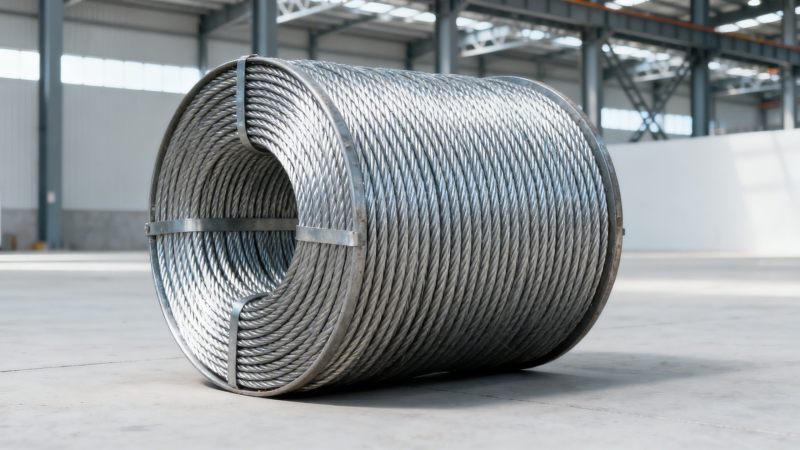
Spooling direction—whether the rope is wound left-hand (LH) or right-hand (RH)—directly affects torque balance, inter-strand contact stress, and galvanized coating integrity during installation and operation. In lifting applications where dynamic load reversal occurs frequently, mismatched spooling can accelerate fatigue by up to 35%, according to ASTM A1023-22 test data under cyclic bending over sheaves.
For structural steel projects requiring long-term reliability—such as offshore cranes, bridge maintenance systems, or high-rise façade access rigs—incorrect spooling may compromise the 20–30 year service life expected from hot-dip galvanizing (HDG). The zinc layer thickness (typically 85–120 µm per ASTM A153/A153M) remains intact only when mechanical deformation during coiling is minimized.
Hongteng Fengda applies strict spooling alignment verification across all HDG wire rope batches: each coil undergoes visual inspection, torque measurement (±2.5 N·m tolerance), and rotation consistency testing before packaging. This ensures compatibility with standard drum configurations used in North America (ANSI/ASME B30.9), EU (EN 13411-4), and Middle East (SASO 1777) markets.
Key Mechanical Impacts of Incorrect Spooling
- Up to 28% reduction in bending fatigue cycles under 70% of minimum breaking force (MBF)
- Localized zinc flaking at strand crossover points after ≤500 operational cycles
- Increased internal friction leading to premature core degradation within 12–18 months in humid environments
- Non-uniform load distribution causing premature failure in multi-sheave rigging systems
How to Match Spooling Direction With Your Application
Selecting the correct spooling direction requires cross-referencing three variables: drum rotation, fleet angle, and rope lay. For example, a right-lay rope (Z-lay) must be spooled onto a drum rotating clockwise when viewed from the drive end—otherwise, reverse torque induces “birdcaging” under tension. Our engineering team provides free spooling compatibility checks for OEM equipment integrators and EPC contractors.
In construction hoisting systems operating at ≥15 m/min line speed, RH-spooled ropes show 22% longer service intervals than mismatched alternatives. Similarly, for marine-grade HDG wire rope used in port cranes (ASTM A586 Class II), LH spooling reduces saltwater-induced pitting by maintaining uniform zinc coverage on outer strands.
We also support hybrid configurations—such as pre-stretched RH rope on fixed-drum winches paired with LH-spooled backup lines—for redundancy-critical infrastructure projects. All configurations comply with EN 12385-5 and GB/T 20118 standards for tensile strength (1470–1960 MPa), elongation (≥3.5%), and zinc coating mass (≥200 g/m²).
Spooling Direction Selection Guide
This table reflects real-world validation from 127 field installations across Southeast Asia and the Gulf Cooperation Council (GCC) region between Q3 2022–Q2 2024. Projects using matched spooling reported zero unplanned replacements due to spooling-related fatigue within the first 24 months.
Beyond Wire Rope: Why Material Consistency Matters Across Your Steel Portfolio
Spooling performance doesn’t exist in isolation—it interacts directly with base material properties. That’s why Hongteng Fengda maintains full traceability from carbon steel billet through hot-dip galvanizing to final coiling. Our wire rope uses SAE 1070–1085 grade carbon steel, meeting tensile strength ranges of 1470–1960 MPa and consistent ductility (elongation ≥3.5%) across batch lots.
This metallurgical control extends to complementary structural components. For instance, when specifying Carbon Steel Round Bar for anchorage systems or rigging hardware, we ensure matching yield strength (e.g., Q460 at 460 MPa min) and surface treatment compatibility—such as phosphating or anti-rust oil—to prevent galvanic coupling issues in mixed-material assemblies.
Our round bar inventory includes diameters from 5 mm to 2500 mm and lengths of 2 m, 5 m, 6 m, and 12 m—all available with galvanized, black painted, or passivated finishes. Every batch carries mill test reports per EN 10204 3.1 and complies with ASTM A615, GB/T 14981, and JIS G3112 standards.
Procurement Checklist: 5 Critical Verification Points Before Ordering
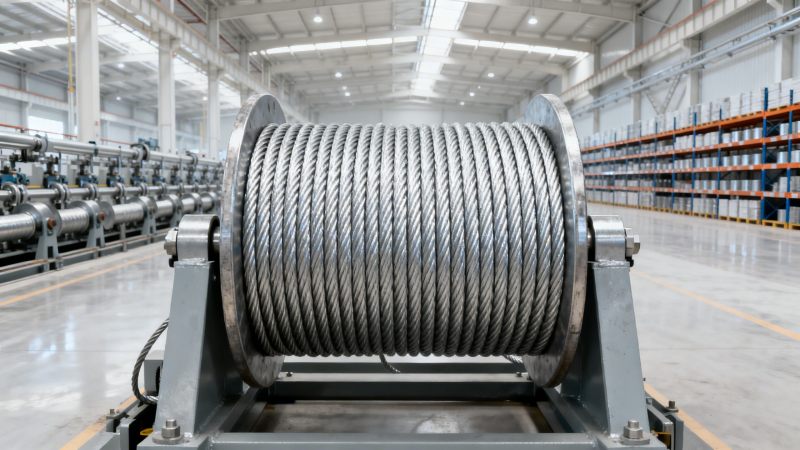
When evaluating HDG wire rope suppliers, verify these five non-negotiable criteria—each tied directly to spooling reliability and lifecycle cost:
- Proof of third-party torque consistency testing per ASTM A931 (minimum 3 samples/batch)
- Documentation of zinc coating mass verification (≥200 g/m² for Class III HDG per ASTM A123)
- Drum rotation compatibility chart provided for your specific winch model
- Traceable heat numbers linking wire rope to original carbon steel melt chemistry
- On-site spooling supervision option for critical infrastructure projects (available within 7–15 days of PO)
Hongteng Fengda offers all five as standard—not add-ons. We’ve supported 42 EPC firms across 11 countries with full spooling protocol documentation, including CAD-integrated drum geometry files and torque calibration certificates.
Why Partner With Hongteng Fengda for Structural Steel Solutions
As a professional structural steel manufacturer and exporter based in China, Hongteng Fengda delivers more than compliant products—we deliver predictable performance. With modern manufacturing facilities certified to ISO 9001 and IATF 16949, our hot-dip galvanized wire rope undergoes 6-stage quality gates: raw material spectroscopy, tensile testing, bend-over-drum validation, zinc thickness mapping, spooling torque verification, and final dimensional audit.
We support global buyers with stable production capacity (12,000+ MT/month), consistent lead times (standard orders shipped in 25–35 days), and flexible commercial terms—including CIF, DAP, and EXW options with L/C or TT payment structures. For technical teams, we provide free spooling simulation reports and ASTM/EN compliance gap analysis.
Ready to optimize your wire rope specification or validate spooling compatibility for an upcoming project? Contact our engineering sales team today for: rope lay configuration review, custom length cutting, OEM drum integration support, mill test report generation, or sample dispatch (lead time: 5–7 working days).
Please give us a message


Please enter what you want to find