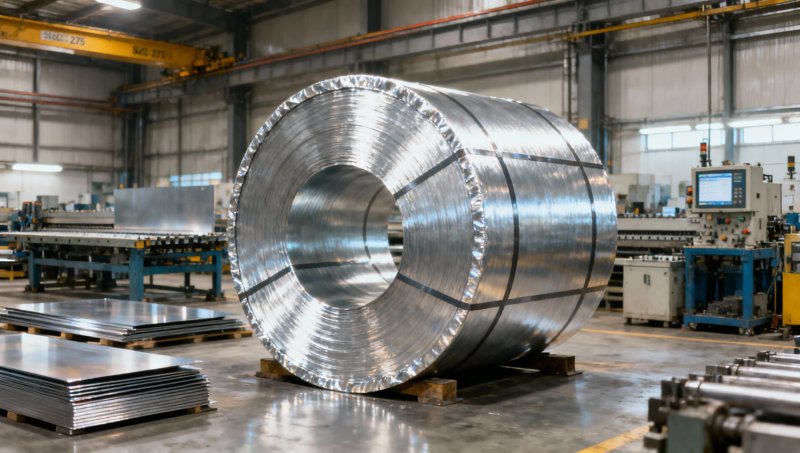
For quality control and safety teams, understanding hot dipped galvanized steel coil SGCC Z275 is essential for evaluating coating performance, corrosion resistance, and compliance in demanding projects. This grade is more than a label—it directly affects service life, inspection standards, and procurement decisions. In this article, we explain what SGCC and Z275 really mean and why they matter in practical steel selection.
In day-to-day steel purchasing and inspection, few labels are misunderstood as often as hot dipped galvanized steel coil SGCC Z275. Many buyers treat it as a simple commercial description: galvanized coil, standard coating, acceptable quality. For inspection personnel, that is not enough. The designation carries implications about substrate type, intended forming use, coating mass, expected corrosion behavior, and what should be verified at receiving and during processing.
The problem is that the label itself does not guarantee field performance. It only becomes meaningful when matched with the right standard, test method, application environment, and fabrication process. That gap between designation and actual suitability is where quality failures usually begin.
What SGCC actually refers to
SGCC is commonly associated with Japanese Industrial Standards for hot-dip zinc-coated steel sheet and coil. In practice, the market often uses SGCC as a commercial shorthand for general-use galvanized steel sheet suitable for forming. Depending on the supplier, the reference is typically linked to JIS G 3302 or legacy market usage around that specification. Because standard revisions and commercial naming practices do not always align perfectly, QC teams should never stop at the grade mark alone. The controlling document on the mill test certificate and purchase contract matters more than the shorthand printed on a tag.
From a quality perspective, SGCC usually signals that the base steel is intended for general forming rather than high-strength structural loading. That distinction is important. A coil marked SGCC may be appropriate for ducting, cladding, light roll forming, appliance parts, or general fabrication, but it is not automatically suitable for applications where mechanical properties, thickness tolerance, impact behavior, or weldability need to meet structural codes.
One common mistake in project execution is assuming “galvanized” equals “protected” and “SGCC” equals “standard safe choice.” It does not. SGCC is a product category indicator, not a complete engineering approval.
What Z275 means in practical inspection terms
Z275 refers to the nominal zinc coating mass, generally 275 g/m² total on both sides combined, under commonly used international designation systems. In commercial comparison, this is often regarded as a relatively heavy zinc coating for sheet and coil products intended to improve corrosion resistance.
That said, quality teams need to pay attention to three details.
One, Z275 is a coating mass designation, not a direct coating thickness statement. Zinc coating thickness depends on zinc density and coating distribution, and the actual thickness per side is only an approximation if derived from mass.
Two, Z275 does not mean each side carries exactly half the coating. Some products may have differential coatings if agreed by order, though the common market assumption is equal coating unless specified otherwise.
Three, the performance of Z275 in service depends heavily on environment. In dry indoor use, it may provide a long service life. In marine atmosphere, chemical exposure, trapped moisture zones, or cut-edge exposure, the same Z275 designation may be far less durable than buyers expect.
For safety and compliance personnel, this is where inspection discipline matters: confirming coating mass on paper is only the first step; understanding whether that coating is sufficient for the actual corrosion category is the decision that prevents premature failure.
Why SGCC Z275 is often specified
SGCC Z275 appears frequently because it sits in a commercially practical range: formable substrate with a coating level that is meaningful for many construction-related and industrial uses. It is often selected for roofing accessories, cable trays, enclosures, light framing, guard components, partition systems, and fabricated sheet metal parts where moderate corrosion resistance is required without moving to more expensive stainless or post-fabrication coating systems.
Its popularity, however, creates a second problem: it is sometimes used as a default specification even where the design environment has not been properly classified. This is a procurement shortcut, not a quality decision.
Where QC teams should be cautious
When a shipment arrives marked SGCC Z275, the inspection question should not be “Does the label match the PO?” but “What exactly must be true for this material to be acceptable in this project?” That usually involves checking at least five areas:
- Applicable standard and edition listed on the certificate
- Base metal thickness and tolerance
- Coating mass test result and test method
- Surface condition, including spangle, passivation, oiling, and storage stain risk
- Mechanical properties if forming, bending, or profiling is involved
Surface condition deserves more attention than it often gets. White rust, edge damage, bare spots, dross pimples, heavy ash inclusion, and roller marks may not always trigger immediate rejection in low-end commercial trade, but for projects involving enclosure integrity, aesthetic exposure, downstream coating, or safety-critical installation, they can become early indicators of poor process control.
The difference between “meeting Z275” and performing well in service
This is one of the most important points for safety managers. A coil can technically meet Z275 and still underperform in the field.
Reasons include:
- Cut edges left unprotected in aggressive conditions
- Improper storage causing early corrosion before fabrication
- Severe forming that cracks the coating
- Contact corrosion from incompatible fasteners or adjacent metals
- Welding and grinding areas that remove zinc protection
- Condensation-prone design details that keep the surface wet
In other words, SGCC Z275 is not a complete corrosion-control strategy. It is one element in a system that includes design, processing, storage, installation, and maintenance.
This issue is familiar in products beyond sheet coil. In lifting, mining, marine, and infrastructure applications, buyers often evaluate galvanized components not only by whether they are coated, but by whether the zinc layer matches the corrosion severity of the service environment. The same decision logic can be seen in products such as Galvanized Steel Wire Rope 1470Mpa to 1960Mpa, where different zinc coating groups are used for mild, medium, or severe corrosion conditions rather than assuming one galvanized finish suits all risk levels. For QC teams, that is the right mindset: coating designation should always be read against exposure conditions, not in isolation.
How SGCC compares with other common galvanized sheet designations
Cross-market sourcing often creates confusion because similar galvanized coil products are described under JIS, ASTM, EN, and GB systems. An overseas buyer may receive offers that appear equivalent but are not directly interchangeable.
For example, SGCC may be compared in trade discussions with designations under EN 10346, ASTM A653/A653M, or relevant GB standards. But equivalence should be treated cautiously. These systems differ in how they define base steel grade, coating designation, mechanical property classes, and dimensional tolerances. A supplier saying “equivalent to SGCC Z275” is making a commercial statement unless the exact standard basis and test results are shown.
For compliance-sensitive projects, the safer approach is to approve against measurable requirements rather than grade name alone:
- Standard number and revision
- Substrate grade
- Coating class
- Thickness tolerance
- Surface treatment
- Required bend or forming performance
- Inspection documents
This avoids a frequent sourcing risk: a material that is “similar in trade language” but non-compliant in project language.
Inspection points that matter more than many buyers realize
In incoming inspection, coating mass is often checked through certificate review, and only sometimes through destructive verification. That can be acceptable if the supplier is qualified and the project risk is low. But for critical applications or new suppliers, relying only on paperwork is weak control.
QC teams should consider whether the project requires:
- Third-party verification of coating mass
- Visual acceptance criteria for surface defects
- Adhesion or bend testing where heavy forming is expected
- Salt spray testing only if contractually relevant and correctly interpreted
- Traceability from coil to fabricated part
Salt spray data is especially easy to misuse. It can be useful for comparative evaluation in some contexts, but it is not a direct predictor of real-life atmospheric corrosion service. If a supplier markets SGCC Z275 using salt spray hours alone, quality managers should ask what standard was used, what failure endpoint was defined, and whether the result is actually relevant to the field environment.
What safety managers should watch after fabrication
Many galvanized coil quality issues do not appear until the material has already been slit, punched, bent, welded, or installed. Safety review should continue beyond receiving inspection.
Post-fabrication concerns include:
- Cracked coating at tight bend radii
- Exposed edges in outdoor assemblies
- Zinc burn-off in welded areas
- Entrapped moisture at lap joints
- Site damage from handling, cutting, or abrasive contact
If the component is part of a guarding system, cable support, enclosure, or access-related assembly, local corrosion can become a safety issue long before general panel corrosion is visible. Inspection plans should therefore focus on high-risk zones rather than only general surface appearance.
Common misunderstandings around SGCC Z275
One misunderstanding is that Z275 always means “long-life outdoor grade.” It may be adequate in many exterior settings, but service life depends on exposure severity, drainage, pollution, chloride level, and maintenance.
Another is that all SGCC products are equal regardless of origin. In reality, process quality varies widely. Coating uniformity, substrate chemistry, edge condition, and dimensional consistency can differ enough to affect forming yield and long-term corrosion behavior.
A third is that thicker zinc automatically solves every durability issue. Once fabrication damage, poor joint design, or incompatible contact materials are present, higher coating mass alone may not prevent early failure.
When SGCC Z275 is a sound choice—and when it is not
For quality and safety teams, SGCC Z275 is usually a sound choice when the material is used in general fabricated sheet applications, exposure is moderate, forming demands are known, and the standard basis is clearly documented. It is also useful where supply availability and cost control matter, provided the application is not mistakenly treated as equivalent to higher-spec corrosion systems.
It is a weaker choice when:
- The environment is marine, highly humid, or chemically aggressive
- The component has safety consequences if corrosion develops at edges or joints
- The project standard requires a different substrate or coating system
- Post-fabrication coating damage is expected and not repaired
- The buyer cannot verify the actual governing standard behind the SGCC label
In those cases, the better decision may be a different coating class, a different substrate specification, additional paint systems, or a redesign of the corrosion protection strategy.
The grade only becomes meaningful when the control plan is clear
Hot dipped galvanized steel coil SGCC Z275 is not just a trading term, but it is not a complete technical answer either. For quality control and safety teams, its real meaning lies in how well the designation is translated into inspection requirements, acceptance criteria, processing controls, and service-environment fit.
The practical lesson is straightforward: do not approve the material because the label looks familiar. Approve it because the standard reference is clear, the coating class is verified, the fabrication route is compatible, and the corrosion risk of the actual application has been honestly assessed. That is what turns a common galvanized coil designation into a reliable and compliant material choice.
Please give us a message


Please enter what you want to find