When comparing hot dip galvanized angle steel vs plain angle steel, buyers often focus on corrosion resistance, service life, and total project cost. Understanding what is angle steel and how surface treatment affects structural steel benefits is essential for engineers, purchasers, and project managers seeking reliable performance in construction, fabrication, and industrial applications.
In most real-world projects, the better choice depends less on the initial material price alone and more on the environment, maintenance expectations, and risk tolerance. Plain angle steel can be suitable for dry indoor use, short project cycles, or applications where coating will be applied later. Hot dip galvanized angle steel is usually the stronger long-term option for outdoor, humid, coastal, or industrial environments because it offers better corrosion protection, lower maintenance needs, and more predictable lifecycle performance.
What buyers are really trying to decide
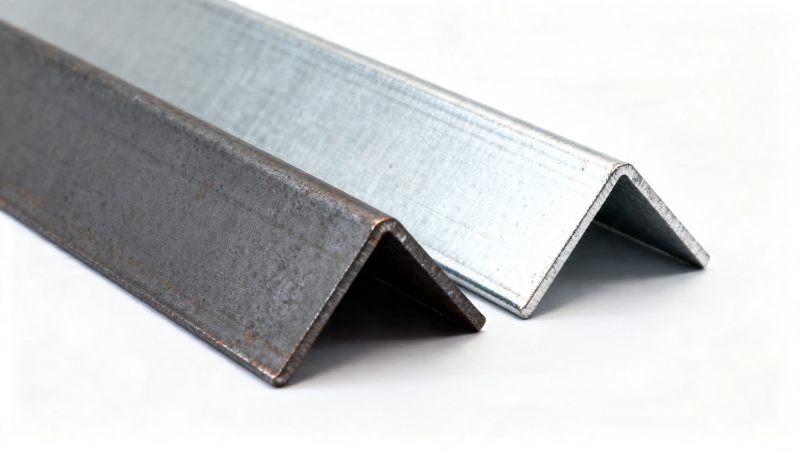
People searching for "hot dip galvanized angle steel vs plain" are usually not looking for a textbook definition. They want to know which option is more cost-effective, safer, and more reliable for the intended application. This is especially true for construction companies, fabricators, distributors, and procurement teams that must balance budget, durability, compliance, and delivery schedules.
The core decision usually comes down to these questions:
- Will the steel be exposed to rain, humidity, chemicals, or salt air?
- How long is the expected service life?
- Is repainting or maintenance practical after installation?
- What are the consequences of corrosion-related failure?
- Does lower upfront cost really mean lower total project cost?
If the project environment is aggressive or access for maintenance is limited, hot dip galvanized angle steel generally delivers better value despite a higher initial purchase price.
Hot dip galvanized angle steel vs plain: the practical difference
Angle steel is an L-shaped structural steel section widely used in frames, supports, brackets, towers, equipment bases, and general steel fabrication. The main difference between hot dip galvanized angle steel and plain angle steel is the surface condition and the level of corrosion protection.
Plain angle steel is usually black steel or untreated carbon steel. It has good strength and machinability, but without a protective layer, it is vulnerable to rust when exposed to moisture and oxygen.
Hot dip galvanized angle steel is carbon steel coated with zinc by immersion in molten zinc. This zinc layer acts as a barrier and also provides sacrificial protection, meaning the zinc corrodes first to help protect the steel underneath.
In practical terms, this means:
- Plain angle steel is cheaper at the beginning but usually requires painting, coating, or regular maintenance in exposed conditions.
- Galvanized angle steel costs more upfront but reduces corrosion risk and ongoing maintenance.
- For outdoor structures, infrastructure, agricultural buildings, utility supports, and marine-adjacent use, galvanized steel is often the safer specification.
Which one performs better in different environments?
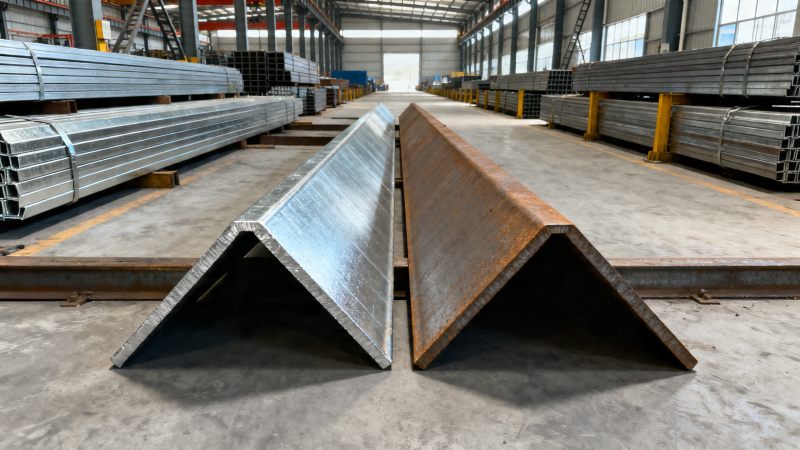
Environmental exposure is the most important factor in this comparison. A material that performs well indoors may fail much faster outdoors.
Plain angle steel is more suitable for:
- Dry indoor buildings
- Temporary fabrication or short-term use
- Applications where secondary coating or painting is already planned
- Projects with strict upfront budget limits and easy future maintenance access
Hot dip galvanized angle steel is more suitable for:
- Outdoor construction
- Humid climates
- Coastal or salt-laden environments
- Industrial areas with atmospheric pollutants
- Agricultural facilities
- Structures where long service life is required with minimal maintenance
For example, if angle steel is used for exposed supports, rooftop framing, guard structures, transmission-related components, or workshop extensions, galvanizing can significantly extend service life and reduce the risk of early rust damage.
Cost comparison: upfront price vs lifecycle value
One of the most common mistakes in steel sourcing is comparing only the unit price per ton. Plain angle steel usually wins on initial cost, but that does not always mean it is the lower-cost option over the full life of the project.
When evaluating total cost, buyers should include:
- Initial material purchase price
- Surface treatment cost after purchase, if required
- Labor for painting or coating
- Transportation and handling of finished material
- Inspection and maintenance cost
- Repair, replacement, or shutdown risk caused by corrosion
In many outdoor or semi-exposed projects, hot dip galvanized angle steel reduces repainting frequency and maintenance downtime. For procurement managers and business decision-makers, this often leads to better lifecycle economics, more stable asset performance, and fewer unexpected maintenance budgets.
By contrast, if the application is inside a dry facility and corrosion risk is low, plain angle steel can remain a rational and cost-efficient choice.
How to choose based on application, fabrication, and project priorities
The right choice should match the project rather than follow a one-size-fits-all rule.
Choose plain angle steel when:
- The steel will remain indoors in low-corrosion conditions
- You need lower initial cost
- The component will be cut, welded, and coated later in your own process
- Maintenance is easy and acceptable
Choose hot dip galvanized angle steel when:
- Long-term corrosion protection is a priority
- The steel will be installed in exposed or hard-to-maintain locations
- Safety and durability matter more than the lowest first cost
- You want to simplify post-fabrication coating work
For projects involving larger structural systems, buyers often compare other galvanized profiles as well. In lightweight roof systems, wall beams, brackets, and steel structure construction, profiles such as Z-beam may also be considered where galvanized coated surfaces, roll forming technology, and stable dimensional tolerance are important. Common materials include Q235B, Q345B, S275, S355, A36, and A572, with thickness options from 6-25mm and lengths from 2-12m or customized, depending on structural and fabrication needs.
Quality, standards, and what serious buyers should check before ordering
Whether purchasing galvanized angle steel or plain angle steel, product quality and supply reliability matter as much as the specification itself. Technical evaluation teams, QA personnel, and project managers should confirm the following before placing an order:
- Base steel grade and mechanical properties
- Dimensional accuracy and straightness
- Applicable standards such as ASTM, EN, JIS, or GB
- Zinc coating consistency for galvanized products
- Surface defects, edge condition, and weldability requirements
- Mill test certificates, inspection reports, and traceability
- Packaging, marking, and export protection
For international sourcing, reliable manufacturers with modern production facilities, stable lead times, and clear quality control systems can help reduce procurement risk. This is especially important for distributors, EPC contractors, and overseas buyers managing delivery schedules and compliance requirements across multiple projects.
Final decision: which one is better?
There is no universal winner in the hot dip galvanized angle steel vs plain angle steel comparison. The better choice depends on exposure conditions, maintenance strategy, design life, and financial priorities.
If your project is indoors, dry, and cost-sensitive, plain angle steel may be fully adequate. If your project faces weather, humidity, pollution, or long-term service demands, hot dip galvanized angle steel is usually the better investment because it offers stronger corrosion resistance, longer service life, and lower maintenance pressure.
For most buyers, the smartest approach is simple: do not judge by purchase price alone. Judge by where the steel will be used, how long it must last, and what failure or maintenance will cost later. That is the comparison that leads to the right material choice.
Please give us a message


Please enter what you want to find