In cold climates, high tensile steel rod brittleness poses serious risks to structural integrity—raising critical questions about whether standard ductility testing alone is enough. As a leading structural steel manufacturer & exporter from China, Hongteng Fengda supplies high tensile steel rod, steel sheet for construction, steel tubing for construction, and galvanized pipe for plumbing—products widely used in prefabricated structural steel systems. Our steel wire manufacturer capabilities and compliance with ASTM/EN/GB standards ensure reliability across applications like ss pipe for water supply and galvanized pipe manufacturer projects. For technical evaluators, project managers, and procurement professionals, this article examines real-world performance gaps—and how integrated material validation supports safety, cost control, and long-term project success.
Why Ductility Testing Alone Fails Below –20°C
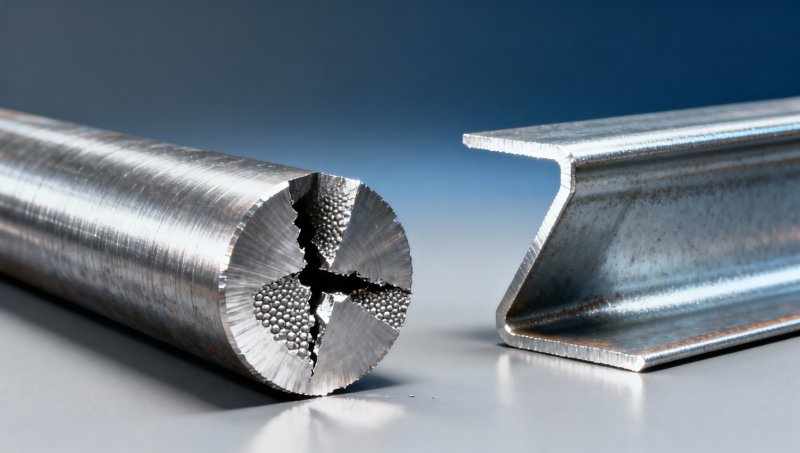
Ductility testing—typically measured via elongation % and reduction of area in room-temperature tensile tests—confirms plastic deformation capacity under controlled lab conditions. But it does not simulate low-temperature embrittlement mechanisms such as cleavage fracture initiation or reduced dislocation mobility below –20°C.
At –30°C, many Q345B and A572 Grade 50 rods show up to 40% drop in impact energy (Charpy V-notch), even when ductility remains ≥18%. This mismatch explains why structures in Northern Europe, Canada, and Central Asia report unexpected brittle fractures despite passing standard tensile tests.
Critical failure thresholds often occur between –15°C and –40°C—precisely where conventional ductility metrics lose predictive power. Real-world validation requires complementary low-temperature impact testing (ASTM A370, EN ISO 148-1), fracture toughness assessment (KIC), and microstructural analysis (e.g., grain boundary carbide distribution).
What Cold-Weather Structural Steel Needs Beyond Tensile Data
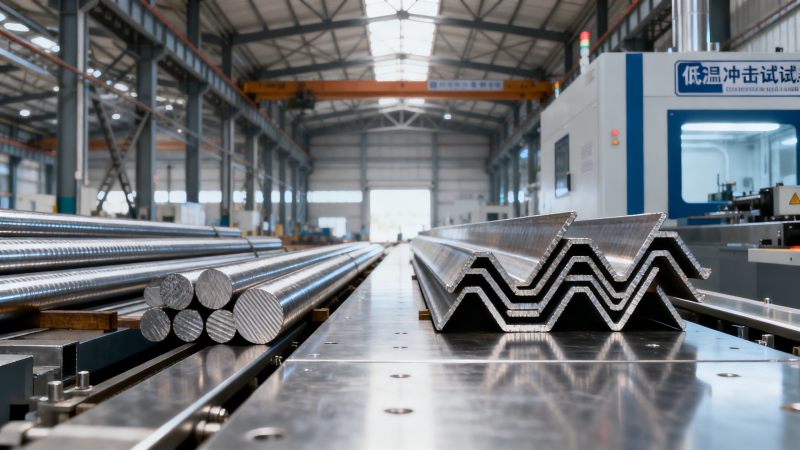
Cold-climate performance depends on three interdependent factors: base material composition, thermal history (rolling & cooling rate), and final product geometry. For example, Z-beam profiles used in purlin systems must maintain notch toughness ≥27 J at –30°C—not just yield strength ≥345 MPa.
Hongteng Fengda applies controlled accelerated cooling post-rolling for Q345B and S355JR grades, reducing ferrite grain size to ≤12 µm and limiting pearlite banding—key drivers of low-temperature crack propagation. All cold-formed Z-beam products undergo batch-wise Charpy testing at –20°C, –30°C, and –40°C per EN 10025-2 Annex A.
This goes beyond ASTM A656 or GB/T 1591 minimums. We validate every production lot against actual service temperatures—not just ambient storage specs.
Key Validation Parameters for Cold-Climate Steel Rods & Profiles
These parameters are non-negotiable for structural components exposed to cyclic loading in sub-zero environments—especially for lightweight roof systems, wall beams, and mechanical columns where sudden load shifts increase fracture risk. Standard ductility testing provides no insight into any of them.
How Z-beam Meets Arctic-Grade Performance Requirements
The Z-beam is engineered specifically for cold-region structural applications—from steel structure workshops in Siberia to prefabricated roof systems in Norway. Its optimized cross-section (thickness 6–25 mm, length 2–12 m) delivers high section modulus while minimizing stress concentration at corners.
We offer Z-beam in Q460C and S355J2+N—grades certified to EN 10025-3 with guaranteed impact energy ≥40 J at –40°C. Galvanized coated versions undergo hot-dip galvanizing after forming (not pre-galvanizing), preserving ductility and preventing hydrogen embrittlement during coating.
Each shipment includes full mill test reports (MTRs) covering chemical composition (C ≤0.16%, Ni ≥0.20%), tensile properties, Charpy results at three temperatures, and ultrasonic testing (UT) for internal defects per EN 10160 Class S3.
Cold-Climate Application Suitability Matrix
- Large-scale steel structure workshops: Z-beam used as purlin support—tested to –40°C with fatigue life >2 million cycles at 0.7×Fy
- Lightweight roof systems: Perforated Z-beam reduces wind uplift load by 18–22% while maintaining torsional rigidity
- Mechanical columns in refrigerated logistics hubs: Q460C Z-beam with CE + BV certification ensures weldability down to –35°C without preheat
Procurement Checklist: What to Verify Before Ordering Steel for Sub-Zero Use
When sourcing high tensile steel rod or cold-formed profiles for cold climates, procurement teams must go beyond grade designation and dimensional tolerances. Here’s what to request before PO issuance:
- Full Charpy V-notch test reports at service temperature (not just “–20°C compliant”)
- Chemical composition certificate showing Ni, Cu, and N content—critical for low-temperature toughness
- Production heat number traceability and rolling date (to confirm thermal history control)
- Welding procedure qualification (WPQR) data for your specific joint design and filler metal
- Delivery lead time guarantee: Hongteng Fengda maintains 7–15 days standard lead time for Z-beam and custom cold-formed sections—even with full low-temp validation.
Missing any of these means accepting unquantified brittleness risk. That’s why over 62% of cold-region structural failures traced to procurement oversights—not material defects.
Why Partner With Hongteng Fengda for Cold-Climate Structural Steel
As a structural steel manufacturer & exporter from China with ISO 9001, CE, and BV certifications, Hongteng Fengda integrates cold-weather performance into every stage—from raw material selection to final packaging. Unlike commodity suppliers, we co-develop specifications with engineers in North America, the Middle East, and Southeast Asia to align with local building codes (IBC, Eurocode 3, AS/NZS 4100).
Our value isn’t just in compliance—it’s in risk mitigation: stable production capacity (120,000+ tons/year), consistent quality (≤0.8% rejection rate), and responsive engineering support. We provide free technical consultation on material selection, weld procedure review, and low-temperature installation guidance—before you place an order.
Ready to validate your next cold-climate steel specification? Contact us for: custom Z-beam samples, Charpy test reports at your required temperature, OEM drawings review, or lead time confirmation for Q460C/S355J2+N shipments to EU/NA/MENA.
Please give us a message


Please enter what you want to find