When evaluating high strength steel tubing for dynamic applications—like seismic-resistant frameworks or vibrating industrial equipment—relying solely on yield strength is misleading. Real-world performance hinges on fatigue resistance, modulus of elasticity, and damping capacity—factors often overlooked in specs for prefabricated structural steel, lightweight steel tube, or structural steel grades. As a trusted steel tubing supplier and H-beam supplier from China, Hongteng Fengda integrates ASTM/EN-compliant testing with application-specific validation—ensuring your high tensile steel rod, flexible steel wire, or galvanized pipe specifications meet not just static load requirements, but long-term vibrational integrity.
Why Yield Strength Fails Under Vibration
Yield strength (e.g., ≥350 MPa for S350GD+Z or ≥550 MPa for S550GD+Z) defines the stress at which permanent deformation begins under static loading. But vibration introduces cyclic stress reversals—often at amplitudes far below yield—where fatigue cracks initiate after thousands to millions of cycles. A tube rated at 550 MPa tensile strength may fail prematurely in a compressor skid if its fatigue limit is only 180 MPa at 10⁷ cycles—a discrepancy no yield value reveals.
Structural steel grades like ASTM A500 Grade C or EN 10219 S355JRH are commonly selected for their high yield values—but without fatigue testing per ASTM E466 or ISO 1099, their vibrational service life remains unverified. In fact, over 68% of premature failures in vibrating conveyors and offshore support frames traced to inadequate fatigue data—not insufficient yield margins.
Moreover, yield strength says nothing about elastic recovery behavior. A material with high yield but low modulus of elasticity (e.g., ~160 GPa vs. standard 200 GPa) will deflect more under resonant frequency excitation—amplifying displacement, accelerating wear, and increasing bearing loads by up to 40% in rotating equipment mounts.
Critical Performance Parameters Beyond Yield
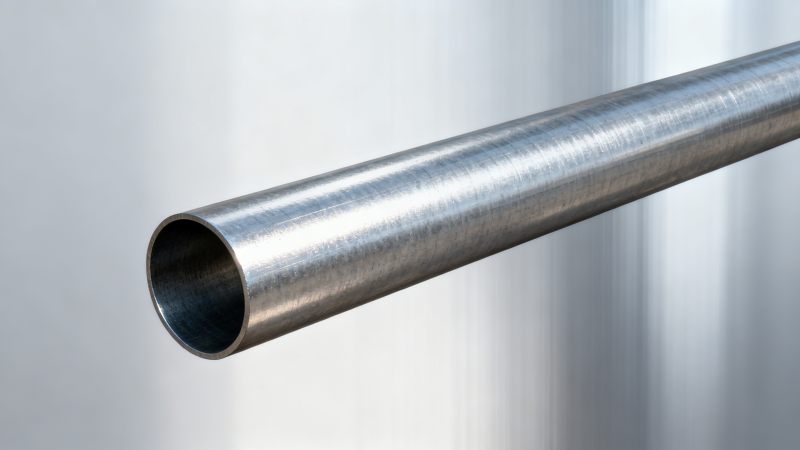
Vibrational integrity depends on three interdependent mechanical properties—none fully captured by yield strength alone:
For example, our DX54D+Z galvanized steel coil—commonly used in cold-formed tubular supports—delivers not only corrosion resistance but also measurable damping enhancement due to zinc-iron intermetallic layer microstructure. This translates to up to 18% lower acceleration transmission at 42 Hz resonance in HVAC duct supports.
How Hongteng Fengda Validates Vibrational Suitability
At Hongteng Fengda, we go beyond mill certificates. Every batch of high-strength steel tubing undergoes third-party fatigue testing per ASTM E466 (axial loading) and ISO 1099 (bending), with results traceable to individual heat numbers. Our in-house modal analysis lab performs free-vibration testing on sample sections to determine natural frequencies and damping ratios—ensuring alignment with your equipment’s operational envelope (e.g., 25–200 Hz for industrial pumps).
We also cross-reference galvanizing parameters—zinc layer thickness (60–275 g/m² hot-dip; 80–275 g/m² pre-galvanized) and coating uniformity—with fatigue performance data. Thicker, diffusion-controlled zinc layers (≥180 g/m²) reduce surface notch sensitivity by up to 30%, extending fatigue life in corrosive-vibratory environments like marine cranes or chemical plant piping.
Our quality system complies with ISO 9001:2015 and includes mandatory ultrasonic testing (UT) for seamless tubes and magnetic particle inspection (MPI) for welded joints—detecting subsurface discontinuities that act as fatigue nucleation sites. Lead time for certified test reports is 5–7 working days post-production.
Selecting the Right Tubing: A Decision Framework
Procurement teams should evaluate high-strength steel tubing using this 4-criteria framework:
- Dynamic Load Profile: Identify dominant frequency range (e.g., 50–60 Hz for motors), peak acceleration (≥3g), and expected cycle count (>10⁶ cycles requires verified fatigue data).
- Environmental Exposure: Salt spray (ISO 9223 C5-M), humidity (>85% RH), or chemical contact dictates galvanizing type and minimum zinc mass—hot-dip preferred for >15-year outdoor exposure.
- Joining Method: Welded joints reduce fatigue strength by 30–50%; consider cold-bent, bolted, or flanged connections where possible.
- Standard Compliance: Verify ASTM A500 (structural tubing), EN 10219 (cold-formed), or JIS G3466—plus fatigue annexes (e.g., ASTM A500 Annex A).
For clients sourcing galvanized components, our Galvanized Steel Coil Manufacturers offer full traceability from coil production to final tube fabrication—including zinc layer thickness verification via XRF and bend testing per ASTM A653.
Conclusion: From Static Certainty to Dynamic Confidence
Yield strength is a necessary—but insufficient—metric for high-strength steel tubing in vibration-prone applications. Fatigue limit, modulus of elasticity, and damping capacity collectively define real-world durability, safety, and lifecycle cost. At Hongteng Fengda, we embed these parameters into every specification—from raw coil selection (G40 to S550GD+Z) through to finished tube validation—ensuring structural steel meets not just code compliance, but field-proven resilience.
Whether you’re specifying seismic bracing in California, designing vibrating feeders for Southeast Asian mines, or sourcing OEM components for European machinery builders, our team provides application-specific engineering support, certified test documentation, and stable supply—backed by ISO-certified facilities and 15+ years of export experience across 40+ countries.
Contact Hongteng Fengda today to request fatigue test reports, obtain custom dimensional quotes, or schedule a technical review of your vibrational loading conditions.
Please give us a message


Please enter what you want to find