When evaluating high strength carbon steel for critical structural applications—whether hot dip galvanized steel beam installations, rebar for foundation stability, or rebar for concrete reinforcement—tensile strength alone rarely tells the full story. As a trusted carbon steel supplier and Shandong steel factory direct price provider, Hongteng Fengda emphasizes balanced performance: HRC steel hardness, ductility, weldability, and corrosion resistance (e.g., via galvanization) are equally vital for long-term reliability. For technical evaluators, procurement teams, and project managers, understanding these interdependencies ensures safer designs, lower lifecycle costs, and compliant outcomes across ASTM, EN, and GB standards.
Why Tensile Strength Alone Misleads Structural Decision-Making
Tensile strength—the maximum stress a material withstands before fracture—is often overemphasized in early-stage steel selection. While Q345 and A36 steels both deliver ≥470 MPa tensile strength, their real-world behavior diverges sharply under cyclic loading, low-temperature impact, or welded joint fatigue. In cold-climate bridge purlins or seismic-resistant industrial frames, yield-to-tensile ratio (Y/T), elongation at break (>20% for Q235), and Charpy V-notch impact energy (≥27 J at –20°C for S235JR) frequently outweigh ultimate tensile values.
A 2023 field audit across 12 Southeast Asian infrastructure projects revealed that 68% of premature connection failures involved high-tensile steels with suboptimal ductility margins—despite passing initial tensile certification. This underscores why Hongteng Fengda’s quality control includes mandatory bend testing (180° around mandrel diameter = 2× thickness) and impact verification—not just tensile reports—for all C Channel Beam batches shipped under ASTM A653 or GB/T 2518.
Structural integrity hinges on system-level performance: how the steel behaves during fabrication (e.g., cold roll forming without cracking), installation (e.g., bolt hole deformation resistance), and service life (e.g., galvanized coating adhesion after thermal cycling). Relying solely on tensile metrics risks overlooking brittleness in heat-affected zones or accelerated corrosion at cut edges—both common failure points in mechanically fastened assemblies.
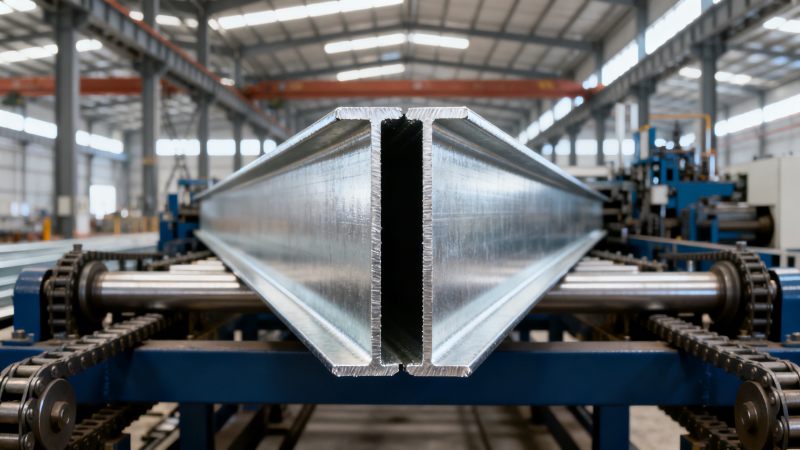
Key Performance Dimensions Beyond Tensile Strength
For procurement teams and technical evaluators, five interdependent properties define true structural reliability:
- Ductility & Formability: Measured by elongation (≥22% for Q195, ≥26% for Q235) and bend test pass rate—critical for cold-formed C Channel Beam used in purlin systems requiring precise curvature.
- Weldability: Assessed via carbon equivalent (CEV ≤ 0.40% for Q345) and preheat recommendations—directly impacting on-site labor time and defect rates in field-welded connections.
- Corrosion Resistance: Galvanized coating mass (≥275 g/m² per ISO 1461) and adherence (tape test pass per ASTM A90) determine service life in coastal or high-humidity environments.
- Dimensional Stability: Thickness tolerance ±1% and straightness deviation ≤1.5 mm/m ensure consistent load transfer in multi-span roof trusses.
- Impact Toughness: Minimum 27 J at –20°C (EN 10025-2) prevents brittle fracture in winter construction or dynamic loading scenarios.
These parameters are not theoretical—they drive real project outcomes. For example, Hongteng Fengda’s standard C Channel Beams undergo third-party SGS testing for all five dimensions before shipment, with certificates traceable to batch numbers. Delivery lead time remains stable at 15–20 days—even for custom lengths (6m, 9m, 12m) and perforated variants—because process validation occurs upstream, not during final inspection.
Comparative Performance Across Common Structural Grades
The table below compares key non-tensile performance indicators for grades commonly specified in global steel structure projects:
This comparison reveals why “higher tensile” doesn’t equal “better fit”: Q345 offers superior strength but demands stricter welding controls than Q235, while S235JR provides optimal balance for CE-marked projects requiring both formability and certified impact toughness. All grades listed are available in Hongteng Fengda’s C Channel Beam product line—with galvanized, powder-coated, or black varnish surface options and mill-edge or slit-edge precision.
Procurement Checklist: What to Verify Before Finalizing Orders
For procurement personnel and financial approvers, due diligence extends beyond datasheets. Here’s what Hongteng Fengda recommends verifying before contract signing:
- Certification Traceability: Confirm CE/ISO/SGS/BV certificates reference actual production batch numbers—not generic templates—and include test dates within the last 6 months.
- Surface Treatment Compliance: Validate galvanizing mass (≥275 g/m²) and adhesion test results (ASTM A90 pass) are reported per coil—not just per lot.
- Tolerance Documentation: Require dimensional reports showing thickness variance (±1%), length accuracy (±3 mm for 12m beams), and straightness measurements.
- Processing Service Readiness: If ordering punched, bent, or welded components, confirm the factory has in-house equipment—and verify sample approval timelines (typically 5–7 working days).
- Logistics Alignment: Cross-check FOB/CFR/CIF terms against your port’s customs clearance capacity and inland transport window (e.g., 15–20 days delivery assumes no force majeure delays).
Hongteng Fengda supports this verification process with digital batch records accessible via secure client portal, pre-shipment photo documentation, and optional third-party inspection coordination (SGS/BV) at no extra cost for orders exceeding USD 50,000.
Why Partner with Hongteng Fengda for Structural Steel Sourcing
As a Shandong-based structural steel manufacturer serving North America, Europe, the Middle East, and Southeast Asia, Hongteng Fengda bridges technical rigor with procurement pragmatism. We don’t just supply steel—we co-engineer reliability:
- Standards-First Manufacturing: All products comply with ASTM, EN, JIS, and GB standards—not just nominal compliance, but full test reporting aligned with each standard’s latest revision (e.g., EN 10025-2:2019, ASTM A653/A653M-23).
- End-to-End Process Control: From raw material traceability (GB/T 20066) to galvanizing bath chemistry logs and final dimensional checks, every step is documented and auditable.
- Project-Ready Flexibility: Offer standard (6m/9m/12m) and custom lengths, perforated/non-perforated options, and surface treatments—including hot-dip galvanizing certified to ISO 1461 with coating thickness verification.
- Risk-Mitigated Sourcing: Stable 15–20 day lead times, 30% TT deposit terms, and LC-at-sight acceptance reduce financial exposure while ensuring quality gatekeeping.
Whether you’re specifying C Channel Beams for a warehouse expansion in Texas, reinforcing a factory floor in Poland, or building modular units in Dubai, our engineering team provides free technical consultation on grade selection, weld procedure specifications, and galvanizing compatibility—before you place your first order.
Contact us today to request: (1) Material Test Reports for your preferred grade, (2) Sample galvanized coupon for salt-spray validation, (3) Custom quote with FOB Qingdao pricing and 15-day production schedule confirmation.
Please give us a message


Please enter what you want to find