When load demands rise, a high tensile steel rod can deliver clear advantages in strength, stability, and long-term performance. For operators, fabricators, and project buyers, understanding where this material truly adds value helps improve safety, control costs, and avoid overengineering. This article explains the practical applications and real-world benefits of choosing the right high tensile steel rod.
Why a checklist approach works better than a generic material comparison
In steel selection, strength alone is not a decision. A high tensile steel rod may look like the obvious upgrade, but its real value depends on load type, connection method, fatigue exposure, fabrication limits, corrosion environment, and procurement requirements. Operators and buyers often lose time when they compare only tensile values without checking the full working conditions.
A checklist-based review helps you answer the practical questions first: Do you actually need higher strength? Will reduced diameter improve assembly space? Does the job involve repeated impact or vibration? Can your workshop thread, bend, cut, or weld the selected grade correctly? By reviewing these points in order, a high tensile steel rod becomes a controlled engineering choice rather than a costly assumption.
Start here: the first six items to confirm before choosing a high tensile steel rod
- Confirm the actual load case. Static tension, dynamic loading, shock, and cyclic stress do not affect the rod in the same way.
- Check required safety margins. Higher strength can reduce section size, but only if the overall design code allows it.
- Review the connection details. Threads, nuts, anchors, couplers, and welded ends may become the weak point before the rod itself.
- Verify environmental exposure. Outdoor, marine, humid, or chemically aggressive locations may require coating or corrosion-resistant treatment.
- Assess fabrication capability. Cutting, straightness, threading accuracy, and heat input control all affect performance.
- Match the material to delivery and certification needs. Global projects may require ASTM, EN, JIS, or GB compliance and traceable mill documentation.
If these six points are not clear, even a premium high tensile steel rod can create delays, rework, or premature failures. For operators on site, this is often the difference between a stable installation and recurring maintenance issues.
Where higher strength really pays off
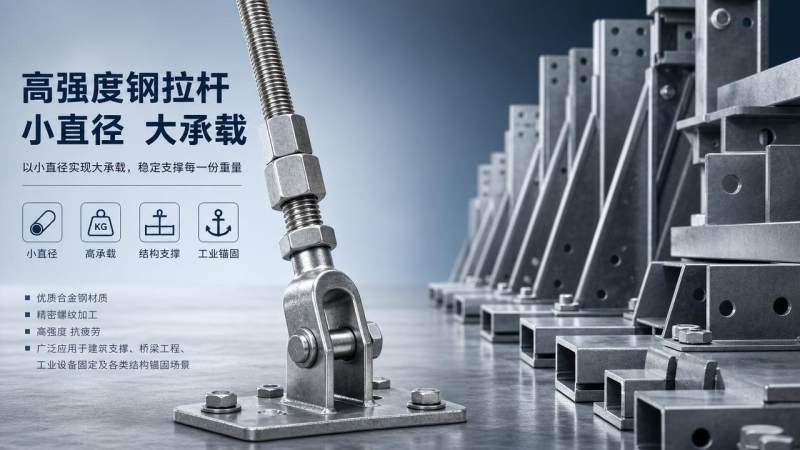
The best use cases are the ones where higher strength solves a real limitation. One common example is space-restricted assemblies. When design space is limited, a high tensile steel rod can deliver required load capacity with a smaller diameter than a lower-grade alternative. This is valuable in compact machine frames, tension members, bracing systems, and structural tie applications where clearance matters.
Another strong case is weight-sensitive fabrication. If a project can safely reduce rod size and total steel mass, handling becomes easier, installation may speed up, and support structures can sometimes be optimized. In transport equipment, suspended systems, and elevated steelwork, these savings can be meaningful over the full project lifecycle.
A high tensile steel rod also pays off in heavy-duty service where tension loads are substantial and reliability matters. Examples include industrial supports, reinforcement systems, lifting-related non-critical structural components, anchoring assemblies, and certain infrastructure connections. In these cases, the benefit is not just ultimate strength, but better resistance to permanent deformation under working loads when the right grade is selected.
Use this decision checklist to judge if the upgrade is justified
1. Load efficiency
Choose a high tensile steel rod when the required tensile performance would otherwise force excessive diameter, extra members, or a more complex layout. If ordinary carbon steel already meets the design with good safety and no space issue, the premium option may not create enough value.
2. Fatigue and vibration conditions
In vibrating systems, moving equipment, rail-adjacent structures, and repeated loading environments, the full fatigue design matters more than the headline strength number. A high tensile steel rod should be chosen with attention to stress concentration, thread quality, surface condition, and connection geometry.
3. Installation practicality
Higher strength is useful only if the rod can be installed correctly. Check straightness, end finish, dimensional tolerance, and compatibility with nuts, plates, clevises, and anchoring accessories. Operators should also confirm torque procedures where relevant, because over-tightening or uneven assembly can reduce the expected performance.
4. Corrosion management
Strength does not cancel corrosion risk. If the rod works outdoors or in a damp industrial setting, confirm whether black, oiled, painted, or galvanized surfaces are more suitable. The right surface treatment can affect not only service life but also maintenance intervals and appearance.
5. Supply consistency
For buyers handling recurring projects, supply stability is a major decision point. A high tensile steel rod should be sourced from a manufacturer that can keep mechanical properties, dimensional accuracy, and lead times consistent across batches. This reduces field mismatch, documentation issues, and replacement delays.
Application-specific notes operators should not overlook
Different sectors use high-strength steel differently, so the same rod is not automatically suitable for every task. In building and structural applications, check whether the rod is primarily carrying tension, contributing to bracing stability, or acting as part of a connection assembly. In industrial manufacturing, the key issue may be vibration, alignment, or wear around the connected components. In infrastructure-related work, long-term exposure, maintenance access, and standard compliance usually matter more than initial material savings.
As an example of adjacent steel products used in transport and support systems, some projects also evaluate Rail components for railway lines, bridge railings, and deck handrails. Available in grades such as U74, U71Mn, PD2, PD3, Q235, 55Q, and 50Q, these products may be supplied in carbon steel or medium manganese steel, with typical lengths from 12m to 30m, thickness from 3mm to 24mm, rail heights of 134mm to 170mm, and tolerance around ±1%. In practical procurement terms, buyers often compare not only strength but also surface condition such as oil, black, galvanized, or painted finishes, along with certification like ISO9001-2008 and ISO14001:2004.
This matters because operators often work across connected steel systems. If one part of the project needs a high tensile steel rod while another uses track, railing, or formed structural sections, consistent quality control and export documentation from a reliable supplier can simplify coordination and reduce sourcing risk.
Common mistakes that reduce the benefit of a high tensile steel rod
- Selecting by tensile strength only and ignoring yield behavior, toughness, or fatigue resistance.
- Reducing diameter too aggressively without rechecking connection stresses and deflection limits.
- Using poor machining or threading practices that introduce surface damage and stress raisers.
- Applying unsuitable welding procedures to grades that require tighter process control.
- Skipping coating decisions in corrosive service because the material is assumed to be “strong enough.”
- Buying mixed batches without verifying standard, heat number, and mechanical property consistency.
These errors often lead to a false conclusion that a high tensile steel rod is overpriced or unreliable, when the real problem is poor application matching or weak execution in fabrication and installation.
Practical selection standards for project buyers and workshop teams
A useful procurement review should cover five areas: mechanical requirements, dimensions, processing method, finish, and certification. Mechanical requirements include tensile capacity, expected service load, and whether shock or repeated loading is present. Dimensional checks should include diameter, straightness, length tolerance, and thread specification where relevant. Processing method means confirming whether the rod will be cut, bent, threaded, or welded after delivery. Finish includes black, oiled, painted, or galvanized condition depending on storage and service exposure. Certification must match the market and project standard.
For international sourcing, manufacturers with broad structural steel capability can offer an advantage. Hongteng Fengda, a structural steel manufacturer and exporter from China, supplies angle steel, channel steel, steel beams, cold formed steel profiles, and customized structural steel components for global construction, industrial, and manufacturing projects. With production aligned to ASTM, EN, JIS, and GB standards, such a supplier can help buyers combine quality consistency, OEM support, and dependable lead times when a high tensile steel rod must fit into a larger steel package.
Quick FAQ for on-site users and decision makers
Is a high tensile steel rod always better than standard carbon steel?
No. It is better when the project gains measurable value from higher load capacity, smaller diameter, reduced weight, or improved performance under demanding service conditions. If the application is simple and lightly loaded, standard material may be more economical.
What should operators inspect first on delivery?
Check identification, straightness, surface condition, dimensions, thread quality if applicable, and supporting certificates. Early inspection prevents installation delays and avoids mixing unsuitable material into the job.
Does higher strength mean lower maintenance?
Not automatically. Maintenance depends on corrosion exposure, connection quality, vibration, coating system, and whether the rod is working within its intended design range.
Action guide: what to prepare before requesting a quotation or technical recommendation
- Define the application and load condition clearly.
- List required dimensions, quantity, and any thread or end-processing needs.
- State the working environment and preferred surface treatment.
- Confirm the required standard, certificate, and destination market.
- Share target delivery time, budget range, and whether OEM customization is needed.
A high tensile steel rod creates the most value when its strength solves a real engineering or operational problem. For operators, that means safer performance and easier installation. For buyers, it means fewer sourcing risks and better whole-project efficiency. If you need to confirm grade options, processing details, standards, lead time, or compatibility with other structural steel products, the next step is to prepare these key parameters and discuss them with an experienced manufacturer before final selection.
Please give us a message


Please enter what you want to find