Why HRC and CRC Matter in Steel Selection
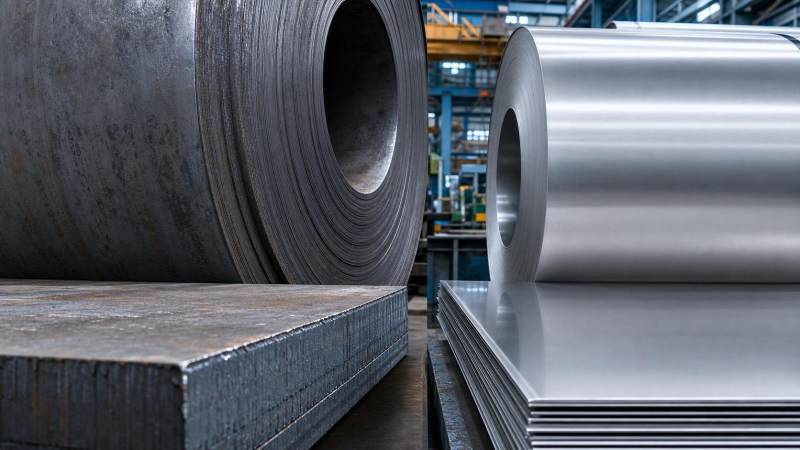
HRC vs CRC is not a minor specification detail.
In steel projects, it affects load behavior, fabrication efficiency, coating results, and total delivered cost.
That is why HRC remains a practical reference point in construction, industrial fabrication, and structural component sourcing.
When comparing HRC with CRC, the real question is not which one is universally better.
The better question is which material condition matches the mechanical demand, tolerance expectation, and downstream process.
This matters even more when projects must balance specification compliance with lead time and cost control.
For global structural steel supply, those tradeoffs shape procurement risk.
Hongteng Fengda, a structural steel manufacturer and exporter from China, works within this reality every day.
Its product range covers angle steel, channel steel, steel beams, cold formed profiles, and custom structural components.
With production aligned to ASTM, EN, JIS, and GB, material selection is tied closely to application logic, not generic preference.
The Basic Difference Behind HRC and CRC
HRC means hot rolled coil.
CRC means cold rolled coil.
Both begin as steel, but they reach the market through different rolling conditions.
HRC is processed at high temperature, above the steel recrystallization range.
That route makes forming easier during rolling and supports efficient large-scale production.
CRC is usually made from pickled hot rolled material, then reduced further at room temperature.
This additional processing improves dimensional precision and surface quality.
Simple definitions, however, do not explain performance on site or in fabrication.
The practical gap appears in finish, consistency, formability, residual stress, and cost structure.
A quick comparison
How Performance Differences Show Up in Real Work
Surface quality is the easiest difference to see.
CRC offers a smoother appearance and better consistency for painting, appliance panels, and exposed fabricated parts.
HRC is less refined on the surface, especially before pickling, blasting, or galvanizing.
Yet appearance is rarely the first priority in load-bearing steelwork.
In structural applications, HRC is often favored because it supports thicker sections, broad availability, and economical processing.
Strength comparisons also need context.
Cold rolling can raise hardness and yield performance through work hardening.
That does not automatically make CRC the better engineering choice.
If the design depends on heavier gauges, weldability, or hot-dip treatment, HRC may fit the process more effectively.
Formability adds another layer.
CRC can perform very well in controlled stamping and shaping.
Still, residual stress and springback must be managed carefully.
HRC is generally more forgiving in larger fabricated members where visual precision is secondary.
Where HRC Usually Makes More Sense
HRC is widely used where structural function matters more than cosmetic finish.
That includes frames, supports, beams, channels, brackets, platforms, and welded assemblies.
It is also common in infrastructure and industrial projects where heavier sections are required.
In these settings, material availability and reliable lead time are often as important as mill properties.
A useful example is channel steel selection.
For purlins, wall beams, lightweight roof systems, brackets, and mechanical columns, hot rolled or galvanized sections are often the practical answer.
In that context, Channel Steel Supplier options can support both standard and customized project demands.
Typical grades include Q195, Q235, Q235B, and Q345B, along with stainless and duplex choices for corrosion-sensitive environments.
Common dimensions such as thickness from 1.5mm to 25mm, height from 80mm to 160mm, and length from 6m to 12m broaden application range.
When hot-dip galvanized or hot-blown galvanized finishes are added, anti-corrosion performance improves further for outdoor or humid service.
That combination of strength, weldability, and practical section sizes explains why HRC-based products remain central in structural steel supply.
What the Industry Is Paying Attention to
The HRC versus CRC discussion has shifted in recent years.
It is no longer only about steel properties in isolation.
Current evaluation often includes supply stability, standards alignment, processing compatibility, and total conversion cost.
For imported steel, consistency between batches matters heavily.
If the same nominal grade behaves differently in forming or welding, downstream loss rises quickly.
That is one reason established exporters with documented quality control carry more weight in technical review.
Hongteng Fengda positions its supply around that requirement, combining production capability with international standards such as ASTM, EN, JIS, and GB.
The benefit is not abstract.
It helps reduce mismatch between drawing requirements, fabrication methods, and delivered steel condition.
Decision factors now receiving more scrutiny
- Whether HRC thickness and tolerance fit the final assembly without secondary correction.
- How surface scale, pickling, or galvanizing affect coating adhesion.
- Whether the steel grade aligns with regional standards and test documentation.
- How lead time compares across hot rolled and cold rolled supply channels.
- What downstream cost appears after cutting, welding, bending, and corrosion protection.
How to Judge HRC Against CRC for a Specific Project
A useful evaluation starts with the finished part, not the mill label.
If the part is load-bearing, hidden, welded, and relatively thick, HRC often deserves first consideration.
If the part is thin, visible, tightly formed, or dimensionally sensitive, CRC may justify its higher cost.
This sounds simple, but many sourcing problems start when that logic is skipped.
The following checkpoints usually clarify the choice:
- Check the required thickness range and section type before comparing price.
- Review welding, punching, bending, and coating steps as one process chain.
- Confirm whether surface finish is functional, cosmetic, or irrelevant.
- Verify grade equivalence across ASTM, EN, JIS, and GB if cross-border sourcing is involved.
- Ask for tolerance data, inspection records, and corrosion treatment details.
In many structural jobs, HRC wins because it fits the real workload, not because it is cheaper alone.
That distinction prevents costly over-specification.
A Practical Way Forward
HRC and CRC serve different purposes, even when they begin from similar steel chemistry.
The better choice depends on how the material will be formed, joined, protected, and used in service.
For structural and industrial applications, HRC often offers the strongest balance of availability, section range, fabrication suitability, and cost control.
CRC becomes more valuable when appearance, precision, and thin-gauge consistency dominate the requirement.
A sound next step is to map the project against grade, thickness, tolerance, finish, corrosion exposure, and processing route.
Once those points are clear, comparing HRC with CRC becomes a technical decision with fewer surprises and better sourcing outcomes.
Please give us a message


Please enter what you want to find