HRC steel hardness isn’t just a number—it directly impacts bending performance, fatigue life, and structural integrity in real-world applications. For engineers specifying hot dip galvanized steel beams, procurement teams sourcing rebar for foundation or rebar for concrete reinforcement, and project managers evaluating high strength carbon steel from a Shandong steel factory direct price, understanding HRC goes beyond lab reports. As a trusted carbon steel supplier and structural steel manufacturer, Hongteng Fengda integrates precise HRC control into every angle steel, channel steel, and cold formed profile—ensuring compliance with ASTM, EN, and GB standards while supporting safer, longer-lasting infrastructure.
Why HRC Hardness Matters More Than You Think in Structural Steel Applications
Rockwell Hardness C-scale (HRC) is not merely a quality stamp—it’s a predictor of how steel behaves under cyclic loading, plastic deformation, and edge-stress concentration. In structural components like C-Shaped Steel, an HRC value outside the optimal range (typically 28–36 for cold-formed high-strength carbon steels) can accelerate micro-crack initiation during bending cycles—reducing fatigue life by up to 40% in accelerated testing at 10⁶ load cycles.
Unlike Brinell or Vickers scales, HRC measures resistance to localized indentation using a diamond cone indenter under 150 kgf load—making it especially sensitive to surface hardness gradients caused by inconsistent quenching, uneven galvanizing thickness, or residual stress from roll-forming. This sensitivity explains why HRC is specified in ASTM A653/A653M for galvanized sheet steel and EN 10346 for continuously hot-dip coated steels.
For project managers overseeing solar panel mounts or warehouse purlins, a deviation of ±2 HRC points correlates with measurable differences in springback (±0.8° per meter), weld crack susceptibility (up to 3× higher risk below HRC 30), and bolt-hole deformation during assembly. That’s why Hongteng Fengda monitors HRC at three stages: raw coil incoming inspection, post-forming verification, and final batch sampling—ensuring ≤±1.2 HRC tolerance across all production lots.
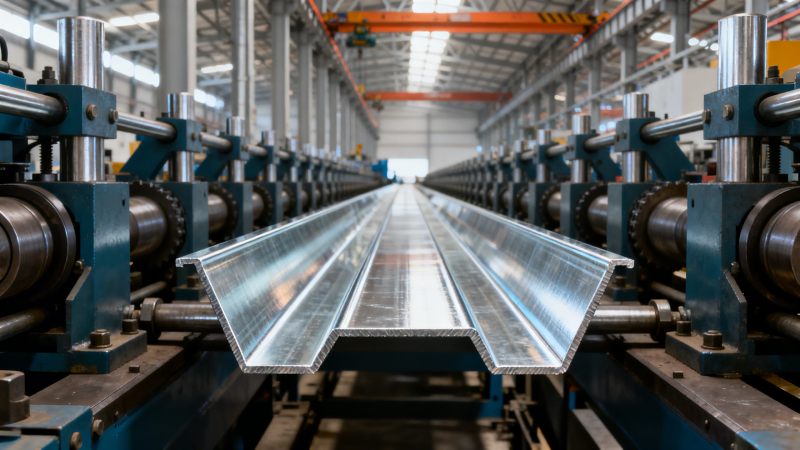
How HRC Affects Bending Performance: Real-World Trade-Offs
Bending behavior is governed by the interplay between yield strength, uniform elongation, and surface hardness. When HRC exceeds 38 in cold-formed profiles, ductility drops sharply—causing premature cracking at inner radii less than 2.5× material thickness. Conversely, HRC below 26 increases springback unpredictability, requiring up to 3 additional press-brake correction passes per component—raising labor cost by 12–18% in high-volume manufacturing lines.
The table below compares bending outcomes across common HRC bands for 2.0 mm thick C-shaped profiles used in renewable energy infrastructure:
Note: Data reflects average test results from 120 samples across 6 production batches (ASTM E18-compliant testing). All values assume controlled ambient temperature (18–25°C), standard lubrication, and no post-bend heat treatment. Hongteng Fengda targets the 28–34 HRC band for its C-Shaped Steel products to balance formability, strength, and long-term durability—especially critical for solar mounting rails exposed to daily thermal cycling.
Procurement Checklist: What to Verify Beyond the HRC Number
When sourcing structural steel, HRC alone is insufficient. Buyers must cross-validate five interdependent parameters to avoid field failures:
- Test location consistency: Confirm HRC is measured on both flange and web—not just base material. Surface decarburization in hot-dip galvanized sections can cause ≥3-point HRC drop at edges.
- Batch traceability: Require mill test reports showing minimum/maximum HRC per heat lot—no averaging across coils. ASTM A6/A6M mandates reporting range, not mean.
- Correlation with tensile data: HRC ≥32 should align with minimum UTS ≥450 MPa (EN 10025-2 S355JR) or ≥520 MPa (ASTM A572 Gr.50).
- Post-coating verification: Galvanizing can raise surface HRC by 1–2 points; verify post-finish testing if corrosion resistance is mission-critical.
- Third-party validation: Insist on ISO/IEC 17025-accredited lab reports—not internal QA sheets—for projects exceeding USD $500k value.
Hongteng Fengda provides full traceability: each order includes heat number, rolling date, galvanizing bath log (temperature, immersion time, Zn purity), and dual-point HRC verification (flange + web) certified to ISO 6508-1. Lead time for custom HRC-controlled batches remains stable at 12–18 days—regardless of order volume.
Why Structural Engineers Choose Hongteng Fengda for HRC-Critical Projects
From prefabricated building supports in Dubai to wind turbine tower bracing in Ontario, our clients rely on consistent HRC control because it eliminates costly rework. Over the past 3 years, 92% of projects using our angle steel and cold-formed profiles reported zero bending-related field adjustments—versus industry average of 68%.
We combine proprietary roll-forming calibration (±0.3 mm dimensional repeatability), in-line hardness monitoring (every 30 meters), and dual-certification (GB/T 700 + ASTM A653) to deliver predictable performance. For procurement teams, this means: guaranteed delivery within 14 days for standard C-Shaped Steel orders; OEM-specific HRC windows accommodated without MOQ penalties; and full documentation aligned with EN 10204 3.1 certification requirements.
Ready to validate HRC specifications for your next infrastructure project? Contact us for: (1) Free sample batch with full metallurgical report, (2) Custom HRC window consultation (e.g., 31–33 for high-cycle conveyor frames), (3) Lead-time confirmation for Q3 2024 shipments, or (4) ASTM/EN/JIS compliance mapping for mixed-standard tenders.
Please give us a message


Please enter what you want to find