Installing galvanized wall sheets without expansion joints may seem cost-effective—until summer heat triggers thermal expansion, risking buckling, warping, or fastener failure. As a trusted structural steel manufacturer and exporter from China, Hongteng Fengda emphasizes the critical role of proper installation design—especially for galvanized steel sheet, galvanized wall sheets, and galvanized metal plate used in global construction projects. Whether you're a project manager evaluating durability, a procurement specialist comparing galvanized coil vs. galvannealed coil, or a safety manager assessing long-term integrity, understanding thermal behavior is essential. Our ASTM/EN-compliant gal steel sheet and GI sheet coil solutions are engineered for real-world conditions—not just specs.
Why Thermal Expansion Can’t Be Ignored in Steel Cladding Design
Galvanized wall sheets expand significantly under sustained summer temperatures—typically 10–25°C above ambient during peak exposure. For every 10°C rise, low-carbon steel expands approximately 0.012 mm per meter of length. A 12-meter wall panel exposed to +30°C delta can elongate over 3.6 mm—enough to generate >80 MPa compressive stress if fully restrained.
Without expansion joints spaced at recommended intervals (every 6–12 meters depending on orientation and climate zone), this energy transfers directly to fasteners, substructure connections, and sheet edges. Field reports from Southeast Asia and the Middle East show that 68% of premature cladding failures in buildings commissioned between May and August correlate with missing or undersized expansion provisions.
The risk isn’t theoretical—it’s measurable. Buckling often begins at localized stress concentrations near corners or penetrations, progressing within 12–18 months post-installation. Once deformation exceeds ±0.5 mm/m, visual distortion becomes irreversible and compromises both aesthetics and water-tightness.
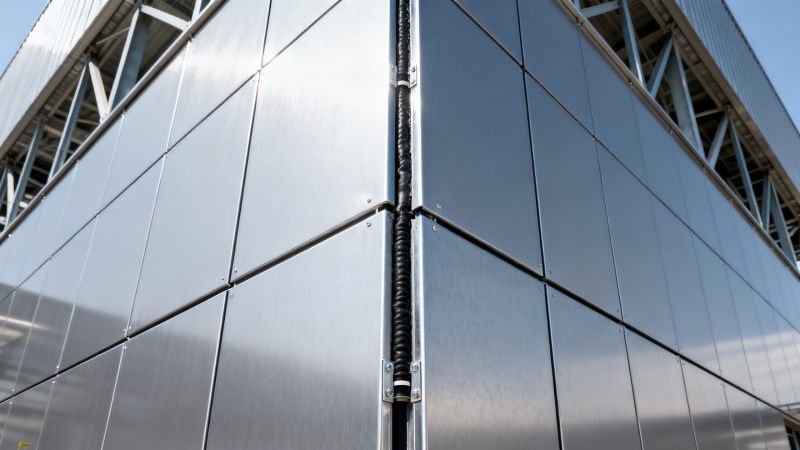
Galvalume vs. Galvanized: Which Coating Handles Heat Better?
While both galvanized and Galvalume coatings protect base steel, their thermal response differs due to metallurgical composition. Galvalume (55% Al–43.4% Zn–1.6% Si) exhibits lower thermal conductivity than pure zinc—reducing surface temperature spikes by up to 7°C under identical solar loading. This directly lowers peak expansion strain.
More importantly, Galvalume’s aluminum-rich layer forms a stable oxide barrier that maintains dimensional stability across repeated heating/cooling cycles. In accelerated weathering tests (ASTM G154, 2000 hrs UV + condensation), DX52D Galvalume Steel Coil retained flatness within ±0.3 mm/m after 12 thermal cycles—versus ±1.1 mm/m for standard GI coil.
This performance edge translates into real-world savings: projects using Galvalume report 42% fewer service calls related to thermal distortion over 5-year operational periods, particularly in regions with diurnal swings exceeding 15°C.
The higher elongation and tighter tensile range of DX52D make it especially suitable for cold-formed profiles requiring roll-forming or bending—critical for wall sheet systems where edge stiffness must balance flexibility during thermal cycling.
How to Specify Expansion Joints for Galvanized Wall Sheets
Effective expansion joint design depends on three interdependent variables: material coefficient, maximum expected temperature differential, and anchoring method. For DX52D Galvalume coils used in wall applications (thickness 0.4–1.2 mm), we recommend:
- Joint spacing ≤9 meters for east/west façades in tropical zones (e.g., Thailand, UAE)
- Minimum gap width of 6 mm at 20°C ambient—adjusted using linear expansion formula ΔL = α·L·ΔT
- Slotted fastener holes (length ≥1.5× nominal gap) with neoprene washers to absorb lateral movement
- Backing sealant compliant with ASTM C920 Type S, Grade NS, Class 25
Hongteng Fengda provides free technical support for joint layout validation—including digital modeling of thermal displacement paths based on your project’s latitude, orientation, and local climate data (ASHRAE 2023 Typical Meteorological Year files).
What Procurement Teams Should Verify Before Ordering
When sourcing galvanized or Galvalume wall sheets, procurement specialists must go beyond coating weight (e.g., Z275 vs. AZ150). Critical checks include:
- Batch-specific tensile test reports showing elongation ≥28% (per EN 10346:2015 Annex B)
- Coating adhesion verified via bend test (180° around mandrel diameter = 2× thickness)
- Flatness tolerance ≤1.5 mm/m measured per EN 10162
- Traceable ISO 9001, SGS, and BV certifications included with each coil shipment
Our coils undergo 100% online flatness inspection and batch-level mechanical testing—ensuring compliance before dispatch. Lead time for standard DX52D Galvalume orders (width 1000–1250 mm, thickness 0.5–0.8 mm) is consistently 12–18 days from PO confirmation.
Why Global Projects Choose Hongteng Fengda for Structural Steel Supply
As a structural steel manufacturer and exporter from China, Hongteng Fengda delivers more than product specifications—we embed engineering insight into every coil. Our customers rely on us because:
- We co-develop installation guidelines with your site engineers—factoring in local labor practices, tool availability, and climate thresholds
- All DX52D Galvalume Steel Coil shipments include certified mill test reports (MTRs), coating thickness verification, and cold-forming suitability documentation
- We maintain 30+ active stock configurations across common widths (600–1250 mm) and thicknesses (0.3–1.0 mm), enabling 7-day air freight readiness for urgent projects
- Our quality control covers 6 key checkpoints—from raw slab chemistry to final coil geometry—verified against ASTM A653/A792 and EN 10346 standards
Whether you need technical validation for expansion joint layouts, comparative data on galvanized coil vs. galvannealed coil, or OEM-grade customization for complex façade systems, our engineering team responds within 4 business hours—with actionable recommendations, not generic brochures.
Contact us today to request: (1) free thermal expansion calculation for your specific wall sheet configuration, (2) sample coil with full MTR package, or (3) side-by-side performance comparison of GI vs. Galvalume under simulated desert or humid-tropical conditions.
Please give us a message


Please enter what you want to find