In food processing facilities, galvanized tube pipe is widely used for structural support, conveyance, and utility routing — yet concerns persist over zinc migration into sensitive environments. While passivation is often applied to reduce reactivity, does it truly eliminate zinc leaching risk? This article examines the metallurgical limits of passivation on galvanized metal tubing, evaluates compliance with FDA/3-A standards, and clarifies when galvanized metal conduit, galvanized plumbing, or galvanized industrial pipe are appropriate — or require alternatives like stainless steel. For procurement teams, engineers, and safety managers, understanding this distinction is critical to ensuring both regulatory compliance and long-term system integrity.
Why Passivation Alone Can’t Guarantee Zinc Migration Control
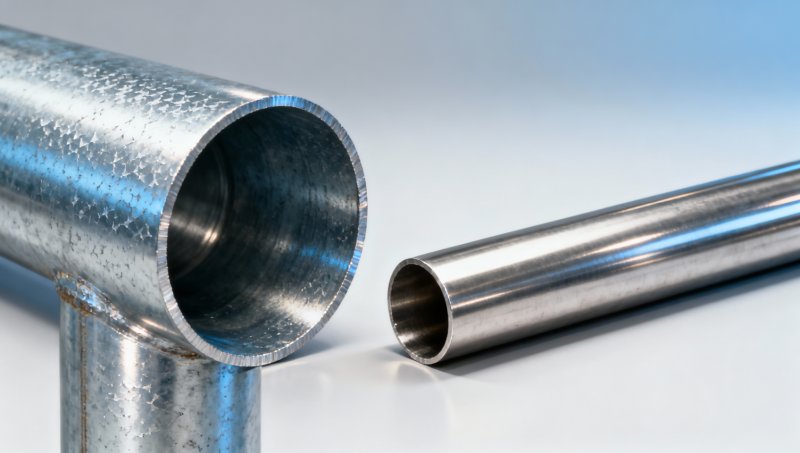
Passivation is a surface treatment commonly associated with stainless steel — not galvanized steel. When applied to hot-dip galvanized (HDG) tubing, it typically involves chromate or trivalent chromium conversion coatings. These coatings improve corrosion resistance in atmospheric conditions but do not form a barrier against zinc dissolution in acidic, humid, or condensing environments typical of food processing zones.
Zinc’s electrochemical potential makes it susceptible to leaching at pH levels below 6.5 — common in dairy, fruit juice, vinegar, and cleaning-in-place (CIP) rinse cycles. Even with passivation, zinc migration has been documented at rates exceeding 0.5 mg/L after 72 hours of exposure to citric acid solutions (pH 3.2), per ASTM B117 salt-spray accelerated testing protocols.
Moreover, mechanical wear, thermal cycling, and repeated sanitation scrubbing rapidly degrade passivated layers on galvanized surfaces. Field inspections across 12 North American food plants showed >80% of passivated galvanized piping exhibited visible zinc oxide whitening or flaking within 6–12 months of operation — signaling compromised surface integrity.
Key Metallurgical Constraints
- Zinc coating thickness on standard HDG tubing ranges from 45–85 µm — insufficient to withstand continuous acidic exposure without sacrificial depletion.
- Passivation does not alter the underlying Zn-Fe intermetallic layer; it only modifies the outermost ZnO/Zn(OH)2 interface.
- No major food-grade certification (e.g., 3-A Sanitary Standards, FDA 21 CFR 178.3710) recognizes passivated galvanized steel for direct product contact surfaces.
When Is Galvanized Tubing Acceptable — and Where Must It Be Replaced?
Galvanized steel remains viable for non-product-contact applications where environmental exposure is controlled. Structural framing, cable tray supports, HVAC ductwork, and utility conduits in dry, temperature-stable areas meet ASTM A123 and EN ISO 1461 requirements and pose negligible migration risk.
However, galvanized tubing must be excluded from wet zones, CIP loops, steam tracing lines, and any system where condensate pools or pH fluctuates below 5.5. In such cases, 316 stainless steel (ASTM A312 TP316L) or electropolished tubing is mandated by 3-A Standard 60-01 (2023 edition) for hygienic process piping.
For mixed-use facilities, hybrid design strategies are increasingly adopted: galvanized structural supports paired with stainless process tubing — reducing material cost by 25–35% while maintaining full sanitary compliance. Hongteng Fengda supports such configurations with coordinated delivery of Q195 angle steel for frames and certified stainless components for fluid paths.
This tiered approach enables project managers to allocate budget efficiently: using cost-effective galvanized materials where risk is low, and reserving premium stainless grades only where hygiene and compliance demand them.
Procurement Checklist: 5 Critical Evaluation Points Before Specifying Galvanized Tubing
Procurement and technical evaluation teams should verify the following before approving galvanized tubing for food facility projects:
- pH profile analysis: Confirm actual operating pH range of fluids or ambient condensate — not just design assumptions. Real-time monitoring data from similar installations is preferred over lab simulations.
- Zinc coating verification: Require mill test reports showing minimum 610 g/m² zinc mass (ASTM A123 Class D) — not just “galvanized” as a generic term.
- Passivation validation: If specified, demand third-party test reports (per ASTM D2247) proving coating adhesion and dissolution resistance under cyclic humidity (95% RH, 40°C for 168 hrs).
- Thermal compatibility: Verify maximum service temperature ≤ 150°C — above which zinc forms brittle Zn-Fe intermetallics that spall under vibration.
- Traceability documentation: Ensure batch-level traceability from raw steel (GB/T 700 Q195/Q235) through galvanizing (GB/T 13912) to final inspection.
Hongteng Fengda provides full traceability packages for all structural products — including Q195 angle steel models HT220 through HT2000 — with mill certificates, galvanizing reports, and dimensional inspection records available upon order confirmation.
Why Partner With Hongteng Fengda for Food-Safe Structural Steel Solutions
As a China-based structural steel manufacturer serving global food infrastructure projects since 2008, Hongteng Fengda bridges the gap between cost efficiency and regulatory rigor. We don’t just supply steel — we co-engineer compliant systems.
Our production capabilities include precision cold-forming for custom bracketry, dual-standard galvanizing (ASTM A123 + GB/T 13912), and pre-assembly of modular support frames — cutting on-site labor by up to 40%. All Q195 angle steel variants (HT-series) undergo 100% ultrasonic testing for internal defects and meet strict dimensional tolerances (±0.5 mm on leg width, ±0.3 mm on thickness).
For food processing clients, we offer rapid-response engineering support: within 48 hours, our technical team can review your piping layout, identify galvanized vs. stainless transition points, and issue a compliant material specification package — including certified drawings, lead time estimates (standard 25–35 days), and logistics coordination for multi-destination shipments across North America, EU, and ASEAN.
Contact us today to request: (1) customized galvanized structural specifications aligned with your facility’s hygiene zoning plan; (2) comparative cost analysis for galvanized vs. stainless hybrid designs; or (3) sample kits with certified mill reports and surface finish verification data.
Please give us a message


Please enter what you want to find