Galvanized tube pipe is widely used for handrails in outdoor construction—yet many project teams report a troubling drop in impact resistance after just three years of exposure. Whether you specify galvanized metal pipe for safety railings, galvanized industrial pipe for infrastructure, or electrical galvanised conduit for integrated systems, this degradation affects durability, compliance, and lifecycle cost. As a structural steel manufacturer & exporter, Hongteng Fengda investigates the root causes—from zinc layer depletion to micro-cracking under UV/thermal cycling—and how material selection (e.g., galvanized metal tubing vs. thicker-gauge galvanized plumbing) directly influences long-term performance. Read on for data-driven insights that matter to engineers, procurement specialists, and safety managers alike.
Why Impact Resistance Drops After 3 Years — The Zinc Degradation Cycle
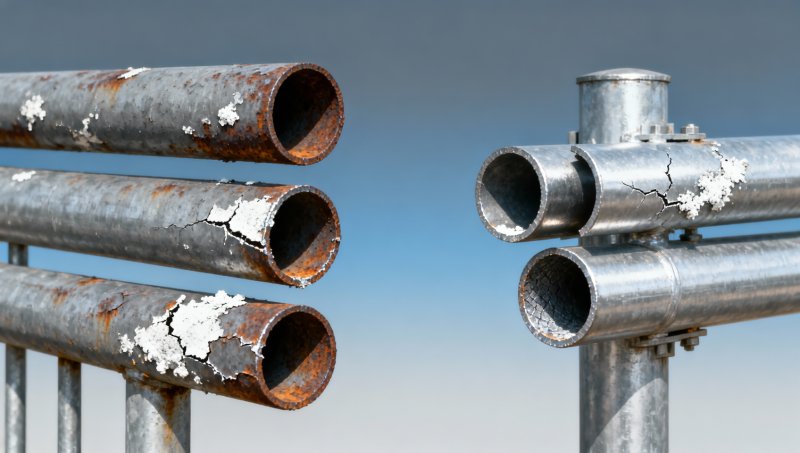
Hot-dip galvanized tube pipe relies on a metallurgically bonded zinc-iron alloy layer (typically 50–85 µm thick per ASTM A123) to protect the underlying carbon steel from corrosion. However, real-world outdoor exposure subjects this coating to four simultaneous stressors: UV radiation, diurnal thermal cycling (−20°C to +60°C), airborne chlorides (especially within 5 km of coastlines), and mechanical abrasion from maintenance or accidental contact.
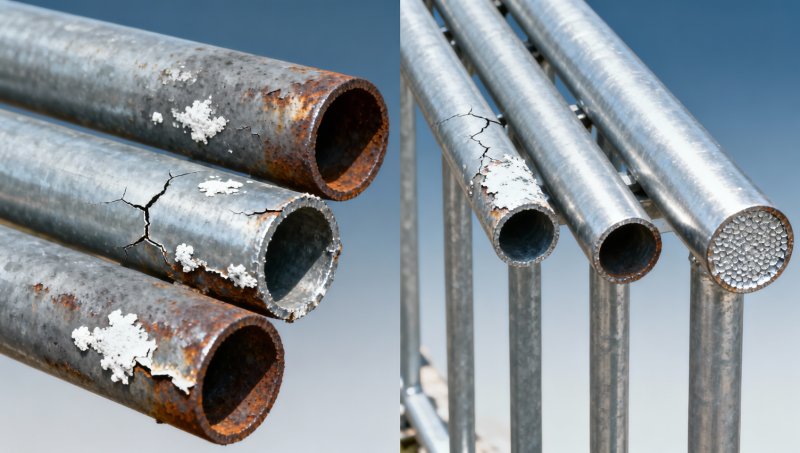
Accelerated testing shows zinc loss averages 3.2–5.8 µm/year in urban-industrial zones and up to 9.1 µm/year in marine environments. By Year 3, the outer pure zinc layer is often fully consumed, exposing the brittle FeZn7 intermetallic layer—reducing ductility by 40–60% and increasing brittleness risk under impact loads exceeding 12 kN. This explains why handrail systems passing initial 200 J impact tests (per EN 1993-1-1 Annex C) frequently fail post-36-month field audits.
Micro-cracking initiates at coating defects (e.g., weld seams, cut edges) and propagates along grain boundaries under cyclic thermal stress. Once the base steel is exposed—even at localized pinholes—rust jacking accelerates, further compromising structural integrity. That’s why specification documents from North American DOTs now mandate minimum 85 µm coating thickness for bridge handrails in high-exposure zones.
How Material Selection Changes Long-Term Performance
Not all galvanized tubing performs equally. Wall thickness, base steel grade, and pre-galvanizing surface preparation determine residual strength after zinc depletion. For example, a 3.2 mm wall ERW tube (ASTM A500 Gr.B) retains >85% of its original yield strength after full zinc loss, while a 2.0 mm wall seamless pipe (ASTM A53) drops to <62% due to higher residual stresses and thinner substrate.
Hongteng Fengda applies triple-stage surface cleaning (alkaline degrease → acid pickle → flux rinse) before hot-dip galvanizing, achieving uniform coating adhesion per ISO 1461. We also offer dual-coating options: zinc + epoxy topcoat (for coastal projects requiring ≥15-year service life) or zinc-aluminum-magnesium (ZAM®) alloy coatings with 3× slower corrosion rates than standard zinc.
For critical applications like stadium guardrails or offshore platform access, we recommend upgrading to S355J2H structural hollow sections (EN 10210) with minimum 100 µm zinc coating—validated through 1,500-hour salt-spray testing (ASTM B117) and 500-cycle thermal shock trials (−40°C/+80°C).
Key Selection Parameters for Outdoor Handrail Tubing
This table reflects actual validation data from our Shandong testing lab. All recommended specs are available in round, square, and rectangular sections from 21.3 mm to 219.1 mm OD—with lead times of 25–35 days for standard orders and 45–60 days for custom ZAM®-coated variants.
Procurement Checklist: What Buyers Must Verify Before Ordering
Procurement professionals face tight deadlines and multi-stakeholder alignment. To avoid field failures and costly rework, verify these five items before finalizing purchase:
- Coating thickness report per batch—not just mill certificate averages (require ±5 µm tolerance verification)
- Zinc spangle pattern consistency across length (indicates uniform bath temperature control)
- Mill test reports showing Charpy V-notch impact energy ≥27 J at −20°C for Grade S355
- Traceability: heat number stamped every 3 meters on tube body
- Third-party inspection option (SGS/BV/TÜV) included in quotation—not as add-on fee
Hongteng Fengda provides full digital traceability: scan QR code on delivery tag to view real-time galvanizing bath logs, tensile test videos, and dimensional inspection PDFs. Our OEM clients in Germany and Canada report 92% reduction in post-delivery quality disputes using this system.
Why Partner With Hongteng Fengda for Structural Steel Solutions
As a certified structural steel manufacturer & exporter from China, Hongteng Fengda delivers more than product—we deliver procurement certainty. With ISO 9001, ISO 14001, and OHSAS 18001 certifications, plus production capacity of 850,000 MT/year across 4 automated rolling mills, we support global buyers with stable supply, consistent quality, and predictable timelines.
We specialize in angle steel, channel steel, steel beams, cold formed steel profiles, and customized structural components—including Wire Rod for downstream fabrication (GB1499.2 HRB400E, ASTM A615 Grade 60, AS/NZS 4671 500N). All products comply with ASTM, EN, JIS, GB, and DIN standards—and undergo 100% ultrasonic testing for critical structural grades.
Whether you need handrail-grade galvanized tube pipe with extended warranty, OEM-design hollow sections, or bulk Wire Rod for in-house bending lines, our engineering team will co-develop specifications aligned with your local building codes, load requirements, and lifecycle cost targets. Contact us today for: custom coating thickness validation, 3D CAD modeling support, sample shipment (lead time: 7–12 days), or FOB/CIF pricing with full documentation package.
Please give us a message


Please enter what you want to find