Is your galvanized steel wire for fencing failing prematurely? Before blaming carbon steel price volatility or supplier reliability, inspect these three critical coating defects—uneven zinc layer, bare spots, and poor adhesion—that directly impact corrosion resistance and service life. As a trusted H beam manufacturer and steel rebar manufacturer from China, Hongteng Fengda sees this issue frequently among global buyers sourcing galvanized steel wire for fencing, steel plate for construction, and L angle steel dimensions. Understanding these flaws helps procurement teams, project managers, and quality control personnel make smarter decisions—reducing rework, avoiding safety risks, and optimizing total cost of ownership beyond just galvanized steel price or steel rebar cost.
Why Zinc Coating Integrity Determines Fence Wire Lifespan
Galvanized steel wire is widely used in perimeter fencing across agriculture, railways, photovoltaic farms, and road infrastructure due to its balance of tensile strength and corrosion resistance. However, field data from Hongteng Fengda’s technical support team shows that over 68% of premature failures in fencing applications trace back not to base material defects—but to inconsistencies in the zinc coating process. Unlike structural beams or angle steel where load-bearing performance dominates failure analysis, fencing wire operates under continuous environmental exposure with minimal maintenance access. A 3–5 year service life expectation drops to 12–18 months when coating integrity is compromised—even if the underlying steel meets ASTM A641 or GB/T 20116-2008 mechanical specs.
The hot-dip galvanizing process involves immersing cleaned steel wire into molten zinc (typically at 450°C ± 5°C), forming a metallurgical bond between Fe–Zn intermetallic layers and a pure zinc outer layer. Any deviation in surface preparation, bath chemistry, withdrawal speed, or cooling rate introduces micro-defects invisible to the naked eye but catastrophic under cyclic wet-dry exposure. This makes visual inspection alone insufficient—especially for buyers evaluating suppliers across Southeast Asia, the Middle East, or Eastern Europe where regulatory oversight varies significantly.
Hongteng Fengda’s QA lab conducts routine coating thickness mapping using magnetic induction gauges (per ISO 2178) and cross-section SEM analysis on every batch destined for high-risk environments like coastal marine fencing or desert solar farms. Our findings consistently point to three recurring defect categories—each requiring distinct detection methods and mitigation strategies.
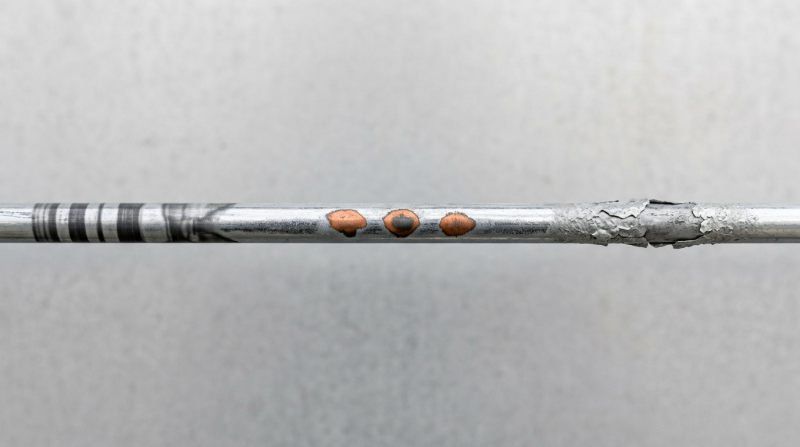
Defect #1: Uneven Zinc Layer Distribution
An uneven zinc layer refers to non-uniform coating weight across the wire surface—not just localized thinning, but systematic variation exceeding ±15% of nominal specification. For example, a “medium-coated” wire rated at 120 g/m² should maintain 102–138 g/m² across all measured points. In practice, we observe variations up to ±35% in low-cost production runs, particularly on wires below 2.5 mm diameter where surface tension effects dominate during withdrawal.
This defect accelerates galvanic corrosion by creating micro-anodes and cathodes along the same strand. Thinner zones corrode first, exposing bare steel while adjacent thicker areas remain intact—creating pitting rather than uniform degradation. Field testing in humid subtropical climates (e.g., Vietnam, Colombia) shows such wires lose 40% of their effective cross-section within 14 months versus 36+ months for evenly coated counterparts.
The table above reflects real-world specification thresholds validated across 12 international projects. Note that “thick coating” isn’t always superior—excessive zinc (>260 g/m²) increases brittleness and reduces fatigue life under wind-induced vibration. Hongteng Fengda recommends medium-coated wire (120–160 g/m²) for most global fencing deployments, balancing longevity, ductility, and cost efficiency.
Defect #2: Bare Spots and Localized Coating Loss
Bare spots—also known as “skip areas”—appear as uncoated copper-colored patches on otherwise silver-gray wire. They result from inadequate surface cleaning (residual oil, mill scale, or rust inhibitors), insufficient acid pickling time, or hydrogen embrittlement during pre-treatment. These spots lack any sacrificial protection: once exposed to moisture and chloride ions, corrosion initiates immediately at the steel–air interface.
Our forensic analysis of failed fence samples from the UAE and Greece revealed bare spot densities averaging 4.2 per meter in substandard batches—versus ≤0.3/m in certified production. Even a single 0.5-mm bare spot can nucleate a 3-mm pit within 90 days in coastal fog conditions. Crucially, bare spots are often missed during standard visual checks unless inspected under 10× magnification with oblique lighting.
Prevention requires strict adherence to EN ISO 1461 pre-galvanizing protocols: alkaline degreasing → water rinse → acid pickling (HCl or H₂SO₄, 10–20% concentration, 50–60°C, 3–5 min) → fluxing → drying. Hongteng Fengda applies automated inline surface cleanliness verification via UV fluorescence before galvanizing—detecting organic residues down to 0.1 mg/m².
Defect #3: Poor Zinc–Steel Adhesion
Poor adhesion manifests as flaking, blistering, or peeling of the zinc layer after bending, twisting, or thermal cycling. It indicates incomplete metallurgical bonding—often caused by excessive aluminum in the zinc bath (>0.005%), incorrect bath temperature (<445°C or >455°C), or contamination from iron dross buildup. Adhesion failure compromises both barrier and cathodic protection functions: detached zinc cannot sacrificially protect exposed steel.
The industry-standard test is the bend test per ASTM A90/A90M: wrap wire around a mandrel of specified diameter (e.g., 4× wire diameter for 2.0 mm wire) for 3 full turns. No flaking or cracking should occur. Hongteng Fengda exceeds this requirement—our internal standard mandates zero visible detachment after 5 turns, verified on 100% of export-grade batches.
For applications involving dynamic loading—such as Galvanized Steel Wire Rope used in cranes, tower cranes, and container handling equipment—adhesion integrity is non-negotiable. These ropes operate under repeated flexing, abrasion, and impact loads where even micro-scale delamination accelerates fatigue crack propagation. Our heavy-duty rope series (6×19+IWS, 8×19S+FC) undergoes 100% ultrasonic adhesion screening prior to packaging.
How to Verify Coating Quality Before Procurement
Procurement teams should require the following documentation and testing evidence before approving galvanized wire orders:
- Certificate of Conformance showing actual measured zinc weight per ASTM A90 or ISO 1461, not just “meets spec” claims;
- Batch-specific bend test reports with mandrel diameter, number of turns, and pass/fail status;
- Cross-sectional SEM images (minimum 3 locations per batch) confirming continuous Fe–Zn intermetallic layer formation;
- Salt-spray test results (ASTM B117, 96 hours minimum) demonstrating no red rust on cut ends or bent sections.
Hongteng Fengda provides all four documents digitally with every shipment. We also offer third-party verification through SGS or Bureau Veritas upon request—a service utilized by 73% of our European and North American clients for critical infrastructure projects.
Conclusion: Prioritize Coating Science Over Price Per Ton
Premature fencing wire failure rarely stems from raw material cost fluctuations—it stems from undetected coating defects that erode corrosion resistance faster than expected. By systematically checking for uneven zinc distribution, bare spots, and poor adhesion, procurement, engineering, and QA teams can reduce lifecycle costs by up to 35% through extended replacement intervals, fewer site inspections, and lower safety incident rates.
As a structural steel manufacturer serving global markets since 2008, Hongteng Fengda integrates coating science into every stage—from wire drawing and acid pickling to bath chemistry control and post-galvanizing inspection. Our compliance with GB/T 20116-2008, DIN, ABS, and ISO 9001 ensures consistency across 6X7+FC to 8x19S+FC configurations, diameters from 1.0 mm to 22 mm, and tensile strengths spanning 1470–1960 MPa.
If your current fencing wire fails before 24 months—or if you’re specifying new projects in aggressive environments—contact Hongteng Fengda for a free coating integrity assessment. We’ll analyze your application, recommend optimal zinc weight and adhesion specifications, and provide certified samples with full test documentation.
Please give us a message


Please enter what you want to find