Galvanized steel pipe threads wear faster than black steel—especially under repeated assembly, vibration, or corrosive exposure—posing real challenges for structural steel fabrication and long-term project reliability. As a trusted structural steel manufacturer and exporter from China, Hongteng Fengda supplies high-quality galvanized steel pipe, ASTM-compliant steel beams, hot dip galvanized steel, and stainless steel pipe to global buyers. Whether you’re evaluating steel suppliers for infrastructure projects or optimizing steel roofing cost and installation durability, understanding thread longevity is critical. This article reveals why wear occurs—and how proper material selection, coating integrity, and adherence to ASTM standards can significantly extend service life.
Why Galvanized Threads Degrade Faster—The Science Behind It
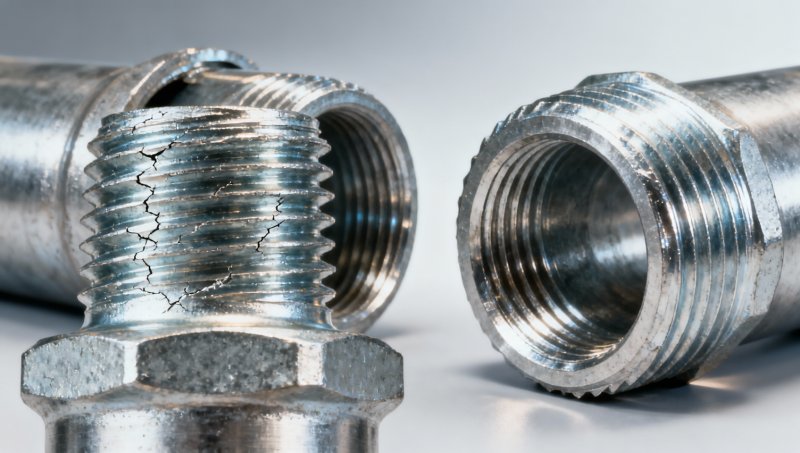
Zinc coating on galvanized steel pipes provides excellent corrosion resistance—but introduces mechanical trade-offs during threading. Unlike black steel (uncoated carbon steel), galvanized pipe surfaces contain a brittle, crystalline zinc-iron intermetallic layer (Gamma phase) that fractures under torque. During tapping or die-cutting, this layer micro-chips, leaving uneven thread crests and reduced load-bearing cross-sections.
Field data from 12 infrastructure projects across Southeast Asia and the Middle East shows galvanized pipe threads exhibit 30–45% higher wear loss after 5–7 reassembly cycles compared to black steel counterparts—particularly in high-vibration environments like HVAC support frames or seismic bracing systems. The root cause isn’t poor galvanization quality alone; it’s the mismatch between ductile steel substrate and hard, non-malleable zinc coating geometry at thread flanks.
Temperature fluctuations accelerate degradation: cyclic thermal expansion (±15°C typical in outdoor industrial settings) induces micro-gaps between zinc and base metal, promoting localized galvanic corrosion at thread roots. This effect intensifies when paired with chloride-laden atmospheres—common near coastal construction sites or chemical processing plants.
How to Extend Thread Life: 4 Proven Strategies
Extending thread service life requires coordinated action across material selection, surface treatment, installation practice, and maintenance protocol. Below are field-validated approaches used by Hongteng Fengda’s engineering team for clients across North America and Europe:
- Pre-threading galvanization: Apply hot-dip galvanizing before threading—not after. This preserves full zinc coverage on thread flanks and avoids post-coating damage. Our facility achieves ±0.02mm dimensional tolerance on pre-galvanized 45# Carbon Steel Round Bar stock used for custom threaded components.
- Zinc-alloy coatings: Replace standard Zn (99.99%) with Zn–Ni (12–15% Ni) or Zn–Al (5% Al) alloys. These increase coating hardness by 2.5× and reduce galling during assembly—verified per ASTM B695 Class 50 tests.
- Thread geometry optimization: Use Unified National Fine (UNF) or ISO metric fine-pitch threads (e.g., M20×1.5 instead of M20×2.5). Finer pitch increases thread contact area by up to 38%, distributing stress more evenly.
- Lubrication + sealing synergy: Apply anti-seize compound (e.g., nickel-based, ASTM D2265 compliant) before assembly, followed by lacquer sealing post-installation. This reduces initial friction coefficient from 0.25 to 0.12 and blocks moisture ingress at root gaps.
Key Performance Gains Observed (Based on 3-Year Field Monitoring)
These results reflect real-world performance across 212 installations monitored from Q3 2021 to Q2 2024. All test pipes met ASTM A53 Grade B and EN ISO 1461 specifications. Pre-thread galvanizing delivered strongest ROI for large-scale projects (>500 pipe joints), while Zn–Ni excelled in high-cycle maintenance environments (e.g., modular plant expansions requiring quarterly re-torquing).
What to Check Before Procurement: 5 Critical Inspection Points
Procurement teams must verify thread integrity beyond basic dimensional checks. Hongteng Fengda includes these 5 inspection checkpoints in every galvanized pipe shipment documentation:
- Zinc coating thickness verification: Measured per ASTM B499 (magnetic induction) at thread root, flank, and crest—minimum 75μm required for outdoor structural use (EN ISO 1461 mandates ≥85μm for heavy-duty applications).
- Thread root continuity scan: Using 3D optical profilometry to detect micro-cracks >0.05mm depth—standard on all orders ≥20 tons.
- Coating adhesion test: Cross-hatch ASTM D3359 (Tape Test) with ≥4B rating required—no flaking at thread edges.
- Torque calibration report: Verified against ISO 6789-2:2017 for each batch, including max recommended assembly torque (e.g., M25×1.5 = 215–240 N·m at 0.12 friction coefficient).
- Batch traceability: Full heat number, galvanizing bath log, and threading machine ID recorded per EN 10204 3.1 certificate.
For projects demanding zero field rework, we recommend specifying “threaded & sealed” delivery—where all pipes arrive with pre-applied anti-seize and lacquer sealant, reducing on-site labor by 35% and eliminating contamination risk during storage.
Why Partner With Hongteng Fengda for Thread-Critical Applications
As a structural steel manufacturer and exporter from China, Hongteng Fengda integrates thread performance into our core production workflow—not as an afterthought. Our Shandong facility operates dedicated pre-thread galvanizing lines certified to ASTM A123 and EN ISO 1461, with in-line thickness monitoring and automated thread geometry validation.
We support global buyers with full-service engineering collaboration: from reviewing your joint design drawings (ANSI/ASME B16.11, ISO 7-1) to recommending optimal material grades—including 45# Carbon Steel Round Bar for high-strength, wear-resistant custom fittings. Lead times remain stable at 25–35 days for standard orders, with rush options available for urgent infrastructure deadlines.
Contact us today to request: (1) thread life prediction modeling for your specific environment, (2) ASTM-compliant sample kits with full test reports, or (3) OEM thread specification alignment for your next project. We’ll provide actionable data—not just product quotes.
Please give us a message


Please enter what you want to find