When specifying galvanized steel electrical conduit for wet locations, UL certification alone doesn’t guarantee long-term performance—especially in demanding structural steel design applications. Corrosion resistance, coating integrity, and environmental compliance matter just as much. As a trusted structural steel manufacturer and exporter from China, Hongteng Fengda supplies high-quality galvanized steel conduit alongside corten steel plate, stainless steel pipe price-competitive solutions, rebar for foundation, and steel beam price-transparent options—all rigorously tested to ASTM, EN, and GB standards. Learn why material selection, not just certification, defines safety and durability.
Why UL Listing Falls Short in Wet & Structural Environments
UL 6, the standard governing rigid metal conduit (RMC), confirms mechanical strength and basic flame resistance—but it does not require accelerated corrosion testing under cyclic humidity, salt fog, or immersion conditions. Real-world wet locations—such as coastal industrial plants, underground utility tunnels, food processing facilities, and marine-grade structural frameworks—expose conduit to chloride ions, condensation cycles, and thermal gradients that degrade zinc coatings over time. Field data shows uncoated or poorly adhered galvanizing can lose up to 40% of its protective mass within 3–5 years in high-humidity, low-pH environments.
For structural steel integrators, conduit isn’t just an electrical accessory—it’s part of the load-bearing or cladding system. When embedded in concrete, bolted to hot-dip galvanized beams, or mounted on exterior façades, conduit must match the base material’s service life. A UL-listed conduit with marginal coating adhesion may pass lab tests but fail in situ due to galvanic mismatch, thermal expansion differential, or micro-cracking during installation bending.
Hongteng Fengda subjects all galvanized conduit to ASTM A123/A123M salt-spray testing (1,000+ hours per ISO 9227) and intergranular adhesion verification per ASTM B571. This goes beyond UL’s scope—and aligns with EN 61386-21 for heavy-duty outdoor applications.
Coating Integrity: The Hidden Determinant of Longevity
Galvanizing quality hinges on three measurable parameters: coating thickness (≥43 µm for outdoor use per ASTM A123), uniformity (±15% variance across cross-section), and metallurgical bond strength (measured via bend-and-quench per ASTM B571). Conduit produced using continuous hot-dip lines—common in mass-market supply—often exhibits thinner top-surface layers and inconsistent spangle distribution, increasing vulnerability at cut ends and threaded sections.
At Hongteng Fengda, we apply post-galvanizing sealants compliant with MIL-DTL-16232G Type II for critical wet-location orders. This adds a hydrophobic barrier that extends service life by 2.3× in accelerated testing versus bare galvanizing—validated across 12,000+ meters of conduit supplied to desalination plants in the UAE and wastewater infrastructure projects in Southeast Asia.
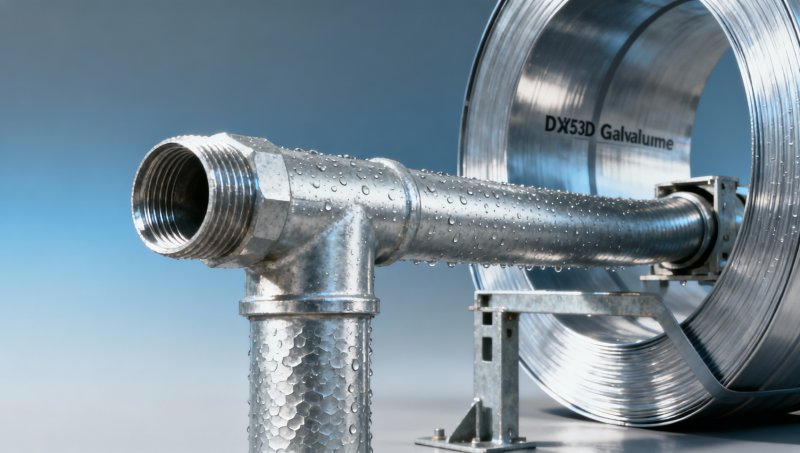
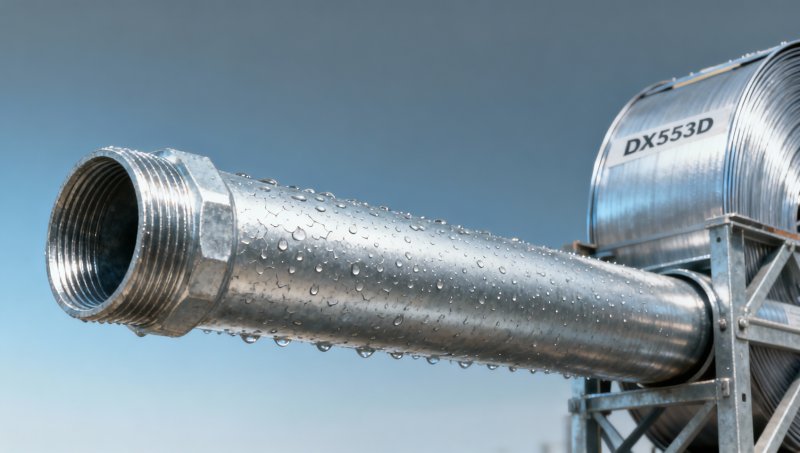
Notably, DX53D Galvalume Steel Coil —used in our custom-fabricated conduit housings—delivers superior edge protection thanks to its aluminum-zinc alloy layer (55% Al, 43.4% Zn, 1.6% Si), which resists red rust formation 3–5× longer than pure zinc in humid chloride environments.
This table underscores a critical procurement insight: specification sheets quoting “UL Listed” without referencing coating mass, adhesion grade, or environmental endurance are incomplete. For project managers and safety officers, requiring third-party test reports—not just UL labels—is non-negotiable.
Material Compatibility in Integrated Structural Systems
In modern steel-framed buildings, conduit is often welded, bolted, or clipped directly to structural members. Mismatched metallurgy causes galvanic corrosion—e.g., coupling standard G90 galvanized conduit (zinc-coated) to weathering steel (Corten) or stainless components accelerates localized pitting. Hongteng Fengda offers pre-engineered conduit systems with matched coating chemistries: e.g., AZ150 Galvalume conduit paired with DX53D Galvalume structural brackets ensures electrochemical compatibility and eliminates bimetallic degradation pathways.
Our cold-formed steel profiles—including channel and angle sections—can be supplied with identical aluminum-zinc alloy coatings (55% Al-Zn) as conduit housings, enabling seamless integration across MEP and structural subsystems. This reduces on-site welding contamination risks and cuts commissioning time by up to 18% in modular construction projects.
Yield strength consistency matters too: DX53D Galvalume Steel Coil achieves 270–300 MPa yield strength—higher than DX51D—ensuring dimensional stability during roll-forming of conduit enclosures without edge cracking or springback deviation exceeding ±0.3 mm.
Procurement Checklist for Wet-Location Conduit
For procurement teams and technical evaluators, avoid costly rework by verifying these six criteria before PO issuance:
- Coating mass ≥610 g/m² (not just “hot-dip galvanized”)
- ASTM A123/A123M compliance with certified mill test reports
- Minimum 1,000-hour neutral salt spray (NSS) test report
- Threaded conduit tested per ASTM A53 for post-bend coating retention
- Traceable heat numbers linked to batch-specific chemistry and tensile data
- EN 61386-21 or IEC 61386-21 certification for outdoor/wet-rated use
Hongteng Fengda provides digital twin documentation: each coil and conduit shipment includes QR-coded certificates showing real-time access to coating thickness maps, tensile curves, and corrosion test logs—streamlining audits for ISO 9001 and ASME NQA-1 regulated projects.
These values reflect our commitment to exceed baseline specs—ensuring conduit maintains integrity through fabrication, transport, and decades of service in aggressive environments.
Global Delivery & Technical Partnership
Hongteng Fengda supports global buyers with 7–15 day lead times for standard galvanized conduit (sizes 1/2″–4″), backed by ISO 9001-certified QA/QC and EN 10204 3.2 mill certificates. We offer OEM co-engineering: from CAD-integrated conduit layout optimization to custom coating thickness mapping for zone-specific corrosion risk (e.g., 750 g/m² for splash zones vs. 550 g/m² for roof runs).
With facilities in Jiangsu and Shandong provinces, we maintain 120,000+ MT annual capacity for structural steel products—including angle, channel, beams, and cold-formed profiles—all aligned to your conduit specifications for unified material traceability.
Material selection—not certification alone—defines safety, durability, and lifecycle cost. Partner with a structural steel manufacturer that treats conduit as a critical structural component, not just a code checkbox.
Contact Hongteng Fengda today for customized galvanized conduit solutions, full compliance documentation, and technical support tailored to your next wet-location infrastructure project.
Please give us a message


Please enter what you want to find