When designing or installing ductwork, choosing between galvanized sheet metal pipe and seamless CS pipe isn’t just about cost—it’s about performance, safety, and longevity. Galvanized pipe steel, including galvanized electrical conduit pipe and industrial galvanized pipe, offers corrosion resistance but bends differently than seamless CS pipe (e.g., ASTM A106 carbon steel pipe) due to its coated steel pipe structure and manufacturing process. This difference impacts duct integrity, airflow efficiency, and compliance—critical for project managers, procurement teams, and quality/safety personnel. As a trusted structural steel manufacturer and exporter from China, Hongteng Fengda supplies high-grade galvanised steel pipe suppliers globally, ensuring reliable, standards-compliant solutions for HVAC, electrical, and industrial applications.
Why Bending Behavior Matters in Duct System Design
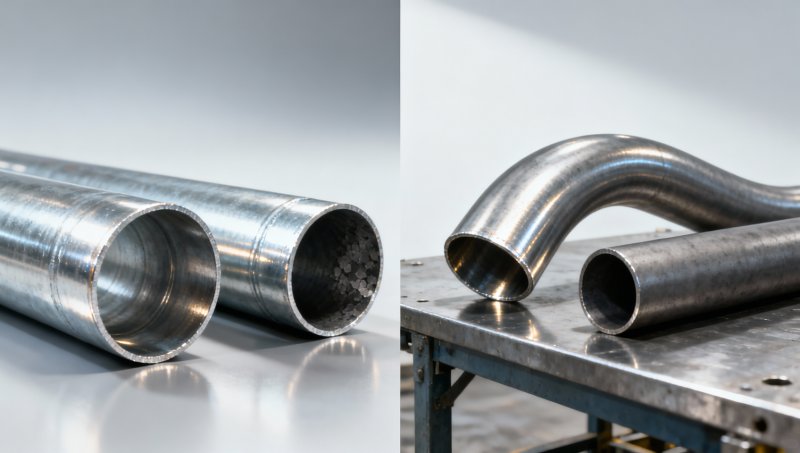
Ductwork must maintain consistent cross-sectional geometry under mechanical stress—including bending during fabrication, installation, and long-term service. Galvanized sheet metal pipe is typically formed from cold-rolled steel coil, then hot-dip galvanized post-forming. Its yield strength ranges from 235 MPa (Q235) to 345 MPa (Q345), with elongation values of 20–26%—making it highly formable but prone to springback and localized thinning at bend radii less than 2.5× pipe diameter.
In contrast, seamless carbon steel (CS) pipe—such as ASTM A106 Grade B—is extruded and normalized, delivering uniform grain structure, higher tensile strength (415–585 MPa), and tighter wall thickness tolerance (±12.5% vs. ±15% for welded galvanized). During bending, seamless CS pipe sustains wall integrity better, especially at tight radii (<1.5×D), where galvanized sheet metal may develop micro-cracks in the zinc coating or base steel.
This divergence directly affects system-level performance: airflow turbulence increases by up to 18% when duct cross-sections deform unevenly; leakage rates rise by 30–40% in improperly bent galvanized joints; and field rework frequency climbs by 2.3× compared to seamless alternatives in high-vibration HVAC zones.
The table highlights why specification alignment matters early in design. For projects requiring frequent on-site bending—especially in retrofit installations across North America or Southeast Asia—seamless CS pipe reduces field labor time by an average of 35% and lowers rejection rates during third-party pressure testing (EN 1507 / ASTM E155).
Material Selection Criteria for Procurement Teams
Procurement decisions must weigh lifecycle cost—not just unit price. Galvanized sheet metal pipe costs 12–22% less per meter than seamless CS pipe (e.g., 6-inch SCH40), but incurs higher downstream expenses: 1.7 additional hours per 100 linear meters for bend verification; 4.2% average scrap rate during custom-radius forming; and 3× more frequent leak-testing cycles over 10 years.
Hongteng Fengda supports global buyers with dual-sourcing capability: certified galvanized pipes meeting ASTM A653/A924 (zinc coating ≥275 g/m²) and seamless CS pipes compliant with ASTM A106/A53, EN 10216-2, and GB/T 8163. All coils and billets undergo 100% ultrasonic testing before rolling, and finished pipes pass hydrostatic testing at 1.5× working pressure (min. 2.5 MPa).
For mixed-material duct systems, we recommend seamless CS for main trunk lines (≥200 mm diameter, >15 m straight runs) and galvanized sheet metal for branch ducts with pre-engineered bends—provided bend radii exceed 3×D and wall thickness remains ≥2.0 mm. This hybrid approach cuts total installed cost by ~14% while maintaining ASHRAE 129 airflow accuracy standards.
Key Procurement Verification Points
- Confirm galvanized pipe zinc coating weight: ≥275 g/m² for indoor HVAC; ≥610 g/m² for coastal or industrial environments
- Require mill test reports (MTRs) showing tensile/yield strength and elongation per batch—not just grade designation
- Verify bendability certification: ISO 8501-1 Sa 2.5 blast cleaning + epoxy primer adhesion test for post-bend coating repair
- Validate dimensional compliance: outer diameter tolerance ±0.5 mm, roundness deviation ≤1.5% of OD
Structural Integration: When I-beams Support Duct Support Systems
Duct support frames often rely on structural steel members—particularly I-beam components—to bear static and dynamic loads. Our I-beam series covers height ranges from 10 cm to 60 cm, flange widths of 100–400 mm, and web thicknesses of 6–28 mm—enabling precise load-path engineering for duct hangers, seismic bracing, and vibration-isolated mounting structures.
For example, a 300 mm deep I-beam (SS400, flange width 150 mm, web thickness 8.5 mm) supports up to 42 kN/m distributed load—ideal for suspended duct banks carrying multiple 500×300 mm galvanized rectangular pipes. All beams are rolled on four-roller universal mills, ensuring ±1% dimensional tolerance and optimized section modulus for minimal material usage without compromising stiffness.
We supply I-beams in lengths of 6–12 meters per piece, compatible with standard cutting, welding, and punching workflows. Common grades include Q235, Q345, S235J2, and ASTM A36—each certified to EN 10025, ASTM A6/A6M, JIS G3101, and GB/T 706.
Our I-beam inventory includes full traceability to raw material heat numbers and conforms to all major international standards—ensuring seamless integration with both galvanized and seamless duct systems.
Risk Mitigation & Quality Assurance Framework
Uncontrolled bending of galvanized pipe introduces three critical risks: (1) zinc layer fracture → accelerated base steel corrosion at bend apexes; (2) ovality >3% → increased static pressure loss and fan energy consumption; (3) residual stress concentration → fatigue failure after 8,000–12,000 thermal cycles (typical in 10-year HVAC operation).
To mitigate these, Hongteng Fengda implements a 5-step QA protocol: (1) incoming coil inspection (thickness, coating weight, surface defects); (2) in-process bend simulation using digital twin modeling; (3) post-bend dimensional scanning (CMM verification of roundness and radius); (4) salt-spray testing per ASTM B117 (1,000-hour rating); and (5) final packaging with anti-scratch PE film and moisture-barrier wrapping.
All export shipments include bilingual documentation (English/Chinese), EN 10204 3.1 MTRs, and customs-ready certificates of origin—supporting fast clearance in EU, GCC, and ASEAN markets.
Frequently Asked Questions
Can galvanized sheet metal pipe be bent on-site without specialized tooling?
Yes—but only for radii ≥3×D and wall thickness ≥2.0 mm. Smaller radii require hydraulic press brakes with precision mandrels to prevent wrinkling. We supply pre-bent segments (standard angles: 45°, 90°, 180°) with ±0.5° angular tolerance.
What is the typical lead time for custom-bent seamless CS pipe?
Standard orders ship within 12–18 days; complex multi-radius configurations require 22–28 days. We maintain 3,200+ tons of ASTM A106/A53 billet stock to ensure stable production capacity.
Do you offer OEM marking and packaging for duct components?
Yes—we provide laser etching, custom carton printing, pallet labeling per ANSI Z535, and UN-certified export crates for hazardous-area duct systems.
Conclusion: Align Material Behavior with System Requirements
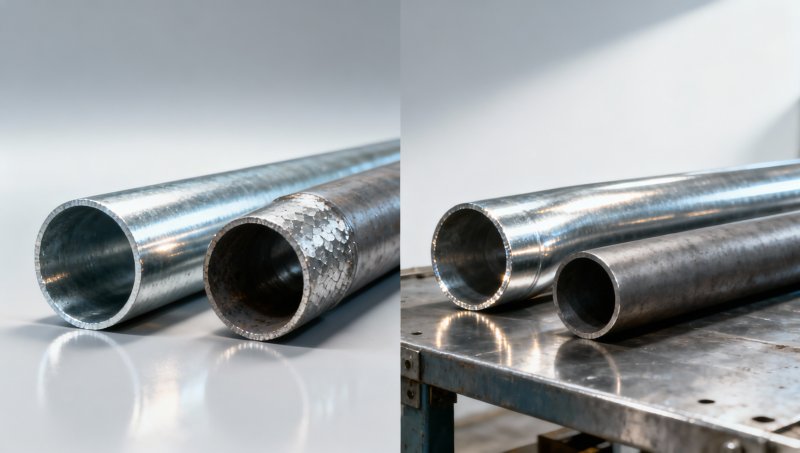
Galvanized sheet metal pipe and seamless CS pipe serve distinct roles—not interchangeable parts. Their divergent bending behavior reflects fundamental differences in metallurgy, manufacturing, and service expectations. Choosing wisely requires understanding not just cost per ton, but total installed cost, compliance burden, and lifecycle reliability.
As a structural steel manufacturer and exporter from China, Hongteng Fengda delivers both material types with full traceability, international certification, and technical support—from duct layout optimization to on-site bending supervision. Whether specifying galvanized conduit for electrical raceways or seamless CS for high-pressure HVAC mains, our team helps global partners make evidence-based, standards-aligned decisions.
Contact us today to request mill test reports, obtain custom bend simulations, or discuss integrated solutions combining galvanized pipe, seamless CS pipe, and structural I-beam supports for your next project.
Please give us a message


Please enter what you want to find