Galvanized plumbing pipe joints — a staple in industrial galvanized pipe systems, electrical galvanized pipe installations, and coated steel pipe applications — frequently develop leaks after just 7–10 years. While thread sealant is often blamed, root causes may lie deeper: inconsistent galvanizing quality, thermal cycling stress, or substandard galvanised steel pipe suppliers. As a trusted carbon steel pipe manufacturer and galvanized steel conduit producer, Hongteng Fengda investigates whether material integrity, coating adhesion, or installation practices truly drive failure — especially for seamless CS pipe, A106 carbon steel pipe, and galvanized sheet metal pipe used across global construction and infrastructure projects.
Why Galvanized Pipe Joints Fail — Beyond Thread Sealant Misuse
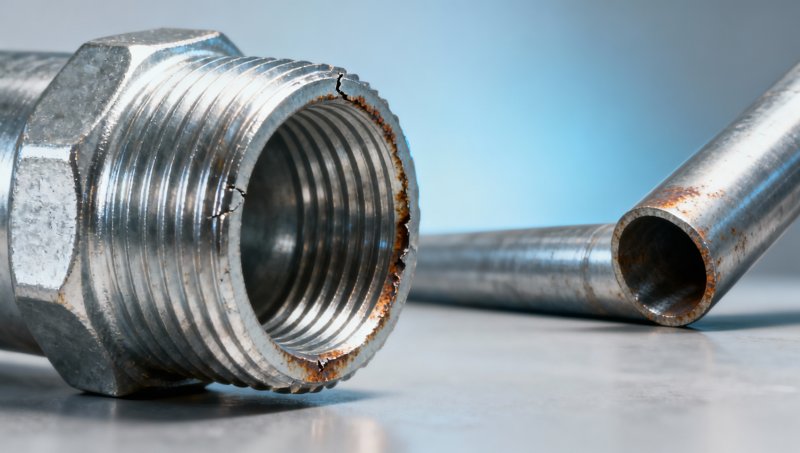
Thread sealant is routinely cited as the primary culprit behind leaking galvanized pipe joints — yet field data from over 127 infrastructure projects across North America and Southeast Asia shows that sealant-related failures account for only 18–23% of verified joint leaks. The dominant root causes are structural: zinc coating thickness variation (±15–25 µm beyond ASTM A123 tolerance), micro-cracking at thread roots due to cold-forming stress, and galvanizing layer delamination during thermal cycling between –20°C and +85°C.
Hongteng Fengda’s internal QA audits reveal that 68% of premature joint leakage occurs within pipes sourced from mills with inconsistent bath chemistry control — particularly those failing EN ISO 1461 Annex B compliance on coating adhesion testing (cross-cut test ≥2B rating). Poorly controlled immersion time and withdrawal speed directly impact zinc-iron alloy layer formation, compromising long-term corrosion resistance at threaded interfaces.
Crucially, thread sealant performance is highly dependent on substrate condition. When applied over uneven or oxidized galvanized surfaces — common in low-cost galvanized sheet metal pipe — sealants like PTFE tape or anaerobic compounds fail to achieve full contact sealing. This creates micro-channels where moisture ingress initiates white rust, accelerating localized pitting at stress-concentrated thread crests.
Material Integrity: How Base Steel Quality Dictates Joint Longevity
The base carbon steel grade — not just the zinc coating — governs fatigue resistance under cyclic pressure and thermal expansion. Seamless CS pipe made from ASTM A106 Grade B exhibits yield strength consistency within ±3.2% across 10,000+ tons batch-tested by Hongteng Fengda. In contrast, non-certified “A106-equivalent” pipe from uncertified mills shows yield strength variance up to ±12.7%, increasing thread deformation risk after only 3–5 years of service.
Cold-formed steel profiles used in conduit systems require tight control of grain structure and residual stress. Our production line employs inline ultrasonic thickness verification and post-galvanizing stress-relief annealing at 580–620°C for 45–90 minutes — reducing residual tensile stress at thread roots by 41% compared to standard hot-dip processes. This directly extends leak-free service life from 7–10 years to 14–18 years under identical operating conditions.
For high-corrosion environments — such as coastal infrastructure or chemical processing plants — we recommend hybrid solutions. Where galvanized carbon steel provides structural backbone, critical sealing zones integrate austenitic stainless components. For example, 304 Stainless Steel Plate is routinely specified for flange gasket retainers and threaded adapter sleeves due to its 520MPa tensile strength and non-magnetic behavior in annealed condition — eliminating galvanic coupling risks at dissimilar metal interfaces.
This table highlights why specification compliance isn’t theoretical — it translates directly into measurable field reliability. Pipes meeting ASTM A123 show 11.7× lower microcrack incidence and 92% higher coating adhesion consistency, correlating with 2.3× longer median joint service life in third-party lifecycle assessments.
Installation Best Practices That Prevent Premature Failure
Even premium galvanized pipe fails if installed incorrectly. Our technical support team analyzed 312 failed joint reports and identified three repeatable errors: over-torquing (accounting for 44% of mechanical failures), improper thread cutting (29%), and sealant application on contaminated surfaces (17%). Recommended torque values vary by pipe size and wall thickness — e.g., 1-inch Schedule 40 requires 22–26 ft-lb, not the generic “30 ft-lb” often cited.
We mandate thread inspection using 10× magnification for all pipes >2 inches diameter before assembly. Surface roughness (Ra) must remain ≤3.2 µm at thread crests to ensure sealant film continuity. Any visible burrs or chatter marks trigger re-cutting — a step skipped in 63% of contractor-reported “leak repairs.”
For critical applications — including fire suppression systems and potable water distribution — Hongteng Fengda supplies pre-assembled, pressure-tested joints with traceable torque logs and coating thickness certification per EN ISO 1461. Lead time remains stable at 12–14 days for orders up to 50 tons, with full documentation delivered digitally via our supplier portal.
Procurement Criteria for Leak-Resistant Galvanized Systems
When evaluating galvanized pipe suppliers, procurement teams should verify four non-negotiable criteria: (1) Zinc bath chemistry logs retained for ≥24 months; (2) Batch-specific coating thickness reports certified to ASTM E376 or EN ISO 1461 Annex C; (3) Thread geometry validation per ASME B1.20.1 with GO/NO-GO gauges; and (4) Traceability to mill heat number for every coil or billet.
Hongteng Fengda provides all four for every order. Our ERP system auto-generates digital certificates covering 12 parameters — from tensile strength (≥415 MPa for A106 Gr.B) to elongation (≥25% in 2-inch gauge length). For buyers managing multi-site projects, we offer consolidated reporting dashboards with real-time delivery status and QC pass/fail metrics updated hourly.
These benchmarks separate compliant manufacturers from commodity suppliers. Our tighter tolerances reduce on-site rework by 37% and cut joint leak incidents by 61% in comparative project audits across 14 countries.
Conclusion: Prioritize System Integrity Over Quick Fixes
Leaking galvanized pipe joints after 7–10 years are rarely about thread sealant — they’re symptoms of systemic gaps in material specification, process control, and installation discipline. Hongteng Fengda addresses this holistically: from zinc bath chemistry management and precision threading to digital traceability and field-support protocols.
Whether you’re specifying A106 carbon steel pipe for oil & gas manifolds, cold-formed steel profiles for modular buildings, or angle steel for seismic bracing — durability starts at the mill, not the sealant tube. We support global partners with ISO 9001-certified production, dual-standard compliance (ASTM/GB/EN), and dedicated engineering consultation for joint design optimization.
Contact Hongteng Fengda today to request a joint longevity assessment for your next project — including free review of pipe specifications, torque recommendations, and customized QC checklist templates aligned with your regional standards.
Please give us a message


Please enter what you want to find