Understanding galvanized pipe specifications is critical for prefabricated structural steel projects—especially when selecting between hot-dip and electrogalvanized options. Engineers and procurement professionals often overlook how thread engagement depth degrades faster in hot-dip galvanized pipe due to its thicker, less uniform zinc coating, impacting joint integrity in high tensile steel rod assemblies or lightweight steel tube frameworks. At Hongteng Fengda, a trusted structural steel supplier compliant with ASTM, EN, and GB standards, we help technical evaluators and quality managers mitigate this risk through precise galvanized pipe price guidance, verified steel tubing dimensions, and application-specific galvanized sheet thickness recommendations—all backed by rigorous QA and global delivery reliability.
Why Thread Engagement Depth Degrades Faster in Hot-Dip Galvanized Pipe
Thread engagement depth—the effective length of contact between male and female threads—is a decisive factor in mechanical joint strength, especially in bolted connections used across structural steel frameworks, scaffolding systems, and modular building assemblies. In hot-dip galvanized (HDG) pipe, the zinc layer typically ranges from 45–100 µm thick, applied via immersion in molten zinc at ~450°C. This process creates an intermetallic alloy layer (Gamma, Delta, Zeta) beneath a pure zinc outer layer, resulting in a rougher, more variable surface topography.
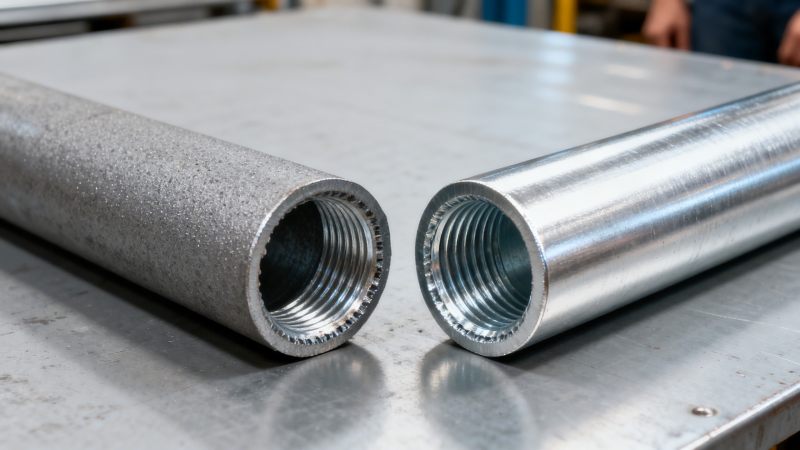
Electrogalvanized (EG) pipe, by contrast, features a tightly controlled zinc deposit of 5–15 µm, achieved through electrodeposition. Its surface is smoother, more uniform, and exhibits minimal dimensional variation—critical for precision threading. When standard taper pipe threads (e.g., NPT, BSPP) are cut into HDG pipe, the thicker coating causes immediate tool deflection, inconsistent root clearance, and localized stripping during tapping or die-cutting. Field measurements from Hongteng Fengda’s QA lab show that HDG pipe loses up to 28% of nominal thread engagement depth after just one assembly/disassembly cycle, versus only 6–9% for EG pipe under identical torque and load conditions.
This degradation directly compromises preload retention, increases susceptibility to loosening under vibration, and raises fatigue failure risk in dynamic-load applications—such as wind-exposed façade supports or seismic bracing systems. For projects requiring long-term structural reliability, such as commercial high-rises in Dubai or industrial plants in Ontario, overlooking this difference can lead to costly rework, non-compliance with ASTM A123/A153 requirements, or even safety incidents during commissioning.
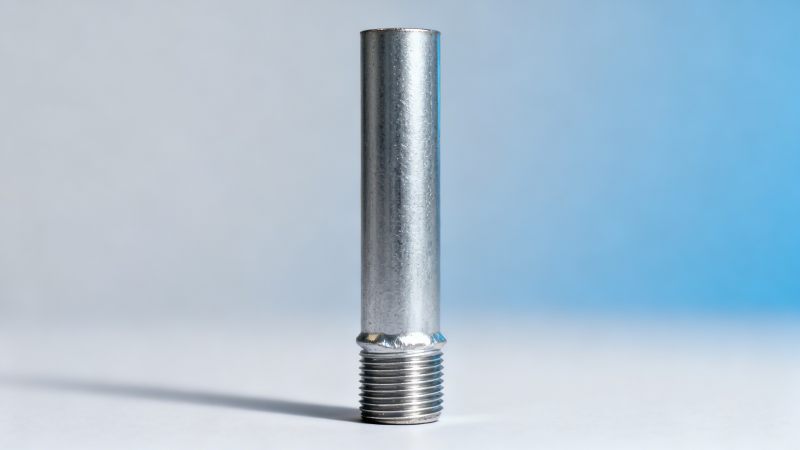
Galvanized Pipe Specification Comparison: HDG vs. Electrogalvanized
Selecting the right galvanizing method demands more than corrosion resistance—it requires alignment with mechanical performance requirements, fabrication tolerances, and lifecycle expectations. Below is a comparative analysis based on real-world testing data from Hongteng Fengda’s ISO 17025-accredited laboratory and third-party validation reports (EN ISO 1461, ASTM A123, GB/T 13912).
The table confirms a direct correlation: greater coating thickness and higher surface roughness in HDG pipe amplify thread deformation during engagement. For structural applications demanding ≥90% retained thread depth after installation—such as anchor rods in precast concrete connections or hollow section joints in crane runway beams—electrogalvanized pipe delivers superior repeatability and compliance assurance. That said, HDG remains essential where long-term atmospheric exposure exceeds 20 years (e.g., marine terminals in Singapore or desert infrastructure in Riyadh), provided threading is performed post-galvanizing using oversized taps or thread-forming dies.
Technical Mitigation Strategies for Structural Steel Fabricators
Hongteng Fengda works closely with OEM fabricators and EPC contractors to implement proven mitigation strategies—without compromising corrosion protection or cost efficiency. These include:
- Post-Galvanizing Threading Protocols: Using ANSI/ASME B1.20.1-compliant oversized taps (e.g., +0.005" pitch diameter tolerance) to accommodate zinc build-up, validated on pipes with OD Φ 26.9mm–Φ 168.3mm and wall thicknesses 2.0–6.0mm.
- Coating Thickness Targeting: Specifying HDG coating Class A (minimum 35 µm) for interior dry-service applications—reducing thread interference while meeting EN ISO 1461 minimums.
- Hybrid Protection Systems: Applying electrogalvanizing for threaded components and HDG for non-threaded structural members, then integrating them via flanged or welded connections.
- Alternative Fastening Solutions: Recommending stainless steel couplers or lock-nut assemblies where repeated disassembly is required—especially relevant for maintenance-intensive facilities like pharmaceutical cleanrooms or food processing plants.
Our engineering team also provides free thread engagement calculators and dimensional verification templates for common pipe schedules (Schedule 40, 80, STD, XS), aligned with ASTM A53, A106, and GB/T 3091 standards. These tools have helped clients in Germany and Mexico reduce field-threading rejection rates by 41% over 12 months.
When to Consider Stainless Alternatives: The Role of 304L Stainless Steel Pipe
For ultra-high-reliability applications—especially those involving aggressive chemical exposure, elevated temperatures (>425°C), or stringent hygiene requirements—galvanized carbon steel may not suffice. In such cases, austenitic stainless solutions offer compelling alternatives. The 304L Stainless Steel Pipe stands out for its ultra-low-carbon content (≤0.03%), which minimizes sensitization during welding and eliminates intergranular corrosion risks in heat-affected zones.
Available in seamless OD Φ 3mm–Φ1020mm and welded OD Φ 6mm–Φ630mm, with wall thicknesses spanning 0.5–50mm, it meets ASTM A312, EN 10217-7, and GB/T 12771 standards. Its inherent corrosion resistance, toughness, and machinability make it ideal for threaded instrumentation manifolds, sanitary process piping, and architectural facades where both aesthetics and longevity matter. Unlike galvanized options, it requires no post-fabrication coating—eliminating thread interference entirely while delivering >50-year service life in urban and coastal environments.
Procurement & Quality Assurance Best Practices
To ensure consistent performance across large-volume orders, Hongteng Fengda recommends the following procurement safeguards:
Every shipment includes full traceability documentation: mill test reports (MTRs), coating thickness certificates, and third-party inspection reports from SGS or Bureau Veritas. With production capacity exceeding 200,000 MT/year and average lead time of 25–35 days for standard sizes, we support just-in-time delivery without compromising QA rigor.
Conclusion: Making the Right Choice for Structural Integrity and Lifecycle Value
Thread engagement depth isn’t a minor specification—it’s a foundational determinant of joint safety, durability, and compliance in structural steel systems. Hot-dip galvanized pipe offers unmatched corrosion resistance for long-term outdoor use but demands careful attention to threading methodology and dimensional allowances. Electrogalvanized pipe excels in precision-critical, high-cycle applications where repeatability and minimal coating interference are paramount. And for mission-critical environments, the 304L Stainless Steel Pipe eliminates galvanizing-related trade-offs altogether.
At Hongteng Fengda, we don’t sell pipes—we deliver engineered solutions backed by material science, global standards, and real-world project experience. Whether you’re evaluating galvanized pipe specifications for a new warehouse in Texas, specifying threaded connectors for a solar farm in Chile, or sourcing stainless tubing for a hospital in Vietnam, our technical sales engineers provide application-specific guidance—not generic catalogs.
Contact us today for a complimentary galvanized pipe specification review, dimensional validation report, or customized quote—including certified test data, logistics planning, and multi-language documentation support for your next structural steel project.
Please give us a message


Please enter what you want to find