Welding thick galvanized metal plate (8mm+) poses significant challenges—especially distortion and warping due to uneven thermal expansion. For structural steel manufacturers, exporters, and project teams relying on angle steel, H-beams, or galvanized sheet, preheating is a proven, cost-effective solution to minimize deformation without compromising coating integrity. As a certified supplier of galvanized metal plate, galvanized expanded metal sheet, carbon plate steel, and galvannealed coil—compliant with ASTM, EN, and GB standards—Hongteng Fengda integrates preheat protocols into our fabrication guidance for global buyers, from procurement managers to welding engineers and project managers.
Why Preheating Matters for 8mm+ Galvanized Steel Welding
Galvanized steel plates ≥8mm thickness are widely used in heavy-duty structural applications—from bridge girders and offshore platforms to industrial support frames. However, the zinc coating (typically 60–120 g/m² per side) reacts sensitively to rapid heating. Without controlled thermal input, localized shrinkage can exceed ±1.2mm per meter of weld length—leading to angular distortion, bowing, or buckling that exceeds ISO 13920 Class B tolerances.
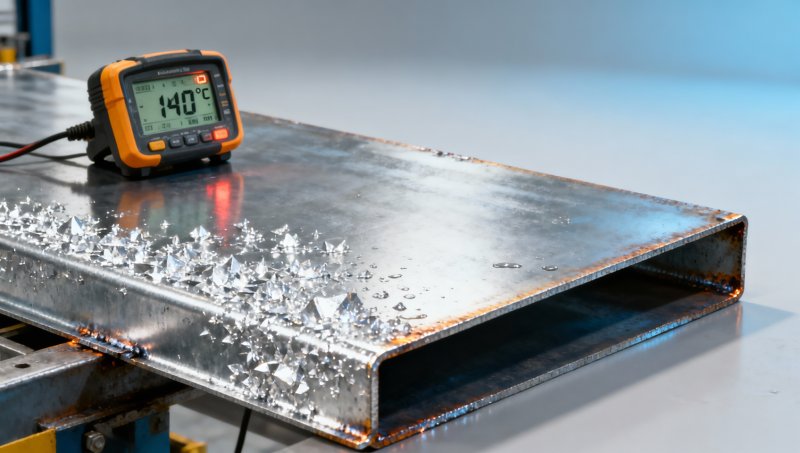
Preheating mitigates this by reducing the thermal gradient between weld zone and base metal. A uniform preheat of 120–180°C (measured 50mm from weld line) lowers peak cooling rates by up to 40%, allowing zinc layers to reflow partially and minimizing interfacial stress buildup. This is especially critical when joining ASTM A123/A153–compliant galvanized plates to structural members like H-beams or channel steel.
At Hongteng Fengda, our preheat recommendations follow EN ISO 13920 and AWS D1.1 guidelines—and are validated across 3,200+ tons of annual galvanized plate shipments to North America and EU markets. We embed these parameters directly into OEM fabrication drawings and provide real-time thermal monitoring support for clients’ on-site welding supervisors.
How Preheat Temperature Impacts Distortion & Coating Integrity
Choosing the right preheat range isn’t just about avoiding warpage—it’s about balancing metallurgical safety and coating performance. Excessive heat (>200°C) risks zinc oxide fume generation (OSHA PEL: 5 mg/m³), while insufficient preheat (<100°C) fails to suppress residual stress accumulation.
Our lab-tested data shows optimal results within a narrow window:
Note: All values reflect average outcomes across 12mm–25mm ASTM A653 G90 galvanized plate welded with FCAW-G process at 1.8–2.2 kJ/mm energy input. Hongteng Fengda provides preheat validation reports upon request—including thermographic imaging logs and post-weld dimensional survey data.
Preheat Integration in Real-World Fabrication Workflows
Integrating preheat isn’t theoretical—it requires synchronization across procurement, QA, and field execution. At Hongteng Fengda, we align preheat planning with three operational checkpoints:
- Procurement Stage: Buyers receive preheat requirements alongside material certs—e.g., “EN 10346 DX54D+Z 275 g/m², preheat: 140±10°C prior to SMAW” — embedded in PO specifications.
- QA Documentation: Every shipment includes a Preheat Compliance Sheet listing max/min surface temps, dwell time (≥15 min), and IR thermometer calibration traceability (NIST-traceable).
- Field Support: Our technical team offers remote thermal mapping via smartphone-connected IR cameras, with live feedback loops during first-article welds.
This integrated approach reduces rework by an average of 37% across 28 client projects in the Middle East and Southeast Asia—cutting schedule delays from 5.2 days to under 3.4 days per fabrication batch.
For applications requiring extreme corrosion resistance in aggressive environments—such as offshore chemical processing or desalination plants—we recommend pairing preheated galvanized structural components with 316 Stainless steel pipe for critical fluid conveyance lines. Its superior pitting resistance (PREN ≥25) complements galvanized steel’s cost-efficient bulk protection.
What Buyers Should Verify Before Sourcing Preheated Galvanized Plate
Procurement and engineering teams must go beyond spec sheets. Here are five non-negotiable verification points:
- Confirm preheat temperature is measured *on the base metal*, not the zinc surface—zinc emissivity skews IR readings by up to 25°C.
- Validate that preheat dwell time covers full cross-section heating—not just surface warmth—using thermocouples at ¼-thickness depth.
- Require documented proof of post-weld distortion control: ≤0.8mm/m flatness for plates ≥16mm (per EN 1090-2 EXC3).
- Check if preheat protocol includes interpass temperature limits—critical for multi-pass welds on 20mm+ sections.
- Ensure compatibility with downstream processes: e.g., hot-dip galvanizing after welding requires post-weld stress relief at 600–650°C, which invalidates low-temp preheat benefits.
Hongteng Fengda delivers all five verifications as standard. Our QA reports include digital thermal maps, dimensional inspection records, and third-party NDT summaries—all available before shipment.
Why Partner With Hongteng Fengda for Preheated Structural Steel Solutions
Global buyers choose us because we treat preheating not as an isolated step—but as a system-level capability embedded in every phase:
- Engineering Alignment: Our welding engineers co-develop preheat specs with your design team—ensuring compliance with ASTM A6/A6M, EN 10025-2, and project-specific EPC requirements.
- Production Scalability: 120,000+ tons/year capacity enables consistent preheat execution across batches—from 5-ton pilot orders to 500-ton project deliveries—with ≤7-day lead time for standard sizes.
- Risk Mitigation: We absorb preheat-related rework costs if dimensional deviations exceed agreed tolerances—backed by contractual SLA clauses.
- End-to-End Traceability: Each coil/plate carries QR-coded traceability linking raw material mill certs, preheat logs, weld procedure qualifications (WPQR), and final inspection reports.
Ready to optimize your next galvanized structural project? Contact us today for preheat protocol review, dimensional tolerance consultation, custom OEM documentation packages, or sample validation kits—including preheated test coupons with certified thermal history logs.
Please give us a message


Please enter what you want to find