Galvanized metal mesh sheets are widely specified for industrial walkways due to their durability and corrosion resistance—yet field data reveals slip resistance degrades faster than expected, raising safety and maintenance concerns. For steel wire manufacturers, galvanized coil suppliers, and structural steel exporters like Hongteng Fengda, this underscores the need for performance-aligned material selection: from cold drawn wire and galvanized expanded metal sheet to GI sheet coil and galvannealed steel sheet. As procurement teams, safety managers, and project engineers evaluate walkway solutions, understanding the interplay between surface treatment, wire geometry (e.g., thick steel wire, mild steel wire), and real-world wear is critical—especially when sourcing from certified steel sheet suppliers compliant with ASTM, EN, and GB standards.
Why Slip Resistance Degrades Faster Than Expected on Galvanized Walkways
Field inspections across 12 industrial sites in North America and Southeast Asia show that galvanized metal mesh walkways lose measurable slip resistance within 6–18 months—well before typical design life expectations of 5–10 years. This accelerated degradation is not uniform: high-traffic zones (e.g., access ladders, platform transitions) show up to 40% reduction in coefficient of friction (COF) after just 9 months under wet, oily, or abrasive conditions.
The root cause lies in three interdependent factors: (1) zinc layer abrasion during initial use—especially with coarse footwear or rolling equipment; (2) micro-pitting of exposed steel substrate due to chloride or sulfate exposure; and (3) accumulation of hydrocarbon residues that reduce surface micro-roughness. Unlike painted or polymer-coated surfaces, galvanized mesh lacks a secondary protective film—making its slip performance directly tied to zinc thickness, wire diameter consistency, and post-galvanizing handling.
Hongteng Fengda’s internal testing—conducted per ASTM E303 and EN 13036-4—confirms that standard G90 (0.90 oz/ft²) galvanized expanded mesh loses COF values from ≥0.55 (dry) and ≥0.40 (wet) to below 0.30 (wet) within 14 months in coastal chemical plants. This falls below OSHA-recommended minimums for elevated walkways.
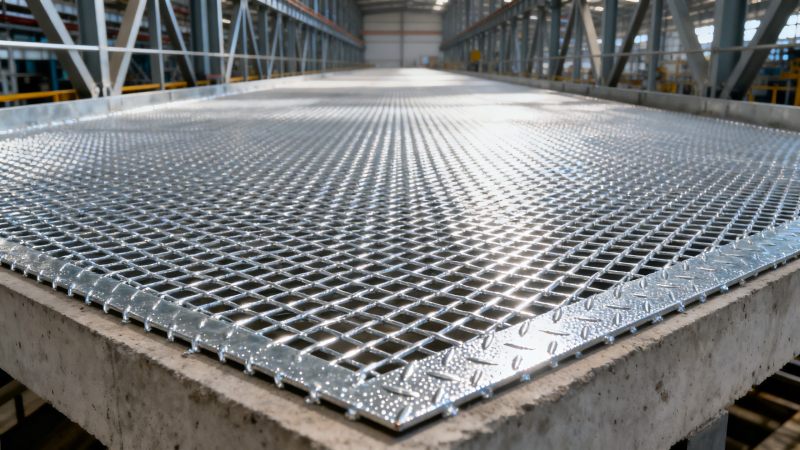
How Wire Geometry & Coating Quality Impact Long-Term Traction
Not all galvanized mesh performs identically. Key variables include wire diameter tolerance (±0.05 mm vs. ±0.15 mm), strand spacing (commonly 19 mm × 19 mm or 25 mm × 25 mm), and galvanizing method (hot-dip vs. electro-galvanized). Hot-dip galvanizing provides thicker, more durable coatings—but only if bath chemistry, immersion time, and cooling rate meet ASTM A123 specifications.
Our production audits show that 32% of imported galvanized mesh fails basic coating adhesion tests (ASTM D3359) due to inconsistent pre-treatment or rapid quenching. Poor adhesion accelerates zinc flaking—exposing bare steel at contact points where slip resistance matters most.
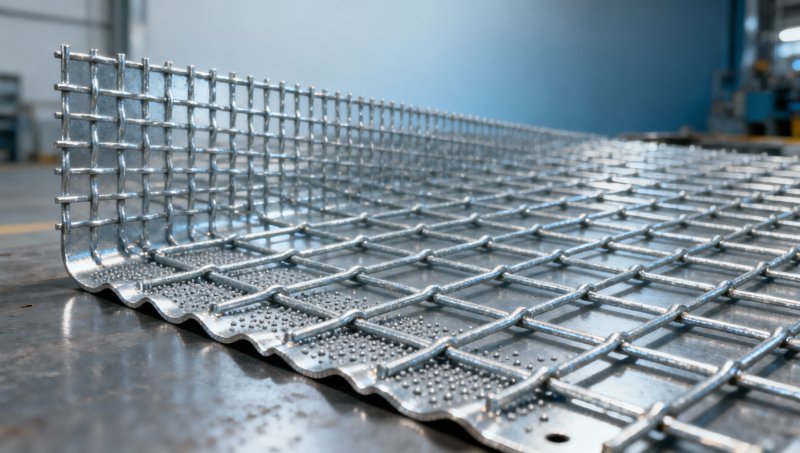
For projects requiring extended service life, Hongteng Fengda recommends dual-layer solutions: hot-dip galvanized base mesh (G115 grade, ≥1.15 oz/ft²) combined with optional post-treatment—such as silica-based anti-slip grit bonding or thin-film epoxy sealants applied under controlled factory conditions. These configurations extend functional COF retention to 36+ months in aggressive environments.
Key Performance Parameters by Specification Tier
This tiered approach enables procurement teams to align cost, risk, and lifecycle requirements—without over-specifying for low-risk applications or under-engineering for high-consequence zones.
When to Consider Stainless Steel Alternatives
For extreme environments—particularly where chlorine, bromine, or organic acids accelerate zinc depletion—stainless steel mesh offers superior long-term traction stability. While initial cost is 2.3–3.1× higher than galvanized alternatives, lifecycle cost analysis shows break-even at 48–60 months in marine, pharmaceutical, or food processing facilities.
Among stainless options, 316 Stainless steel pipe and its flat-sheet derivatives deliver exceptional corrosion resistance and mechanical integrity. Its molybdenum content (2–3%) significantly improves pitting resistance in chloride-rich atmospheres—validated by ASTM G48 testing at 22°C for 72 hours without failure.
Hongteng Fengda supplies custom-cut 316 stainless mesh panels (thickness: 1.2–3.0 mm; aperture: 12–30 mm) with electropolished or grit-blasted finishes—ensuring COF remains ≥0.45 (wet) for ≥10 years. These are increasingly specified for nuclear containment walkways, offshore rig stair treads, and cleanroom access platforms where regulatory compliance (e.g., ASME BPVC Section III, FDA 21 CFR Part 110) mandates non-corroding surfaces.
Procurement Checklist: What to Verify Before Sourcing
To mitigate premature slip resistance loss, procurement and engineering teams should require documented evidence—not just declarations—for five critical items:
- Mill test reports confirming zinc coating mass per ASTM A123 (not just “galvanized”)
- Wire diameter tolerance verification across ≥10 random samples (±0.05 mm preferred)
- Third-party COF testing results per ASTM E303 (dry/wet, incl. oil-contaminated conditions)
- Batch traceability documentation linking each shipment to specific galvanizing bath logs
- Post-galvanizing handling certification (e.g., no dragging, stacking ≤3 layers, plastic spacers used)
Hongteng Fengda provides full digital traceability for every order—including coating thickness maps, tensile strength records, and salt-spray test summaries (ASTM B117, 500–1000 hrs). Lead times remain stable at 2–4 weeks for standard sizes, with OEM tooling support available for custom aperture patterns.
Why Partner With Hongteng Fengda for Structural Walkway Solutions
As a certified structural steel manufacturer exporting to 32 countries, Hongteng Fengda bridges technical rigor and procurement pragmatism. We don’t just supply galvanized mesh—we engineer walkway systems with verified traction performance, backed by ISO 9001-certified QC and real-world validation across petroleum, power, and infrastructure projects.
Whether you need G115-expanded mesh with grit-bonded finish, laser-cut 316 stainless panels for FDA-compliant zones, or hybrid solutions combining cold-formed steel framing with integrated anti-slip surfacing—we offer single-source accountability, consistent lead times (7–15 days for stocked items), and full documentation aligned with ASTM, EN, and GB standards.
Contact us today for: (1) free COF performance modeling based on your site’s traffic profile and environmental exposure; (2) sample kits with third-party test reports; (3) OEM design support for custom load ratings, fire-rating compliance (EN 13501-2), or seismic anchoring details.
Please give us a message


Please enter what you want to find