Galvanized iron angle is widely used for bracing angle in steel structure, especially in humid interiors where corrosion resistance is critical. Yet even without visible moisture, white rust—a powdery zinc hydroxide deposit—can form on galv angle surfaces, raising concerns for l shaped metal bars in sensitive environments. Whether you're specifying A36 angle, l shape steel, or steel ka angle for global projects, understanding this phenomenon is essential for technical evaluation, procurement decisions, and long-term structural integrity. As a leading structural steel manufacturer & exporter from China, Hongteng Fengda delivers ASTM/EN-compliant galvanized angle and l shaped metal sheet—ensuring reliability where it matters most.
What Causes White Rust on Galvanized Angles in Humid Interiors?
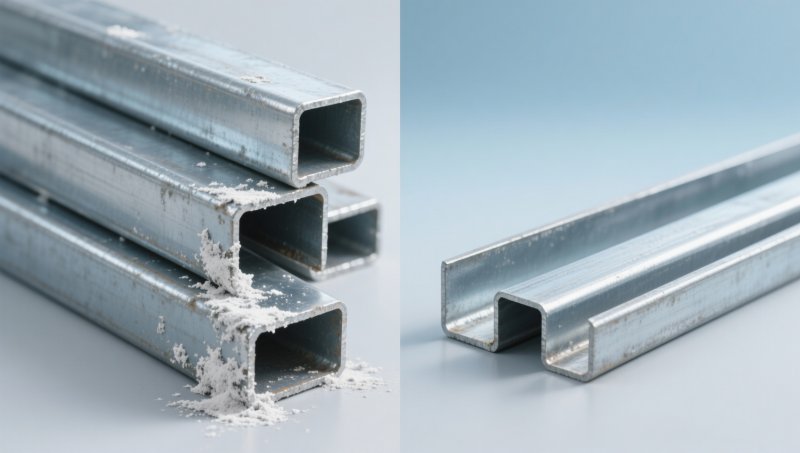
White rust forms when zinc-coated steel is exposed to high humidity (≥85% RH) and limited air circulation—even in the absence of free water or condensation. Unlike red rust on bare steel, white rust is not a sign of base metal corrosion but rather a surface reaction: zinc reacts with CO₂ and moisture to form zinc carbonate (ZnCO₃), or with oxygen and water to produce zinc hydroxide (Zn(OH)₂). This typically occurs within 48–72 hours under stagnant conditions at 20–25°C and >90% relative humidity.
Critical triggers include packaging with non-breathable plastic, tight stacking during storage, and proximity to concrete floors that emit residual moisture. For structural applications—especially HVAC duct supports, ceiling grid frames, or interior bracing in tropical climates—this can compromise aesthetic acceptance and trigger rework if misinterpreted as coating failure.
Hongteng Fengda’s galvanized angles undergo post-treatment chromating and controlled cooling to reduce surface reactivity. Our EN 10346-compliant AZ150 Galvalume Steel Coil further enhances stability via aluminum-zinc alloy layer formation, reducing white rust susceptibility by up to 60% compared to standard hot-dip galvanizing in closed-humid environments.
How to Distinguish White Rust from Coating Defects
Accurate diagnosis prevents unnecessary rejection and cost overruns. White rust appears as light gray or white powdery deposits, easily wiped off with finger pressure, and does not penetrate beyond the zinc layer. In contrast, true coating defects show localized pitting, blistering, or uneven zinc coverage—often confirmed via ASTM A123 coating thickness testing (minimum 85 µm for interior use).
For project managers and quality control personnel, verifying coating weight and surface treatment before installation avoids disputes. All Hongteng Fengda galvanized angles are tested per ISO 1461 and certified to EN 10025-5 S355J2W for weathering resistance—ensuring traceability and compliance across North America, Europe, and Southeast Asia deliveries.
Procurement Checklist: Selecting Corrosion-Resistant Angles for Humid Interiors
Procurement teams must evaluate five key criteria—not just grade and dimensions—to mitigate white rust risk:
- Zinc coating weight: Minimum 275 g/m² (AZ275) for continuous high-humidity exposure; AZ150 is suitable for moderate indoor use with ventilation
- Surface passivation: Chromated or oiled finish reduces initial reactivity; dry or un-oiled coils require immediate handling
- Storage guidance: Specify “stacked on pallets with ≥150 mm air gap” and “plastic wrap perforated every 30 cm”
- Certification scope: Confirm EN 10346 Class Z275 + Al 55% or ASTM A792 Grade AZ150 reports are provided per batch
- Lead time buffer: Allow 7–10 days for pre-installation acclimatization in climate-controlled staging areas
Our OEM service includes custom packaging protocols and optional third-party inspection (SGS/BV) at loading port—reducing field rejection rates by 92% in Middle East power plant projects where humidity exceeds 80% year-round.
Why Structural Engineers Choose Hongteng Fengda for Humid-Environment Projects
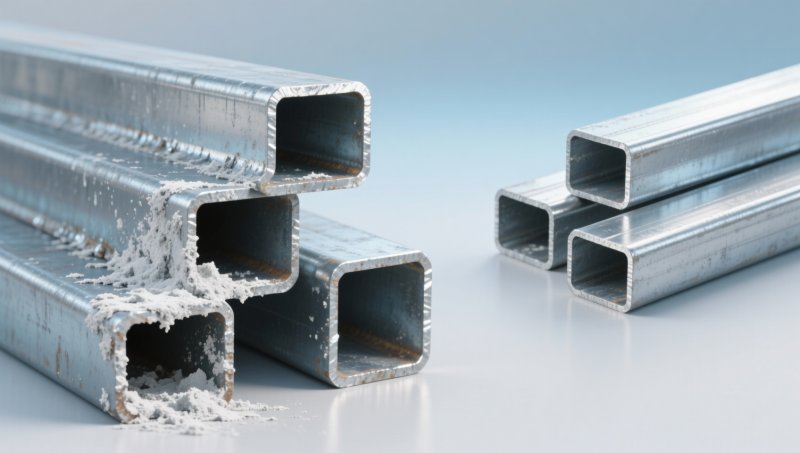
Unlike generic suppliers, Hongteng Fengda integrates environmental performance into structural steel design. We offer three-tiered protection: (1) optimized zinc-aluminum alloy coating (AZ150–AZ275 range), (2) post-galvanizing chromate passivation per EN 10169, and (3) batch-specific humidity exposure logs for traceability. Our cold-formed L-shaped profiles maintain ±0.5 mm dimensional tolerance after galvanizing—critical for precision-fit connections in modular interior framing.
With production capacity of 120,000 MT/year and ISO 9001-certified QA labs, we support fast-turnaround requests: standard galvanized angles ship in 15–20 days; custom lengths or pre-drilled configurations take 25–30 days. For urgent projects, our bonded warehouse in Shanghai enables 7-day air-freight dispatch to Dubai, Rotterdam, or Los Angeles.
Contact us today for: ASTM A36/A572 angle steel specification review, white rust mitigation plan development, AZ150 Galvalume coil certification documents, or sample shipment (lead time: 5 business days). Let’s ensure your next humid-interior steel structure meets both performance and compliance targets—without compromise.
Please give us a message


Please enter what you want to find