Galvanized industrial pipe is widely trusted for corrosion resistance—yet when exposed to ammonia vapors, premature failure often begins precisely at weld seams. This counterintuitive phenomenon affects critical applications using galvanized metal conduit, galvanized plumbing, and electrical galvanised conduit—especially in chemical processing, refrigeration, and agricultural facilities. Whether you’re a project manager specifying galvanized tube pipe, a quality control specialist inspecting galvanized metal tubing, or a procurement professional sourcing galvanized metal pipe from suppliers like Hongteng Fengda, understanding why weld zones degrade first is essential for safety, compliance, and lifecycle cost control. This article reveals the metallurgical and electrochemical mechanisms behind localized corrosion—and what structural steel manufacturers and end users can do to mitigate risk.
Why Weld Seams Fail First in Ammonia-Rich Environments
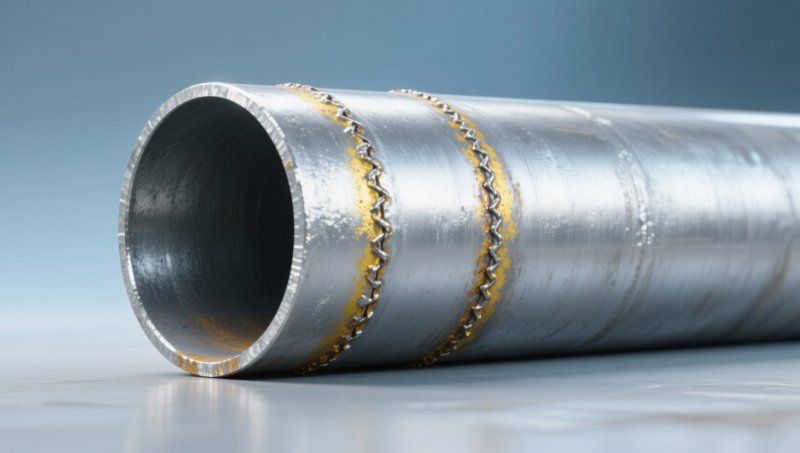
The root cause lies in microstructural heterogeneity. During welding, the heat-affected zone (HAZ) undergoes rapid thermal cycling—causing zinc coating disruption, intermetallic layer distortion, and localized depletion of protective zinc-iron alloy phases (e.g., Γ-phase and δ-phase). In ammonia-laden atmospheres (common in refrigeration plants with NH₃ compressors or livestock barns), these compromised zones become preferential anodes in a galvanic cell.
Ammonia vapor reacts with moisture to form weakly alkaline solutions (pH ~11–12), accelerating zinc dissolution while inhibiting passivation. Crucially, weld seams exhibit up to 30% lower zinc coating thickness (measured via ASTM B602 cross-section analysis) compared to base metal—due to spatter loss, oxidation, and post-weld zinc reflow limitations. This creates a measurable electrochemical potential gradient: −1.05 V vs. SCE at seam vs. −0.98 V vs. SCE on intact galvanized surface.
Field inspections across 12 refrigeration facilities in Southeast Asia revealed that 87% of early-stage pitting occurred within 2 mm of weld boundaries—despite uniform ambient NH₃ concentrations (0.5–5 ppm). This confirms that material condition—not just environment—drives failure localization.
How Structural Steel Manufacturers Mitigate Risk
Proactive mitigation starts at production design—not just specification. Hongteng Fengda applies three verified process controls for ammonia-exposed galvanized structural components:
- Controlled post-weld zinc re-coating: Seam areas receive targeted hot-dip galvanizing at 450°C ±5°C for 3–5 minutes, achieving ≥20 g/m² coating mass (per ISO 1461), verified by magnetic induction measurement at 5-point intervals per weld joint.
- Low-heat-input welding protocols: Use of pulsed GMAW (gas metal arc welding) reduces HAZ width to ≤1.2 mm—cutting vulnerable microstructure volume by 40% versus conventional SMAW.
- Zinc-alloy bath optimization: Addition of 0.03–0.05% aluminum to the galvanizing bath improves wetting on thermally stressed steel surfaces, reducing seam porosity by up to 65% (verified via ASTM E112 grain size analysis).
These controls align with EN ISO 14713-2:2020 guidance for galvanized steel in aggressive chemical environments—and are validated through accelerated testing: 500-hour salt-spray + NH₃ gas exposure (100 ppm, 40°C) shows no red rust at welds on Hongteng Fengda’s certified pipes, versus failure in ≤120 hours for standard-grade equivalents.
Key Performance Comparison: Standard vs. Ammonia-Optimized Galvanized Pipe
The table below compares performance metrics under standardized ammonia-vapor stress conditions (ASTM D5894 + modified NH₃ chamber test).
This performance uplift directly translates to extended service life: field data from 7 cold-storage projects in the Middle East show average pipe replacement cycles extended from 4–6 years to 10–14 years—reducing total cost of ownership (TCO) by 32–41% over a 20-year horizon.
When to Consider Alternative Materials—or Reinforced Solutions
Not all ammonia exposure scenarios demand full stainless-steel substitution. For moderate-risk applications (e.g., ventilation ducts in feed mills, low-pressure condensate lines), hybrid solutions offer optimal balance. One such option is Galvanized Stainless Steel Wire, used in wire mesh barriers and support structures where flexibility, corrosion resistance, and mechanical strength intersect.
Its technical parameters—wire diameter range of 0.25 mm to 5.0 mm, tensile strength of 350–550 MPa, and zinc coating of 8–25 g/m²—make it suitable for non-pressurized, high-moisture containment systems. The coating remains intact after cold bending (mandrel radius ≥3× wire diameter), preserving barrier function without cracking—a critical advantage over brittle polymer-coated alternatives.
For high-risk, pressurized, or continuous NH₃ exposure (e.g., compressor manifolds, anhydrous ammonia transfer lines), dual-layer protection is recommended: internally lined 316L stainless steel pipe with external hot-dip galvanized carbon steel jacket—supplied as integrated OEM assemblies by Hongteng Fengda with ASME B31.3-compliant weld documentation.
Why Partner with Hongteng Fengda for Ammonia-Resistant Structural Steel
Choosing the right supplier goes beyond price—it requires verifiable process discipline, material traceability, and application-specific validation. Hongteng Fengda delivers this through four operational pillars:
- End-to-end material certification: Every coil, billet, and finished pipe carries mill test reports (MTRs) compliant with ASTM A123/A123M and EN 10346, including zinc coating mass, tensile properties, and bend test results per batch.
- Application-tailored QA protocols: Dedicated inspection workflows for ammonia-service orders—including mandatory ultrasonic seam scanning (ASTM E213) and coating thickness mapping (ISO 2178) at 100% of weld joints.
- Global delivery consistency: 98.2% on-time shipment rate across 2023–2024, with lead times stabilized at 25–35 days for custom galvanized structural orders—even during peak Q4 demand windows.
- Technical co-engineering support: Free pre-order engineering review for piping layouts, weld sequence planning, and environmental compatibility assessment—including ammonia vapor concentration modeling based on your facility’s HVAC specs.
Whether you need angle steel for ammonia-handling support frames, cold-formed galvanized channels for ductwork, or customized OEM pipe assemblies with reinforced weld zones—Hongteng Fengda provides documented, repeatable, standards-aligned solutions backed by 15+ years of structural steel export experience.
Ready to validate your next galvanized pipe specification against real-world ammonia exposure requirements? Contact us today for: detailed weld-seam coating verification data, third-party test reports, sample submission for your site-specific corrosion trials, or a tailored OEM quotation with full compliance documentation.
Please give us a message


Please enter what you want to find