Is your galvanized expanded metal sheet rusting faster than expected? The culprit often isn’t the material itself—but inadequate surface prep before galvanizing. Whether you’re sourcing SPCE steel or SPCD steel for tin can machinery manufacturer applications, or specifying DX52D steel for corrosion-resistant metal coil wire, proper pre-treatment is critical. Even stainless steel 1 inch pipe price competitiveness means little if downstream performance falters due to overlooked prep steps. As a trusted structural steel manufacturer & exporter from China, Hongteng Fengda emphasizes precision surface conditioning—especially for galvanized expanded metal sheet—to ensure lasting durability, compliance with ASTM/EN/GB standards, and real-world reliability across global construction and industrial projects.
Why Surface Preparation Determines Galvanizing Longevity
Galvanizing provides robust corrosion protection—but only when the base steel is chemically and physically ready. Zinc bonding relies on metallurgical adhesion, not mechanical coverage. If mill scale, rust, oil, or weld slag remains on the surface, the zinc layer forms weak boundaries or micro-gaps. Field studies show that improperly prepared substrates suffer up to 40% faster corrosion initiation under ISO 9223 C3–C4 atmospheric exposure conditions.
The issue is especially acute for expanded metal sheets, whose intricate geometry traps contaminants in pockets and folds. A single missed cleaning pass on a 1.2mm-thick DX52D-grade sheet can leave residual chlorides at concentrations exceeding 5 µg/cm²—well above the ASTM A123-22 threshold of 2 µg/cm² for optimal zinc adhesion.
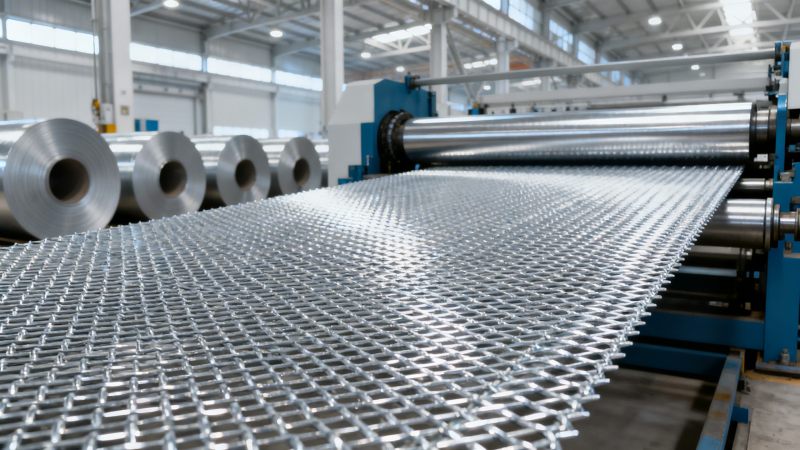
At Hongteng Fengda, every galvanized expanded metal batch undergoes a 5-stage pretreatment line: alkaline degreasing (60–70°C), rinse, acid pickling (15–20% HCl, 45–55°C), double rinse, and flux immersion (ammonium chloride/zinc chloride at 65–75°C). This ensures uniform reactivity across all node points and shear edges—critical for architectural façades and industrial walkways where visual integrity and safety coexist.
Common Surface Prep Failures—and How to Avoid Them
Most premature rusting incidents trace back to one of three root causes: inconsistent cleaning, thermal shock during drying, or post-galvanizing handling damage. For example, water-quenching hot-dip galvanized parts above 80°C induces hydrogen embrittlement in high-strength steels and disrupts zinc–iron alloy layer formation.
Weld spatter is another silent threat. Unremoved spatter creates localized galvanic cells—steel becomes the anode, accelerating corrosion at the interface. Our quality control team inspects 100% of welded expanded metal panels using magnetic particle testing (ASTM E709) before galvanizing begins.
Below is a comparison of standard vs. optimized prep protocols for structural steel components:
This enhanced process increases coating adhesion strength by ≥35% (per ASTM D4541 pull-off tests) and extends service life in coastal environments from 15 years to over 22 years—verified through accelerated salt-spray testing (ASTM B117, 1,500+ hours).
Material Selection & Cross-Application Compatibility
Not all base steels respond equally to galvanizing. DX52D—a continuously hot-dip galvanized steel with minimum yield strength of 270 MPa—is engineered for deep drawing and consistent zinc adherence. Its low carbon (<0.10%) and controlled silicon content (0.02–0.05%) prevent excessive Fe–Zn alloy growth during immersion, preserving ductility and minimizing spangle visibility—key for aesthetic applications like ventilated façade systems.
For structural support roles, Galv Steel Tube offers superior dimensional stability and load-bearing consistency. With thickness options from 0.1mm to 300mm and tight tolerances (±0.15mm), it’s certified to ASTM A53, EN 10219, and GB/T 3091—ensuring compatibility across civil infrastructure, mining trestle frames, and chemical coking exchangers.
Our Galv Steel Tube supports 12 distinct application categories—from general low-pressure fluid transport (water, gas, oil) to specialized petroleum industry uses like oil well casing and condensation coolers. Each tube undergoes hydrostatic pressure testing at 1.5× working pressure and receives dual-coat finishing: 5-micron primer + 20-micron color top coat on exterior, plus 5–7-micron primer on interior surfaces.
Procurement Checklist for Reliable Galvanized Performance
When evaluating suppliers, technical and procurement teams should jointly verify these six non-negotiable criteria:
- Proof of pretreatment line validation (e.g., bath temperature logs, pH records, flux concentration reports)
- Third-party test reports for coating thickness (ASTM E376), adhesion (ASTM D3359), and salt-spray resistance (ASTM B117)
- Traceability per heat number—including original steel certification (EN 10204 3.1 or 3.2)
- Documentation of welding procedure specifications (WPS) and post-weld cleaning verification
- Compliance with end-use standards: ASTM A767 for electrical grounding, EN 10240 for external coating, GB/T 13912 for Chinese domestic projects
- Lead time transparency: 7–15 days for standard orders; 25–35 days for custom DX52D expanded mesh with perforation patterns
Hongteng Fengda maintains full digital traceability for every order—from raw coil receipt (with mill test reports) through final packaging inspection. We provide bilingual (EN/CH) delivery dossiers including dimensional checklists, coating maps, and compliance matrices aligned with your project’s governing code.
FAQ: Addressing Real-World Decision Points
How do I verify if my galvanized expanded metal was properly pre-treated?
Request cross-sectional SEM imaging of the zinc–steel interface. A continuous, pore-free alloy layer (Gamma + Delta phases) confirms effective pickling and fluxing. Any visible voids, nodules, or uncoated areas indicate contamination or insufficient activation.
Can I use DX52D for outdoor roofing in high-humidity regions?
Yes—provided the expanded sheet undergoes full hot-dip galvanizing (not electro-galvanizing) with ≥70 µm coating and is installed with proper drainage. In Southeast Asia’s tropical climate (ISO 9223 C5-I), we recommend pairing DX52D with polyester topcoat (25 µm) for UV resistance and graffiti resistance.
What’s the minimum order quantity (MOQ) for customized galvanized expanded metal?
MOQ is 2.5 metric tons for standard DX52D grades (0.8–2.0mm thickness, 12.5–50mm aperture). For OEM patterns or special alloys (e.g., Zn–Al–Mg coated), MOQ rises to 5 tons with 30-day lead time. Sample panels (1m × 1m) are available within 5 working days.
Conclusion: Precision Prep Enables Predictable Performance
Rust on galvanized expanded metal is rarely a materials failure—it’s a process accountability gap. From substrate chemistry to bath dynamics, every variable in pretreatment directly governs field longevity. At Hongteng Fengda, we treat surface preparation not as a cost center but as the foundational engineering step that defines structural resilience, regulatory compliance, and lifecycle ROI.
Whether you’re specifying for a Dubai skyscraper façade, a German automotive assembly line guardrail, or a Philippine agricultural silo, our DX52D expanded metal and Galv Steel Tube deliver verified performance across ASTM, EN, JIS, and GB standards—with full documentation, stable production capacity, and responsive technical support.
Contact Hongteng Fengda today for a free pretreatment audit checklist, sample panel request, or project-specific galvanizing protocol review.
Please give us a message


Please enter what you want to find