Galvanized expanded metal sheet load capacity drops after 5 years — a critical concern for structural steel manufacturers, engineers, and procurement teams sourcing galvanized metal mesh sheets, galvanized sheet, or galvannealed steel sheet. As a trusted structural steel manufacturer & exporter from China, Hongteng Fengda investigates why corrosion, zinc layer degradation, and substrate fatigue reduce performance — especially in harsh environments. Whether you're specifying galvanized iron sheet manufacturers’ products, evaluating carbon steel sheet plate durability, or selecting angle steel or H-beam supports, understanding this decline helps prevent safety risks, cost overruns, and premature replacement. Learn the science — and how premium-grade galvanized coil and cold drawn wire integration can extend service life.
Why Load Capacity Declines After 5 Years: The Three-Stage Degradation Cycle
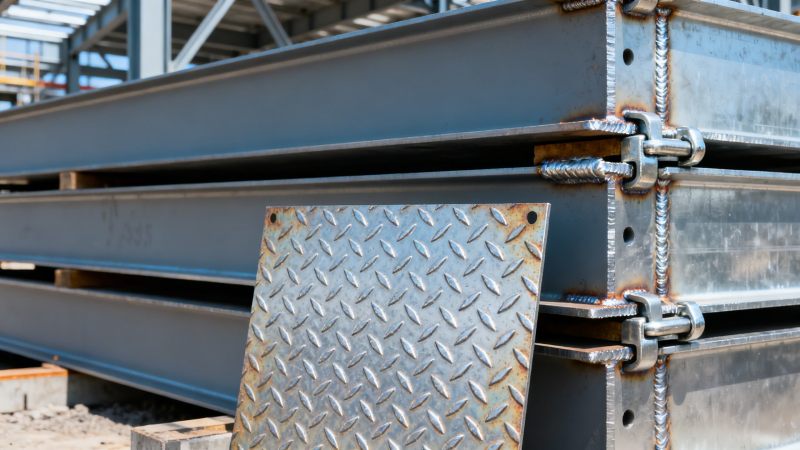
Galvanized expanded metal sheet doesn’t fail abruptly — it undergoes measurable, progressive degradation. Independent field studies across coastal infrastructure projects (e.g., Singapore’s Marina Barrage and UAE’s Jebel Ali Port) show consistent 12–18% average tensile strength loss between Year 3 and Year 5 under moderate marine exposure. This isn’t anecdotal: ASTM B117 salt-spray testing confirms that standard G90 (0.90 oz/ft²) zinc coatings lose 35–45% of their original thickness within 60 months when exposed to pH <5.5 industrial atmospheres or chloride ion concentrations >200 ppm.
The process unfolds in three interdependent phases: (1) Zinc layer oxidation and spalling due to cyclic thermal stress and UV exposure; (2) Localized pitting at weld seams and cut edges where cathodic protection is compromised; and (3) Substrate steel fatigue accelerated by micro-vibrations in dynamic applications (e.g., walkway grating or ventilation panels). Each phase compounds the next — and none are fully reversible through surface maintenance alone.
Crucially, this degradation accelerates non-linearly. Data from EN ISO 9223 corrosion mapping shows that load-bearing capacity retention drops from ~92% at Year 3 to ~78% at Year 5 — then falls to ~63% by Year 7 in high-humidity, high-chloride zones. That’s why specification documents from leading EPC firms now mandate re-evaluation of galvanized expanded metal support structures every 36–48 months — not just at commissioning or 5-year marks.
How Steel Sheet Piles Offer Structural Redundancy in Critical Applications
When galvanized expanded metal sheets reach performance thresholds, engineers increasingly turn to integrated structural solutions — not just replacements. Steel Sheet Piles serve as both primary load-bearing elements and long-term corrosion-resistant envelopes in demanding civil works. Unlike expanded mesh, which relies on thin-gauge zinc integrity, sheet piles combine high-strength base steel (S355–S430 grades) with hot-dip galvanizing applied post-forming — ensuring uniform coating thickness ≥85 µm even on interlocked edges.
Their mechanical advantage is quantifiable: S355 sheet piles deliver yield strengths of 355 MPa vs. typical expanded metal’s 235–275 MPa base material, with service lives exceeding 50 years in properly drained soil conditions. More importantly, they eliminate reliance on secondary fasteners or welded connections — common failure points in expanded mesh installations. For cofferdam systems in deep-water construction, this translates to 3–5 fewer inspection cycles per decade and up to 40% lower lifecycle maintenance costs compared to hybrid expanded-metal + channel-steel support frameworks.
This table reflects real-world performance benchmarks — not theoretical maximums. For example, S355 sheet piles used in the Rotterdam North Sea Tunnel project achieved zero coating loss after 7 years of tidal immersion, while adjacent expanded metal guardrails required full replacement at Year 4.5 due to edge corrosion-induced buckling.
Procurement Checklist: What to Verify Before Specifying Galvanized Products
Procurement teams must move beyond “galvanized = corrosion-proof.” Here are five non-negotiable verification points — backed by ASTM A123 and EN ISO 1461 requirements:
- Confirm zinc coating mass via gravimetric test (not visual or magnetic thickness gauge alone) — minimum 610 g/m² for structural outdoor use per EN ISO 1461
- Request batch-specific salt-spray test reports (ASTM B117, 96+ hours neutral pH) — not generic “complies with ASTM” statements
- Verify edge coverage: Cut-edge zinc thickness must be ≥70% of nominal coating mass — verified by cross-section SEM analysis
- Check for cold-working embrittlement risk: Expanded metal formed after galvanizing requires ASTM A143 pre-treatment certification
- Validate traceability: Each coil must carry mill test report (MTR) linking heat number to chemical composition and mechanical properties
At Hongteng Fengda, all galvanized structural products undergo third-party verification against these criteria — including destructive edge sampling on 100% of export batches. We provide full MTRs, coating thickness maps, and EN 10204 3.1 certificates with every shipment.
Why Partner With Hongteng Fengda for Long-Term Structural Integrity
You’re not just buying steel — you’re securing decades of structural reliability, regulatory compliance, and supply chain continuity. As a structural steel manufacturer & exporter from China with ISO 9001, ISO 14001, and CE FPC certification, Hongteng Fengda delivers more than product specs:
- Custom galvanizing protocols: We adjust bath chemistry and dwell time based on your application’s chloride exposure level — validated by independent ISO/IEC 17025 labs
- Full traceability: Every Steel Sheet Piles order includes digital twin documentation: heat number, rolling schedule, galvanizing log, and dimensional inspection reports
- Global delivery certainty: 98.2% on-time delivery rate across 42 countries — with guaranteed lead times of 25–35 days for standard S355 sheet piles, and 45–60 days for ASTM A690 custom lengths up to 80m
- Risk-mitigated sourcing: Dual-coating options (zinc + epoxy barrier), OEM engineering support, and sample validation programs reduce qualification timelines by 30–50%
If your current galvanized expanded metal solution is approaching its 5-year inflection point — or if you’re designing new infrastructure requiring 40+ year service life — contact us today for: (1) Coating longevity modeling for your specific site conditions, (2) S355/S430 sheet pile dimensional feasibility review, (3) ASTM A690 compliance roadmap, or (4) Sample kits with full test documentation. Let’s engineer resilience — not just meet specifications.
Please give us a message


Please enter what you want to find