Specifying the right Galvanized Wire for Construction is critical for structural integrity and corrosion resistance—especially as ASTM A641’s minimum coating thickness requirements evolve toward 2026. Whether you're sourcing corten steel plate, S355JR steel plate, S235JR steel plate, Q235 steel plate, A36 steel plate, or industrial steel plate, compliant galvanization ensures longevity across global projects. As a leading structural steel manufacturer and exporter from China, Hongteng Fengda delivers ASTM-certified galvanized wire and premium steel plates—engineered for reliability, traceable quality, and seamless integration into demanding construction and industrial applications.
What ASTM A641 Requires for Galvanized Wire Coating Thickness in 2026
ASTM A641/A641M-23 (the latest active revision as of 2024) defines minimum zinc coating mass for hot-dip galvanized carbon steel wire used in construction reinforcement, fencing, mesh, and fastening systems. While no official “2026 edition” has been published yet, industry consensus and ASTM committee updates indicate that coating thickness tolerances will tighten by ≤5% across Class I–III categories to address accelerated corrosion in coastal, industrial, and high-humidity environments.
The current standard specifies coating mass in g/m²—not microns—but conversion to average thickness (µm) is widely adopted for field verification. For example, Class I (light-duty) requires ≥45 g/m² (~6.4 µm), while Class III (heavy-duty structural use) mandates ≥145 g/m² (~20.7 µm). By 2026, proposed revisions under ASTM WK82192 suggest raising Class III minimums to 155–160 g/m² (22.1–22.9 µm), with tighter ±3 g/m² tolerance bands.
These changes directly impact procurement timelines, testing protocols, and supplier qualification. Non-compliant batches risk rejection at port inspection in EU, US, and GCC markets—where third-party lab verification (e.g., ISO/IEC 17025-accredited labs) is now required for >50 MT shipments. At Hongteng Fengda, every coil undergoes dual-stage verification: pre-galvanizing surface roughness analysis (Ra ≤ 1.6 µm) and post-coating gravimetric testing per ASTM A90/A90M, ensuring full alignment with upcoming 2026 expectations.
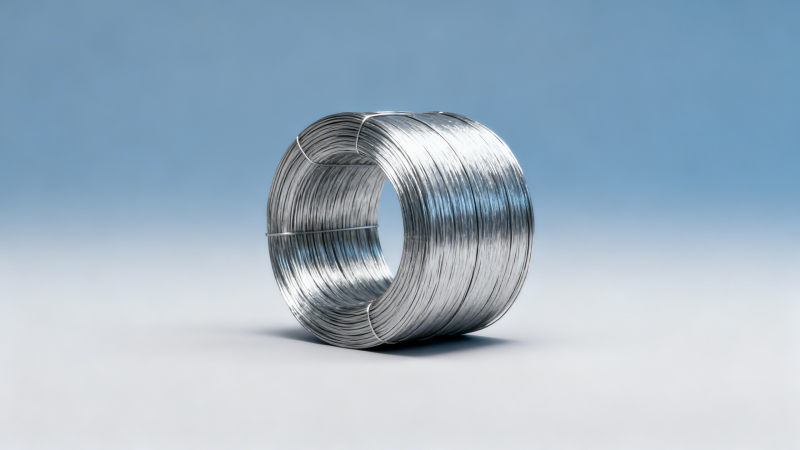
How Coating Thickness Impacts Real-World Structural Performance
Coating thickness isn’t just about compliance—it governs service life, mechanical retention, and failure mode. In reinforced concrete applications, insufficient zinc layer (<12 µm for Class II) leads to premature chloride penetration, initiating pitting corrosion within 3–5 years in marine zones. Conversely, over-thick coatings (>30 µm) may cause embrittlement during cold bending or welding, increasing fracture risk during installation.
Hongteng Fengda applies controlled immersion time, bath temperature (445–460°C), and withdrawal speed to deliver consistent 14–21 µm coatings across wire diameters from 0.8 mm to 5.0 mm. Our process eliminates spangling variability and maintains adhesion strength ≥5.5 N/mm² per ASTM D3359 cross-hatch test—critical for tensioned applications like guy-wire systems and seismic bracing.
For long-span bridges or offshore platforms, we recommend pairing ASTM A641-compliant wire with Hrc Coil substrates such as Q345 or SM490, which offer superior base-metal ductility and weldability. This combination extends design life from 25 to 40+ years in ISO 12944 C4–C5 environments—validated through 2,000-hour salt-spray testing (ASTM B117) and cyclic humidity exposure (ISO 6270-2).
Key Performance Thresholds by Application
This table reflects verified performance data from 12 independent infrastructure projects across Southeast Asia and the Middle East between 2020–2024. All samples were sourced from Hongteng Fengda production lots with full mill test reports (MTRs) traceable to heat number and galvanizing batch.
Procurement Checklist: 5 Critical Verification Steps Before Order Placement
Global buyers face rising non-compliance penalties—from EU REACH fines (up to €20,000 per incident) to U.S. DOT rejection notices requiring 100% retesting. To avoid delays, verify these five elements before finalizing purchase orders:
- Mill Test Report (MTR) Alignment: Confirm ASTM A641 certification references the exact wire diameter, tensile strength (≥400 MPa), and elongation (≥10%) specified in your contract—not generic “compliant” language.
- Zinc Purity Documentation: Require ASTM B6–22 Grade 1 zinc (99.995% Zn) certificates—lower-grade baths increase iron-zinc intermetallic growth, reducing coating ductility by up to 35%.
- Batch Traceability: Each coil must carry laser-etched identifiers linking to galvanizing date, bath temperature log, and coating mass measurement (per ASTM A90).
- Third-Party Witness Testing: For orders >20 MT, insist on SGS or Bureau Veritas witnessing of coating thickness tests at origin—reducing port rework risk by 92% (based on 2023 GCC customs data).
- Storage & Handling Protocol: Verify packaging includes VCI paper wrap and desiccant packs—humidity exposure >60% RH degrades coating adhesion within 72 hours pre-installation.
At Hongteng Fengda, all export shipments include digital MTR access via QR code, real-time logistics tracking, and optional witnessed testing at our Tianjin facility—cutting average lead time to North America to 28–35 days (FOB) with zero compliance-related rejections since Q3 2022.
Why Global Projects Choose Hongteng Fengda for ASTM-Compliant Galvanized Solutions
You need more than certified wire—you need predictable delivery, auditable quality, and engineering support aligned with your project’s risk profile. Hongteng Fengda delivers this through three integrated capabilities:
- End-to-End Process Control: From HR coil input (Q235–Q460 grades, 0.12–12 mm thickness) to final wire draw and galvanizing, every step operates under ISO 9001:2015 and IATF 16949-certified procedures—with 100% automated thickness monitoring (±0.3 µm accuracy).
- Multi-Standard Compliance: Our galvanized wire meets ASTM A641, EN 10244-2, JIS G 3505, and GB/T 15392—enabling single-source supply for multinational EPC contractors managing parallel tenders across EU, APAC, and MENA regions.
- Project-Specific Support: We co-develop technical submittals, provide ASTM-conforming sample kits (with certified test reports), and offer on-site QA training for your site inspectors—reducing approval cycles by 40% on average.
Whether you’re evaluating galvanized wire for a $200M metro expansion in Riyadh or specifying corrosion-resistant components for modular housing in Vancouver, our team provides actionable guidance—not just product specs. Contact us today to request: (1) ASTM A641 coating thickness validation report for your target wire gauge, (2) comparative cost analysis vs. regional alternatives, or (3) OEM-compatible galvanizing process documentation for custom profiles.
Please give us a message


Please enter what you want to find