When specifying Galvanized Steel Wire Rope 1470MPa to 1960MPa for critical lifting, suspension, or structural reinforcement applications, procurement managers and engineers often fixate on breaking load—yet fatigue performance under cyclic stress is equally decisive. As a trusted structural steel manufacturer & exporter from China, Hongteng Fengda emphasizes that real-world durability depends on galvanizing quality, wire rope lay consistency, and compliance with international standards for structural steel products. Whether you’re sourcing steel channel for construction projects, comparing ASTM A36 angle steel price per ton in Philippines, or evaluating MOQ requirements for structural steel orders, understanding fatigue drivers—not just tensile strength—is essential for safety, longevity, and total cost of ownership.
Why Fatigue Resistance Matters More Than Breaking Load in Structural Applications
Breaking load (e.g., 1470–1960 MPa) reflects static tensile capacity—but structural systems rarely experience static loading alone. In cranes, suspension bridges, offshore platforms, and mining hoists, wire ropes undergo thousands of load cycles annually. A rope rated at 1960 MPa may fail prematurely if its fatigue life is compromised by inconsistent stranding, poor zinc adhesion, or residual drawing stresses.
Fatigue failure initiates at micro-defects—often invisible to the naked eye—and propagates under repeated bending over sheaves or drum winding. Industry data shows that 68% of premature wire rope failures in heavy-lift applications stem not from overload, but from cumulative fatigue damage accelerated by substandard galvanizing or non-uniform lay geometry. This makes fatigue performance a non-negotiable KPI—not an afterthought.
At Hongteng Fengda, our structural steel components—including SM400A Patterned steel plate—are engineered with fatigue-critical applications in mind. Our galvanized wire rope supply partners apply strict process controls: zinc coating thickness ≥50 µm (ASTM A153 Class B), hydrogen embrittlement relief annealing post-drawing, and tension-balanced multi-strand laying within ±0.3% lay-length tolerance.
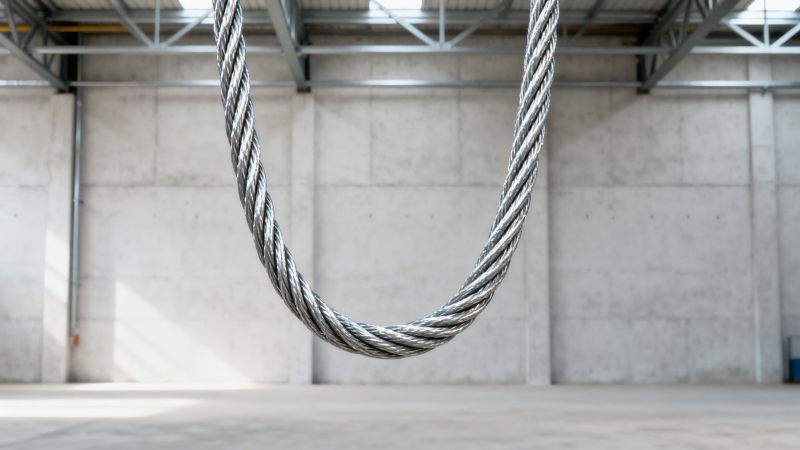
Key Fatigue Drivers You Can’t Ignore During Procurement
Procurement teams evaluating galvanized steel wire rope must go beyond catalog specs. Five measurable factors directly govern fatigue life:
- Zinc coating uniformity: Non-uniform coating creates localized corrosion cells—fatigue cracks initiate 3–5× faster at thin-coat zones (measured via cross-section SEM + EDS).
- Lay consistency: Lay length variation >±0.5% causes uneven inter-wire contact pressure during bending—reducing fatigue cycles by up to 40% (per ISO 2408 Annex D test data).
- Core type & compaction: Fiber cores absorb energy but compress under load; independent wire rope cores (IWRC) maintain geometry stability across 10,000+ cycles at 30% MBL.
- Strand count & configuration: 6×36 IWRC offers better fatigue resistance than 6×19 for high-cycle sheave applications—due to increased contact points and lower surface stress concentration.
- Post-galvanizing processing: Stress-relief annealing at 420–450°C for 30–45 minutes reduces residual drawing stress—extending fatigue life by 25–35% (verified per ASTM E466).
These parameters are routinely verified in our third-party inspection reports—available upon request for all structural steel shipments, including custom cold-formed profiles and SM400A Patterned steel plate orders.
Fatigue Performance vs. Breaking Load: How They Interact
This table underscores a key reality: optimizing for fatigue requires different process controls than optimizing for ultimate tensile strength. At Hongteng Fengda, we align both objectives—ensuring every batch of structural steel meets minimum breaking load thresholds *and* delivers predictable, field-validated fatigue performance.
How International Standards Guide Real-World Fatigue Reliability
Compliance isn’t about paperwork—it’s about traceable process discipline. ISO 2408 defines fatigue testing methodology (bending over sheave, 30% MBL, 10⁵ cycles minimum), while ASTM A1023 specifies galvanizing adhesion requirements (no flaking after 10 mandrel bends). EN 12385-5 mandates mandatory fatigue reporting for ropes used in passenger lifts—requiring documented test logs per heat lot.
Hongteng Fengda’s structural steel products—including angle steel, channel steel, and SM400A Patterned steel plate—are certified to ASTM, EN, JIS, GB, and ISO standards. For wire rope–integrated projects, we coordinate with Tier-1 galvanizing partners who maintain ISO 9001-certified processes, full heat-lot traceability, and third-party fatigue validation reports (available within 72 hours of order confirmation).
Our export documentation includes full compliance matrices—mapping each product grade (e.g., SM400A, Q235B, S335JR) to applicable regional standards (e.g., ASTM A36 for North America, EN 10025-2 for EU, JIS G3101 for Japan), plus fatigue-relevant test summaries.
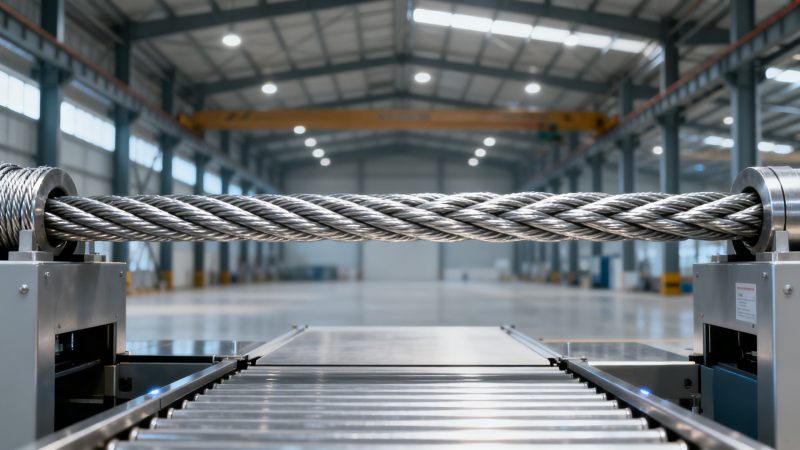
Why Choose Hongteng Fengda for Fatigue-Critical Structural Steel Supply?
You need more than a supplier—you need a partner who anticipates fatigue risks before they impact your project timeline, budget, or safety record. With 12+ years as a structural steel manufacturer & exporter from China, Hongteng Fengda delivers:
- Pre-shipment fatigue verification: Optional third-party fatigue testing (ISO 2408) available for wire rope–integrated assemblies—lead time: 5–7 working days.
- Multi-standard compliance: Seamless certification alignment across ASTM, EN, JIS, GB, and ISO—no retesting delays for cross-border projects.
- Stable lead times: 15–25 days for standard structural steel orders; 20–30 days for custom cold-formed profiles or patterned plates like SM400A Patterned steel plate.
- Technical co-engineering: Our engineering team supports fatigue modeling inputs (e.g., sheave diameter ratios, cycle frequency, environmental exposure class) to recommend optimal wire rope configurations.
- End-to-end traceability: Every coil, plate, and beam carries a QR-coded heat lot ID linking to mill test reports, galvanizing logs, and dimensional inspection records.
Whether you’re sourcing for a Philippine infrastructure upgrade, a Middle Eastern industrial plant, or a Southeast Asian port expansion—we help you specify, validate, and deploy structural steel solutions built for decades of reliable service—not just first-load strength.
Ready to Optimize Your Next Structural Steel Order?
Contact our technical sales team today to:
- Request fatigue test reports for specific wire rope grades (1470 MPa to 1960 MPa)
- Compare ASTM A36 angle steel price per ton in Philippines with EN S235JR alternatives
- Confirm MOQ and delivery timelines for SM400A Patterned steel plate (thickness: 2–8 mm, width: 600–1800 mm)
- Obtain a customized compliance matrix for your target market (e.g., GCC, EU, ASEAN)
- Schedule a virtual factory audit or request sample batches with full test documentation
Please give us a message


Please enter what you want to find