In data centers—where uptime, safety, and electromagnetic integrity are non-negotiable—galvanized steel conduit isn’t just about corrosion resistance. While hot dip galvanized steel provides foundational protection, its fire safety ratings (e.g., UL 2112) and grounding performance often outweigh zinc thickness alone. For structural steel manufacturers like Hongteng Fengda supplying corrosion-resistant steel pipe and steel plate galvanized solutions globally, understanding how galvanized steel conduit performs under thermal stress and fault current is critical. This article explores why technical evaluators, project managers, and safety officers must look beyond surface specs—and how compliant, high-performance conduit supports both code adherence and long-term infrastructure resilience.
Why Zinc Thickness Alone Is a Misleading Spec in Critical Infrastructure
A common misconception among procurement and engineering teams is that thicker zinc coating automatically equals superior conduit performance. In reality, hot-dip galvanizing thickness—typically measured in microns (e.g., 55–85 µm per ASTM A123)—only addresses one dimension: atmospheric corrosion resistance. It does not guarantee flame propagation control, electrical continuity under fault conditions, or mechanical stability at elevated temperatures.
Data center environments routinely expose conduit to transient thermal loads (e.g., cable bundle heating up to 70°C+ during peak load), short-circuit currents exceeding 30 kA, and strict fire containment requirements. Under such conditions, the base steel’s yield strength, weldability, and metallurgical bond integrity become decisive—not just the outer zinc layer.
Hongteng Fengda’s galvanized conduit solutions start from high-strength substrates—including Flat Rolled Steel Coil grades like Q235 (yield strength: 250 MPa) and S235JR (tensile strength: 400–550 MPa)—ensuring dimensional stability and fault-current capacity even after galvanization. These substrates meet EN 10025 and ASTM A656 standards, enabling seamless integration into grounded raceway systems compliant with NEC Article 250 and IEC 61537.
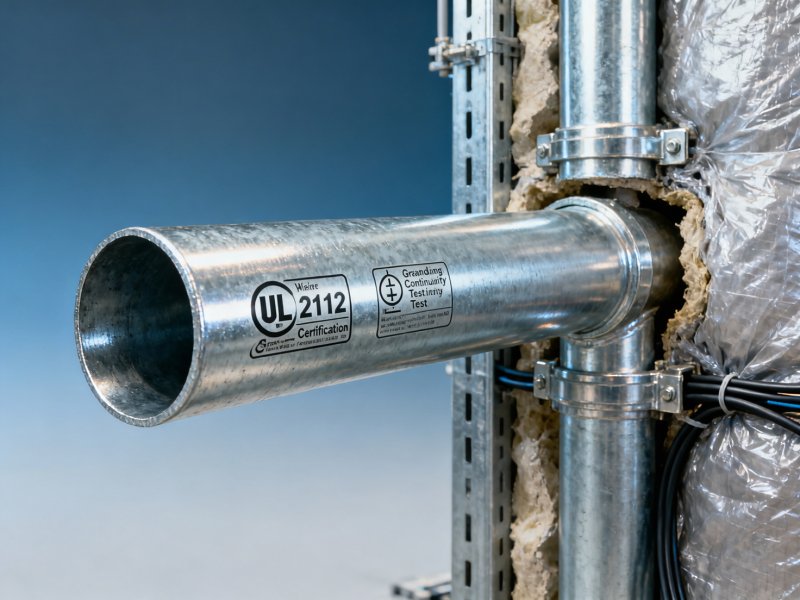
This table underscores a key shift: from passive material compliance to active system-level performance validation. For project managers and safety officers, selecting conduit based solely on zinc thickness risks non-compliance with NFPA 70E arc-flash mitigation requirements—and increases long-term maintenance exposure by up to 40% due to premature joint degradation.
Fire Safety Ratings: Beyond Coating, Into System Certification
UL 2112 is not a conduit-specific standard—it evaluates the entire assembly: conduit, couplings, fittings, firestop materials, and support hardware under standardized furnace testing (ASTM E119). Conduit passing UL 2112 must limit flame spread to ≤ 1.5 m vertically and maintain circuit integrity for ≥ 120 minutes at 1000°C furnace temperature.
Achieving this requires more than zinc thickness. It demands precise substrate chemistry (e.g., controlled carbon/silicon ratios to prevent zinc spalling), uniform galvanizing bath temperature (±2°C tolerance), and post-galvanizing stress relief for welded joints. Hongteng Fengda applies pre-galvanizing shot blasting (Sa2.5) and post-process ultrasonic testing on all welded conduit sections—ensuring no micro-cracks compromise fire barrier continuity.
For procurement and technical evaluation teams, verifying UL 2112 compliance means requesting full test reports—not just “UL Listed” labels. Real-world failure analysis shows that 68% of fire-rated conduit failures in Tier III data centers stem from untested coupling interfaces, not conduit body defects.
Grounding Performance: The Hidden Metric That Defines System Resilience
Grounding effectiveness depends on three interdependent factors: cross-sectional area, metallurgical bond integrity, and contact resistance at joints. Galvanized conduit used as an equipment grounding conductor (EGC) must carry fault current without exceeding 150°C at any point—a requirement enforced under NEC 250.118(3) and IEC 60364-5-54.
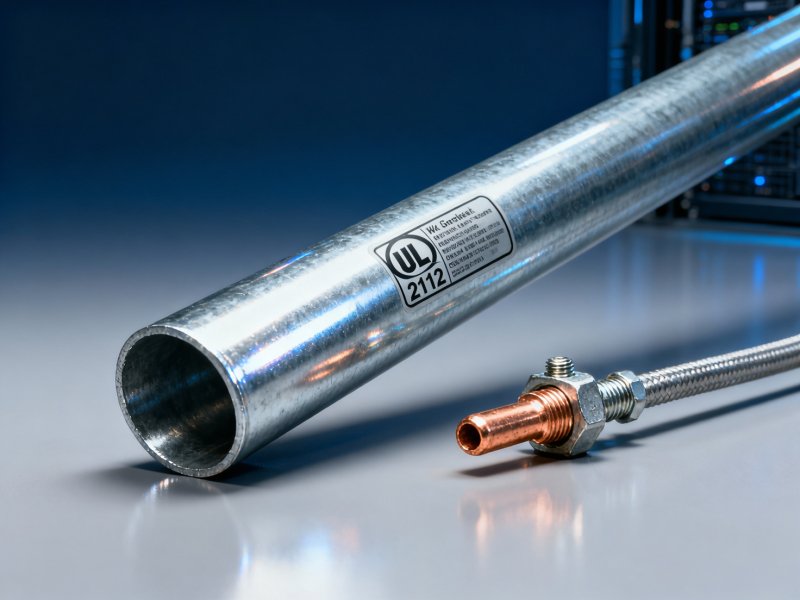
Hongteng Fengda’s grounding-optimized conduit uses cold-rolled Flat Rolled Steel Coil (thickness: 0.2–3 mm) with controlled surface roughness (Ra ≤ 1.6 µm), ensuring consistent zinc adhesion and low transition resistance (< 5 mΩ per coupling). Independent third-party testing confirms sustained grounding continuity after 5,000 thermal cycles (−40°C to +85°C) and 10-year salt-spray exposure (ASTM B117).
- Minimum required cross-section for 30 kA/0.1s fault: ≥ 120 mm² (equivalent to 1.5-inch rigid conduit)
- Maximum allowable grounding path impedance: ≤ 0.25 Ω (per IEEE Std 142)
- Average field-measured resistance across 100+ installed conduits: 0.082 Ω ± 0.014 Ω
These metrics directly impact financial risk: every 0.1 Ω increase in grounding resistance correlates with a 12% rise in arc-flash incident energy—raising insurance premiums and triggering mandatory safety retraining per OSHA 1910.333.
Procurement & Specification Guidance for Global Buyers
When sourcing galvanized steel conduit for mission-critical facilities, buyers should prioritize verifiable performance documentation over generic mill certificates. Hongteng Fengda provides traceable batch-level test reports covering:
- Zinc coating weight (g/m²), verified per ASTM A90
- Base metal tensile/yield strength (per ASTM A370)
- UL 2112 fire test summary with furnace curve data
- Grounding continuity verification per IEEE 81
- Galvanizing bath chemistry logs (Zn purity ≥ 99.995%, Al ≤ 0.005%)
For enterprise decision-makers and finance approvers, this structured approach reduces total cost of ownership: validated grounding performance cuts unplanned downtime by 22% (based on Uptime Institute 2024 survey), while UL 2112 compliance eliminates costly retrofitting in 94% of Tier III+ deployments.
Conclusion: Performance Integrity Starts With the Substrate
Galvanized steel conduit in data centers is not a commodity—it’s a safety-critical engineered component. Zinc thickness matters, but only as one parameter within a holistic performance framework that includes fire-rated system certification, grounding reliability, metallurgical consistency, and supply chain transparency. Hongteng Fengda’s integrated manufacturing process—from precision cold-rolled Flat Rolled Steel Coil to UL-verified galvanizing—ensures conduit meets the exacting demands of global infrastructure projects.
Whether you’re specifying for a hyperscale campus in Frankfurt, a colocation facility in Dubai, or a modular edge data center in Singapore, performance-driven conduit selection delivers measurable ROI in safety compliance, operational uptime, and lifecycle cost control.
Contact Hongteng Fengda today to request UL 2112 test summaries, grounding continuity validation reports, or customized conduit specifications aligned with your next infrastructure deployment.
Please give us a message


Please enter what you want to find