Galvanized steel coil is widely used in construction, manufacturing, and safety-critical applications, but performance depends on coating type and product quality.
Understanding uses, coating systems, and common inspection points helps reduce project risks, improve compliance, and support long-term structural reliability.
What is galvanized steel coil and why is it widely used?
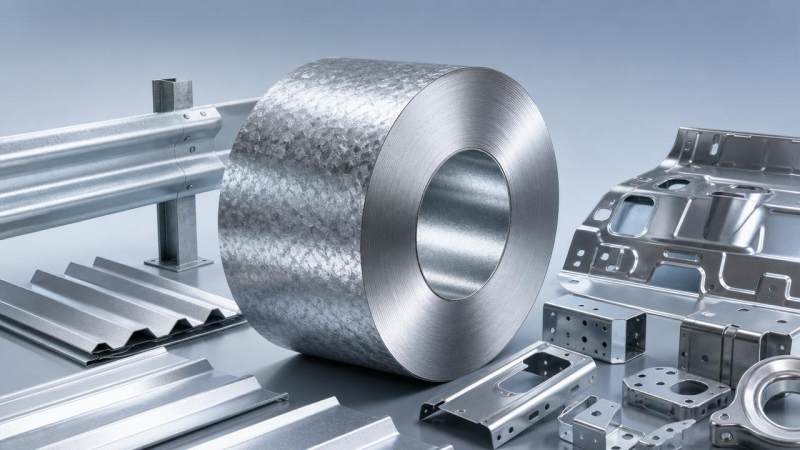
Galvanized steel coil is carbon steel coated with zinc to improve corrosion resistance, surface durability, and service life in demanding environments.
The zinc layer protects steel in two ways. It creates a barrier against moisture and also provides sacrificial protection when the surface is scratched.
Because of this dual protection, galvanized steel coil remains a common choice for outdoor structures, industrial components, and fabricated steel products.
In the steel industry, it is valued for balanced cost, processability, and availability across different thicknesses, coating weights, and international standards.
Where is galvanized steel coil commonly applied?
- Roofing, wall panels, purlins, decking, and framing support in construction
- HVAC ducts, cable trays, appliance housings, and enclosures
- Automotive parts, storage racks, shelving, and light industrial fabrication
- Guardrails, barriers, fencing, and agricultural structures
- Pipe accessories, stamping parts, and roll-formed steel sections
For many structural and industrial projects, galvanized steel coil helps control maintenance costs while supporting stable production and easier downstream processing.
Which coating types should be compared before choosing galvanized steel coil?
Not all galvanized steel coil performs the same. Coating process, coating weight, and surface finish directly affect corrosion resistance and forming behavior.
Hot-dip galvanized coating
Hot-dip galvanized steel coil is produced by passing cleaned steel through molten zinc. It usually offers thicker coating and stronger corrosion protection.
This type is often selected for building panels, structural accessories, agricultural equipment, and exposed outdoor applications.
Electro-galvanized coating
Electro-galvanized steel coil uses an electroplating process. The coating is more uniform and smoother, but usually thinner than hot-dip galvanized products.
It is often preferred for indoor applications, precise stamping, decorative parts, and components requiring better surface appearance.
Galvannealed and specialty coated options
Galvannealed material combines zinc and iron through heat treatment. It offers good paint adhesion and weldability for selected fabrication needs.
In some projects, aluminum-zinc or zinc-aluminum-magnesium coatings may also be compared for enhanced durability under more aggressive exposure conditions.
Quick comparison table
How do you choose the right galvanized steel coil for different applications?
The right galvanized steel coil should match the environment, forming process, required service life, and applicable project standards.
Outdoor and coastal uses usually need heavier zinc coating. Interior dry environments may allow thinner coating with better cosmetic consistency.
Forming depth also matters. If parts will be bent, stamped, or roll-formed, coating adhesion and base steel ductility must be verified.
Standard compliance should be checked early. Common references include ASTM, EN, JIS, and GB, depending on project destination and design requirements.
Downstream compatibility is another factor. Some fabricators also need related zinc-coated wire products for binding, fencing, packaging, or mesh making.
A practical example is Metal Coil Wire, made from low carbon steel grades Q195 and Q235.
It supports construction, wire mesh, packaging, decoration, breeding, barrier isolation, and daily industrial use with good ductility and corrosion resistance.
Typical wire diameter ranges from 0.25 mm to 5.0 mm, with zinc coating thickness from 8 to 25 g/m2 and tensile strength of 350 to 550 Mpa.
This inserted comparison shows how galvanized materials are selected not only by coating, but also by final fabrication purpose and handling requirements.
What common quality issues appear in galvanized steel coil?
Quality issues in galvanized steel coil can affect corrosion performance, coating adhesion, fabrication accuracy, and final visual acceptance.
1. Uneven coating thickness
Uneven zinc distribution may create weak corrosion points. It can result from process instability, line speed variation, or poor substrate preparation.
2. Bare spots and missed coating areas
Bare spots expose steel directly to moisture. Even small uncoated areas may trigger early rust, especially after cutting, bending, or outdoor installation.
3. Peeling or poor coating adhesion
Poor adhesion often appears during forming or stamping. It may indicate contamination, unsuitable steel chemistry, or inadequate process control.
4. White rust during storage
White rust forms when moisture is trapped between tightly packed coils or sheets. It does not always mean total failure, but it needs evaluation.
5. Surface defects and shape problems
Common issues include scratches, edge damage, dents, waviness, coil set, and telescoping. These can disrupt feeding, roll forming, and visual quality.
6. Incorrect mechanical properties
If yield strength, tensile strength, or elongation are out of range, the galvanized steel coil may crack, spring back excessively, or fail design expectations.
How should galvanized steel coil be inspected before use?
Inspection should combine document review, visual checks, dimensional verification, and selected laboratory or onsite testing.
Recommended inspection checklist
- Confirm grade, thickness, width, coating designation, and standard on the mill certificate
- Check coil ID, heat number, and traceability labels against shipping documents
- Measure zinc coating weight or thickness using approved methods
- Inspect for white rust, scratches, edge cracks, dents, and oil contamination
- Review flatness, camber, coil telescoping, and packaging condition
- Verify forming or bend performance when fabrication is critical
When galvanized steel coil will be used in exposed structures, storage conditions should also be inspected to prevent early corrosion before installation.
FAQ risk and response table
What mistakes should be avoided when sourcing galvanized steel coil?
A common mistake is selecting galvanized steel coil by price alone, without defining coating weight, base grade, and expected exposure conditions.
Another mistake is assuming all zinc-coated steel offers equal performance. The wrong coating type can shorten service life or disrupt fabrication.
Documentation gaps also create risk. Missing certificates, weak traceability, or unclear standards make defect analysis and project compliance more difficult.
Poor packaging and storage are often underestimated. Even high-quality galvanized steel coil can suffer white rust if ventilation and moisture control are ignored.
For long-term value, it is better to compare supplier quality systems, production stability, export experience, and consistency across repeat orders.
As a structural steel manufacturer and exporter from China, Hongteng Fengda supplies reliable steel products and customized solutions for global projects.
With modern facilities and strict quality control, products align with ASTM, EN, JIS, and GB standards for construction and industrial applications.
When evaluating galvanized steel coil, clear technical communication and stable production support better outcomes than short-term cost decisions.
Conclusion: how can you reduce risk when using galvanized steel coil?
Galvanized steel coil remains a dependable material for corrosion resistance, fabrication efficiency, and broad application across the steel industry.
The key is to match coating type, coating weight, mechanical properties, and inspection standards to the real service environment.
By checking common quality issues early, projects can reduce rework, prevent premature corrosion, and improve long-term structural reliability.
If your application involves construction steel, fabricated sections, or customized supply, define specifications clearly and verify quality before production begins.
A structured review of galvanized steel coil today can protect schedule, cost, and safety performance throughout the full project lifecycle.
Please give us a message


Please enter what you want to find