Choosing galvanized sheet for roofing is rarely just about appearance or initial quotation. In steel-based construction, zinc coating thickness has a direct effect on corrosion resistance, maintenance frequency, replacement cycles, and the real cost of ownership over time.
That makes coating weight an important evaluation point in warehouses, factories, agricultural buildings, workshops, and infrastructure projects. A lower-priced roof sheet may look competitive at the start, yet become expensive if the coating is too light for the environment.
For projects comparing suppliers across regions, the better question is not only how much galvanized sheet for roofing costs per ton or per square meter, but how well that cost matches exposure conditions, expected life, and compliance requirements.
Why zinc coating thickness matters from the beginning
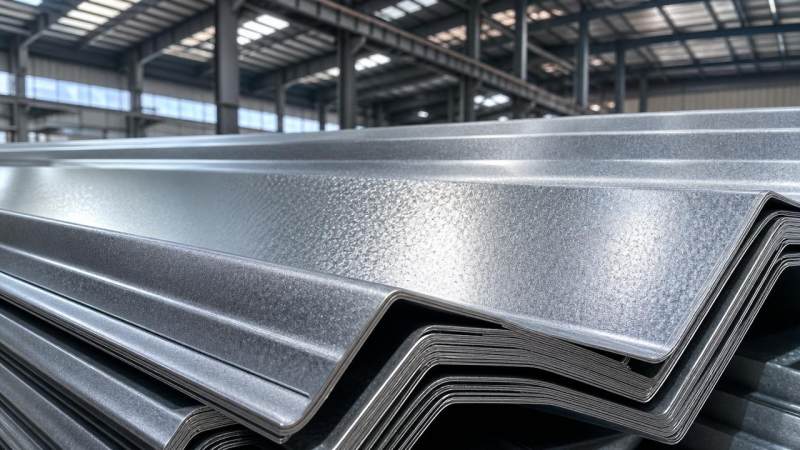
A galvanized roofing sheet protects steel through a zinc layer applied to the surface. This layer works as a physical barrier and also provides sacrificial protection when the surface is scratched or edges are exposed.
In practical terms, thicker zinc coating usually means more time before red rust appears. It does not make the roof indestructible, but it slows corrosion and helps the sheet perform more reliably in demanding service conditions.
This is why coating designations such as Z120, Z180, or Z275 matter. They are not just technical labels. They indicate how much zinc is applied, and that translates into a different durability profile.
Durability is shaped by environment, not coating alone
The performance of galvanized sheet for roofing depends on where it will be used. Dry inland conditions are very different from coastal, chemical, humid, or livestock-related environments.
A light industrial building in a mild climate may perform well with a moderate coating. A coastal warehouse, fertilizer storage unit, or animal housing facility usually requires stronger corrosion protection.
Roof design also affects results. Poor drainage, long-term standing water, trapped dust, and cut edge exposure can accelerate zinc consumption even when the base material meets the nominal specification.
Typical durability factors to compare
How coating thickness changes price logic
The price of galvanized sheet for roofing rises with zinc coating weight because more zinc means more material input and, in many cases, stricter process control. That part is straightforward.
What is less obvious is how a lower coating can shift cost into later stages. Premature repainting, local repairs, leakage risk, production downtime, or full roof replacement often cost far more than the original material difference.
For long-life assets, the lowest purchase price is not always the most economical option. A better comparison uses total project cost over the expected service period.
A practical way to compare options
- Check coating designation, not only sheet thickness.
- Match coating level to exposure category and maintenance access.
- Estimate expected replacement interval under local conditions.
- Include installation loss, edge treatment, and accessory compatibility.
- Ask whether the supplier can document standard compliance.
What to review in specifications and sourcing documents
When comparing galvanized sheet for roofing, it helps to review the full material profile instead of a single number. Coating thickness matters, but so do steel grade, forming suitability, sheet dimensions, and manufacturing method.
Mid-project problems often come from incomplete specification control. One supplier may quote a similar-looking product with a different base grade, narrower tolerance, or lighter coating than expected.
A useful reference point is Galv Sheeting, which covers common grades such as DX51D+Z, DX52D+Z, SGCC, and S250GD+Z through S550GD+Z, with zinc layers from 60 to 275g/m².
It also reflects the range often required in construction and industrial use: thickness from 0.12mm to 6.00mm, width from 600mm to 1500mm, and custom lengths up to 12m.
For roofing applications, double-sided galvanized carbon steel sheet produced by continuous hot-dip plating is commonly preferred when balanced corrosion protection and broad standard compatibility are required.
Where roofing sheet decisions usually become more demanding
Not every project needs the same zinc level. The right galvanized sheet for roofing depends on service environment, project life, budget structure, and the consequences of failure.
Common use cases
- Industrial workshops where roof replacement interrupts production.
- Agricultural buildings exposed to humidity and chemical residues.
- Logistics and transportation facilities with large roof spans.
- Energy and utility structures needing stable outdoor performance.
- Commercial construction requiring compliance with ASTM, EN, JIS, or GB standards.
In such cases, the roofing material is part of a broader steel package. That is where an experienced structural steel manufacturer can add value by aligning roofing sheet specifications with beams, channels, cold formed profiles, and custom components.
Hongteng Fengda works in that context. With export supply experience across North America, Europe, the Middle East, and Southeast Asia, the focus is not only on production volume, but also on stable quality, standards compliance, and dependable lead times.
A simple framework for balancing durability and cost
A useful evaluation model is to separate short-term price from life-cycle value. This prevents under-specification on exposed roofs and over-specification on low-risk buildings.
What to do before finalizing a roofing sheet choice
Before selecting galvanized sheet for roofing, organize the decision around exposure class, expected service life, coating requirement, sheet profile, and relevant standards. That creates a clearer basis for supplier comparison.
Then compare not only unit price, but also documentation, coating consistency, dimensional tolerance, and production capability. In export procurement, supply stability can be as important as technical performance.
A roofing sheet that fits the environment, structure, and project timeline will usually outperform a cheaper alternative chosen on appearance alone. For steel projects with long service expectations, zinc coating thickness is not a minor detail. It is one of the main drivers of durability, risk, and cost control.
The next step is straightforward: define the actual exposure conditions, shortlist suitable coating levels, and compare offers against life-cycle value rather than headline price only.
Please give us a message


Please enter what you want to find