Galvanized sheet thickness plays a bigger role in performance than many buyers expect. For technical evaluators, it directly affects corrosion resistance, structural suitability, fabrication behavior, and long-term cost efficiency. Understanding how coating requirements, base steel grade, application environment, and international standards interact is essential when comparing options for construction and industrial projects.
What does galvanized sheet thickness actually include?
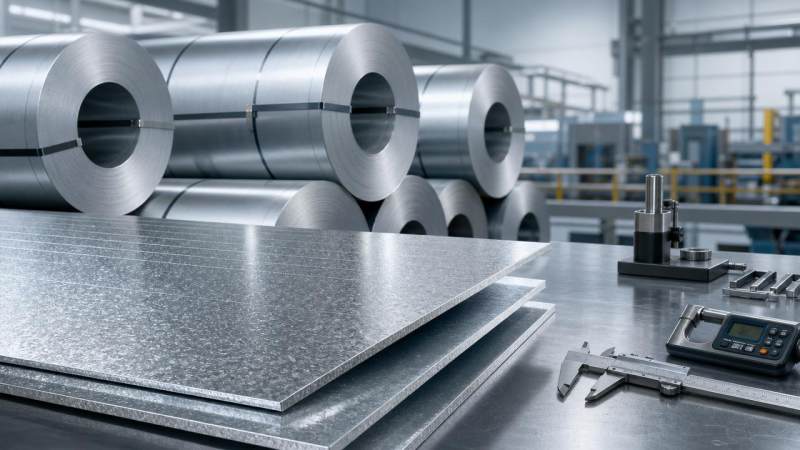
One of the most common mistakes in technical review is treating galvanized sheet thickness as a single number. In practice, it usually includes two related but different elements: the base steel thickness and the zinc coating thickness. Buyers may focus on the nominal gauge or millimeter value of the sheet itself, but field performance also depends on how much protective zinc has been applied and how evenly it covers the surface.
This distinction matters because two sheets with the same overall dimension may perform very differently in service. A sheet with a suitable base metal but insufficient coating may meet short-term mechanical needs while failing early in corrosive environments. On the other hand, a heavier coating on a thin substrate may improve corrosion resistance but still leave the material vulnerable to denting, deformation, or poor fastening performance.
For technical evaluators, the real question is not simply “How thick is it?” but “How is the total specification built?” A correct assessment should check nominal sheet thickness, coating mass or coating thickness, tolerance range, and the production standard used to define those values. In structural or industrial procurement, this prevents mismatches between design intent and delivered material.
Why does galvanized sheet thickness have such a strong impact on performance?
The performance impact comes from the dual role of steel and zinc. The steel provides load-bearing capacity, stiffness, and dimensional integrity. The galvanized coating acts as a protective barrier and also offers sacrificial corrosion protection. When either side of this balance is poorly selected, lifecycle performance suffers.
A thicker base sheet generally improves rigidity, span capability, fastening retention, and resistance to impact during transport and installation. This is especially important in cladding support systems, enclosures, machinery covers, ducts, cable trays, and light structural assemblies. However, increasing only the steel thickness without reviewing the coating can lead to overconfidence in durability.
Coating thickness becomes critical when the product is exposed to humidity, industrial air pollution, marine salt, condensation cycles, or chemical splash. A thicker zinc layer usually extends time to first maintenance, provided surface preparation and galvanizing quality are controlled well. That is why galvanized sheet thickness is closely linked not only to fabrication performance but also to inspection planning, replacement intervals, and total ownership cost.
How should technical evaluators compare thickness requirements by application?
The correct thickness depends on the actual duty of the sheet, not on a generic market preference. Evaluation should begin with service environment, expected loads, joining method, and required design life. For indoor dry applications, a lighter coating may be acceptable if structural demands are low. For outdoor or semi-exposed installations, both substrate thickness and zinc protection typically need to be more conservative.
In building applications, galvanized sheet thickness often affects panel stability, wind resistance, screw pull-through behavior, and resistance to distortion during forming. In industrial manufacturing, it also affects weld response, bend radius capability, punch quality, and flatness retention after processing. For infrastructure support components, the consequences of under-specification can be more severe because corrosion and mechanical fatigue may develop together over time.
Technical teams should also distinguish between aesthetic failure and functional failure. In some projects, early white rust or edge corrosion is mostly a visual issue. In others, such as equipment housings, support brackets, or exposed frames, the same degradation can reduce service safety or require premature replacement. Therefore, galvanized sheet thickness should be selected in relation to both appearance expectations and functional risk.
Quick evaluation table for common decision factors
Is thicker always better when selecting galvanized sheet?
No, and this is where many procurement decisions become inefficient. A heavier specification may appear safer, but it can increase material cost, freight cost, forming difficulty, and processing time. In some production lines, excessive thickness reduces efficiency or requires different tooling. In light-gauge assemblies, it may even create fit-up problems with accessories designed around a narrower tolerance band.
The better approach is fitness for purpose. If the sheet is mainly used as a cover, liner, or low-load enclosure in a controlled indoor environment, an overbuilt section may not create measurable project value. Conversely, for exposed structural support elements, too little thickness can become expensive through maintenance, damage claims, or early replacement.
Technical evaluators should therefore compare cost against service life and fabrication efficiency, not against thickness alone. The most economical galvanized sheet thickness is often the one that satisfies mechanical and corrosion requirements with the least downstream risk. That decision should be documented with environment class, expected life, and fabrication method rather than a simple “thicker is safer” rule.
Which standards and test points should be checked before approval?
A reliable technical review should start with the governing standard. Different regions and project owners may reference ASTM, EN, JIS, or GB systems, and these standards do not always express thickness and coating in the same way. Some focus on base metal dimensions, some on coating mass per square meter, and some provide different tolerance structures. Without aligning these references, a supplier and buyer may both believe they are discussing the same galvanized sheet thickness while actually comparing different definitions.
Beyond the standard name, evaluators should check mill test certificates, coating adhesion, surface condition, actual measured thickness, and dimensional tolerance. If the sheet will be bent or punched, process validation samples may also be necessary. For projects involving export sourcing, consistency between batches is as important as compliance in a single shipment.
Manufacturers with modern facilities and documented quality control can reduce this risk significantly. A capable structural steel supplier should be able to support buyers with standard-based documentation, stable production, and custom processing when required. This becomes especially valuable when the project includes not just flat sheet but a broader steel package with profiles, beams, channels, and fabricated components.
How does galvanized sheet thickness affect fabrication, installation, and downstream performance?
Fabrication behavior is often underestimated during specification review. Different galvanized sheet thickness levels respond differently to cutting, punching, roll forming, welding, and fastening. Thin sheet may be easier to form but more prone to distortion, oil canning, or local buckling. Thicker sheet may be more stable in service but may require stronger equipment, larger bend radii, or tighter process control to avoid coating damage at formed edges.
Installation performance is equally important. Thicker material usually improves handling robustness, but it can increase weight and change labor requirements on site. In assemblies exposed to vibration, repeated movement, or thermal cycling, the interaction between sheet thickness, support spacing, and fastening detail becomes more important than the sheet specification alone.
This is also relevant when projects combine galvanized sheet with other steel components. For example, some infrastructure or industrial packages may include profiles and track-related products alongside sheet-based parts. In such cases, buyers often benefit from working with suppliers that understand a full steel system rather than a single item. As an example, projects involving transport or safety barrier applications may also source Rail products in carbon steel or medium manganese steel, available in models such as U74, U71Mn, Q235, and 55Q, with thickness ranges from 3mm to 24mm and lengths from 12m to 30m. Even though sheet and rail products are used differently, the same technical discipline applies: material grade, dimensional tolerance, environment, and standard compliance all drive real performance.
What are the most common mistakes when evaluating galvanized sheet thickness?
The first mistake is checking only nominal thickness and ignoring coating specification. The second is assuming all galvanized products follow the same standard definitions. The third is selecting material based only on price per ton instead of installed value and service life. These errors are common in international sourcing, especially when technical and commercial teams review documents separately.
Another mistake is ignoring the actual exposure category. A sheet used in a dry warehouse and a sheet used near coastal spray should not be evaluated with the same corrosion assumptions. It is also risky to overlook edge condition, cut area protection, and fabrication sequence. Even when the supplied galvanized sheet thickness is correct, poor downstream processing can reduce the expected corrosion performance.
Finally, some buyers approve a sample but fail to control batch consistency. For larger projects, repeatability matters. Technical evaluators should confirm whether the supplier can maintain thickness tolerance, coating quality, and lead time across multiple production runs. A lower unit price may not be attractive if variation causes rework, delays, or warranty exposure later.
What should be confirmed first before requesting quotation or final approval?
Before moving to quotation or approval, technical evaluators should organize a short but disciplined checklist. Confirm the required base metal thickness, acceptable tolerance, zinc coating class, steel grade, intended fabrication method, and service environment. Then verify which international standard governs the order and what inspection documents must be provided with shipment.
It is also wise to discuss whether the material will be used alone or as part of a wider structural steel package. A manufacturer and exporter with experience in angle steel, channel steel, beams, cold formed steel profiles, and custom structural steel components can often help buyers simplify sourcing, improve compatibility, and control schedule risk. For global construction and industrial projects, that broader supply capability can matter as much as the sheet specification itself.
In short, galvanized sheet thickness should never be reviewed as an isolated catalog number. It is a performance variable tied to corrosion life, forming behavior, mechanical adequacy, and total project efficiency. If you need to confirm a practical specification, it is best to first communicate the application environment, design life target, processing route, standard requirement, and quantity plan. With those points clear, suppliers can provide a more accurate recommendation, more reliable pricing, and a lower-risk procurement path.
Please give us a message


Please enter what you want to find