When sourcing galvanized cold drawn soft hard steel wire rod for cold drawn wire, the annealing atmosphere isn’t just a technical footnote—it directly impacts tensile strength, surface quality, and drawability. For procurement managers, engineers, and structural steel buyers evaluating suppliers like Hongteng Fengda (ASTM/EN/JIS/GB-compliant manufacturer), understanding this parameter helps avoid common defects in steel beams, ensures compliance with international standards for structural steel products, and supports cost-effective, high-yield wire drawing. Whether you’re comparing ASTM A36 angle steel price per ton in Philippines or assessing MOQ requirements for structural steel orders, atmospheric control during annealing is a critical yet often overlooked factor in material performance and downstream processing reliability.
Why Annealing Atmosphere Directly Affects Cold Drawn Wire Performance
Annealing transforms cold drawn soft hard steel wire rod from a high-stress, work-hardened state into a ductile, uniform microstructure—enabling consistent reduction ratios of 15%–35% per pass during subsequent wire drawing. But the protective gas environment—typically nitrogen-hydrogen mixtures (N₂ + 5–10% H₂) or pure nitrogen—dictates whether decarburization, surface oxidation, or internal scale formation occurs.
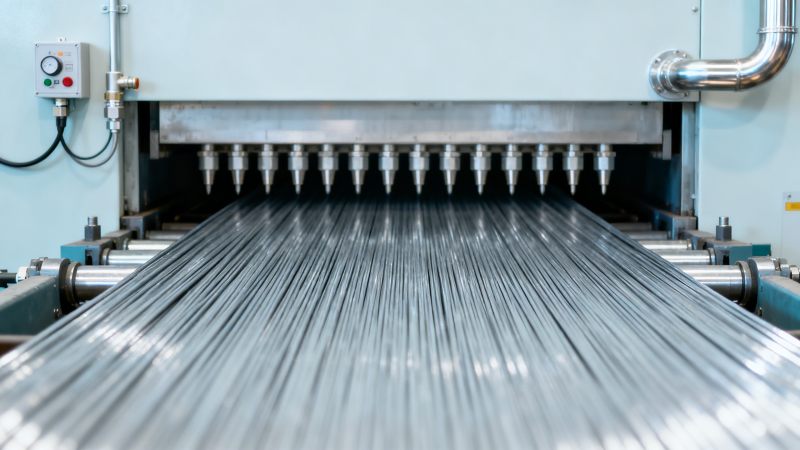
At Hongteng Fengda’s ISO 9001-certified production lines, controlled-atmosphere annealing furnaces maintain dew points below –40°C and oxygen levels under 10 ppm. This prevents iron oxide nucleation on the wire surface—reducing post-anneal pickling time by up to 40% and eliminating micro-pitting that compromises coating adhesion in downstream galvanizing.
For project managers specifying structural components, inconsistent annealing leads to batch-to-batch variations in yield strength (±30 MPa) and elongation (±5%), increasing scrap rates during bending or threading operations. That’s why ASTM A510 and EN 10080 explicitly require documented furnace atmosphere monitoring—not just final mechanical test reports.
How Atmosphere Choice Impacts Downstream Applications
The choice between reducing (H₂-rich), inert (N₂-only), or vacuum annealing isn’t theoretical—it maps directly to application-critical outcomes:
- Galvanized fasteners & mesh: Requires full decarburization control → N₂ + 7–10% H₂ prevents intergranular oxidation at grain boundaries, ensuring uniform zinc alloy layer thickness (±1.5 μm).
- Cold formed structural anchors: Demands precise tensile strength repeatability (Rm = 420–480 MPa, CV ≤ 2.3%) → dew point stability ±1°C across 72-hour continuous runs.
- PPGI substrate wire: Must support tight coil winding (ID ≥ 400 mm) without edge cracking → atmosphere uniformity ensures surface hardness variation < ±5 HV across 1.2 mm diameter cross-sections.
This precision matters when your project uses Color Coated Galvanized Roof Sheet PPGI—where base wire integrity directly affects coating adhesion, especially at cut edges exposed to coastal humidity or industrial pollutants.
Key Atmospheric Parameters vs. Structural Steel Requirements
These tolerances ensure compatibility with structural applications demanding long-term load-bearing integrity—especially where galvanized cold drawn wire feeds into cold-formed steel profiles used in seismic-resistant building frames or modular bridge girders.
Procurement Checklist: What to Verify Before Ordering Wire Rod
Buyers must go beyond mill certificates. Here are 5 non-negotiable verification points—aligned with ASTM A641 and GB/T 342—when sourcing from China-based structural steel exporters:
- Request furnace log printouts showing real-time dew point, O₂, and temperature profiles for your batch—not just averages.
- Confirm atmosphere composition is validated via GC-MS (gas chromatography-mass spectrometry), not just thermal conductivity sensors.
- Verify surface roughness (Ra) post-annealing: ≤ 0.4 μm for wire diameters 5.5–13.0 mm (critical for smooth die entry in multi-pass drawing).
- Check if hydrogen concentration is adjusted dynamically based on carbon content—e.g., higher C% requires ≥8.5% H₂ to prevent graphite precipitation.
- Require third-party witness testing (e.g., SGS or Bureau Veritas) for at least one lot per 500 MT shipment.
Hongteng Fengda provides all five as standard—along with digital traceability linking each coil ID to its exact annealing cycle data, accessible via secure customer portal within 24 hours of shipment.
Why Structural Steel Buyers Choose Hongteng Fengda for Critical Wire Rod Supply
Global procurement teams select us not just for compliance—but for risk mitigation across three dimensions:
- Technical Risk Reduction: Our dual-furnace annealing system allows parallel processing of different atmospheres—so you can qualify both reducing and inert variants against your specific wire drawing parameters before committing to mass production.
- Logistics Certainty: With 30,000+ MT annual wire rod capacity and dedicated rail loading at Tangshan port, we guarantee ≤ 25-day lead times for orders ≥ 100 MT—even during Q4 peak season.
- Compliance Assurance: Every coil carries dual certification: GB/T 342 + ASTM A510 Class I, plus optional EN 10263-3 or JIS G 3506 reporting upon request.
Whether you're specifying wire for tension rods in high-rise façade systems—or sourcing substrate for Color Coated Galvanized Roof Sheet PPGI destined for solar farm support structures, our process discipline eliminates guesswork in your supply chain.
Next Steps: Get Your Technical & Commercial Evaluation Package
We’ll help you make a confident decision—without requiring engineering assumptions or supplier interviews. Within 48 business hours of your inquiry, you’ll receive:
- A comparative analysis of your current wire rod’s annealing logs versus our batch-specific furnace data (sample provided upon request).
- A tailored cost-per-kilogram breakdown—including landed cost estimates for your target market (e.g., Philippines, Germany, UAE).
- Free sample coils (10 kg minimum) with full metallurgical report, including SEM imaging of surface morphology.
- Customized OEM documentation pack aligned with your ERP system’s MRP requirements.
Contact our structural steel technical sales team today to discuss your galvanized cold drawn soft hard steel wire rod requirements—or request immediate access to our latest ASTM/EN/JIS/GB-compliant product catalog and annealing process white paper.
Please give us a message


Please enter what you want to find