For outdoor support systems, material selection is becoming more performance-driven. Weather exposure, faster installation targets, and lower maintenance expectations are changing how steel components are specified.
In this shift, galvanized angle with holes stands out as a practical choice. It combines corrosion protection, connection efficiency, and dependable load support for outdoor structures.
From cable trays to equipment frames, the demand is moving toward components that simplify assembly while improving service life. That trend is especially clear in construction, utilities, and industrial expansion.
Outdoor support systems are moving toward faster, longer-lasting steel solutions
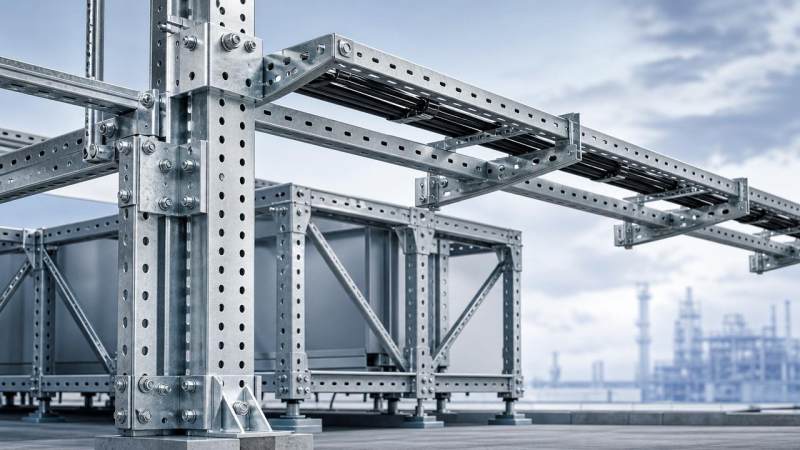
Traditional outdoor supports often required extra drilling, added coating work, or complex site fitting. Those steps increased labor time and created more opportunities for installation error.
Today, galvanized angle with holes is increasingly preferred because it arrives ready for bolted assembly. Pre-punched holes help reduce field modification and improve alignment consistency.
Galvanized surfaces also answer a major outdoor challenge. Rain, humidity, temperature variation, and airborne contaminants can shorten steel life if the protective layer is inadequate.
As project schedules tighten, every saved installation step matters. That is why galvanized angle with holes is becoming common in support brackets, racks, perimeter structures, and modular framing.
Several market signals are driving wider use of galvanized angle with holes
The increase in outdoor infrastructure and modular construction is pushing steel buyers toward standardized, easy-to-install sections. Pre-engineered support members fit this direction well.
Another signal comes from maintenance planning. Many projects now evaluate total life cost, not only initial price. Corrosion resistance therefore carries more weight during specification.
There is also stronger attention on international standards. Reliable suppliers that work with ASTM, EN, JIS, and GB requirements are better positioned in cross-border steel sourcing.
Main forces behind the trend
Why galvanized angle with holes fits current outdoor engineering priorities
The appeal of galvanized angle with holes comes from balancing structure and practicality. It supports mechanical fastening while retaining the basic strength expected from angle steel.
In outdoor support systems, repeatability is important. Uniform hole patterns help maintain installation accuracy across long runs, multiple frames, and replacement work.
Galvanized angle with holes also works well where welding on site is limited. Bolted assembly can simplify safety management and reduce weather-related work interruptions.
Key performance advantages
- Corrosion resistance for exposed environments
- Faster installation through pre-made holes
- Less rework during alignment and connection
- Suitable for modular support layouts
- Better maintenance planning over long service periods
These benefits are especially relevant in solar support accessories, fence systems, warehouse exteriors, roadside structures, and outdoor mechanical equipment supports.
Material preparation and coating quality are becoming stronger decision points
As demand rises for galvanized angle with holes, attention is shifting upstream. Buyers are not only comparing dimensions, but also coating stability, steel consistency, and forming quality.
That is where coil quality matters. Base material affects punching accuracy, bending behavior, and coating performance across finished structural components.
For projects needing dependable galvanized feedstock, Galvanized Steel Coil Manufacturers can support broader steel fabrication needs with grades such as DX51D+Z, SGCC, and S350GD+Z.
Available thickness from 0.12mm to 3.5mm, widths from 600mm to 1500mm, and zinc coatings up to 275g/m² help meet varied outdoor service demands.
When galvanized angle with holes is produced from controlled galvanized steel sources, the result is often better dimensional accuracy, improved corrosion performance, and more stable delivery quality.
The impact is spreading across design, fabrication, installation, and maintenance
The growing use of galvanized angle with holes affects more than material selection. It changes how outdoor support systems are designed, assembled, and maintained over time.
Design stage
Engineers can plan around standard connection points. This supports modular drawings, clearer tolerance control, and easier integration with brackets, channels, and fasteners.
Fabrication stage
Less secondary drilling can improve output efficiency. It also reduces variation between batches, which is useful for repeat orders and export-oriented production planning.
Installation stage
Crews can complete fitting faster with fewer tools. For outdoor projects, this matters when site access, weather windows, or elevated work conditions increase time pressure.
Service stage
A durable zinc layer helps delay corrosion. Combined with replaceable bolted connections, this can simplify inspection, repair, and component substitution during long-term operation.
What deserves closer attention before specifying galvanized angle with holes
Even though galvanized angle with holes offers clear advantages, correct specification still matters. Outdoor exposure levels and load conditions can vary greatly by application.
Critical checks before selection
- Confirm angle size, thickness, and load-bearing requirement
- Review hole diameter, spacing, and edge distance
- Match zinc coating level to local corrosion conditions
- Check compatibility with bolts, channels, and brackets
- Verify standards compliance for export or regulated projects
- Assess whether custom lengths or OEM punching are needed
For coastal, chemical, or high-humidity environments, coating specification deserves extra review. In those cases, the wrong zinc layer can reduce the expected service life significantly.
A practical response is to align supply capability with application demands
A useful approach is to evaluate galvanized angle with holes as part of a complete support system, not as an isolated steel item. Material consistency and supply coordination matter.
Hongteng Fengda, as a structural steel manufacturer and exporter from China, supports this need through angle steel, channels, beams, cold formed profiles, and custom structural components.
With modern facilities and quality control aligned with ASTM, EN, JIS, and GB, the company helps global projects reduce sourcing risk and improve delivery confidence.
The next step is choosing galvanized angle with holes based on real outdoor conditions
The trend is clear: outdoor support systems now favor steel parts that save time, resist corrosion, and perform reliably over longer periods. Galvanized angle with holes fits that direction well.
A strong decision starts with application review. Focus on load path, exposure class, hole pattern, coating requirement, and supply consistency before final specification.
When these factors are matched correctly, galvanized angle with holes can support safer installation, lower maintenance pressure, and better project value in outdoor steel systems.
For upcoming outdoor structures, compare standard sizes with custom fabrication options early. That simple step can improve both engineering efficiency and long-term structural reliability.
Please give us a message


Please enter what you want to find