Why does galv steel pipe selection matter so much outdoors?
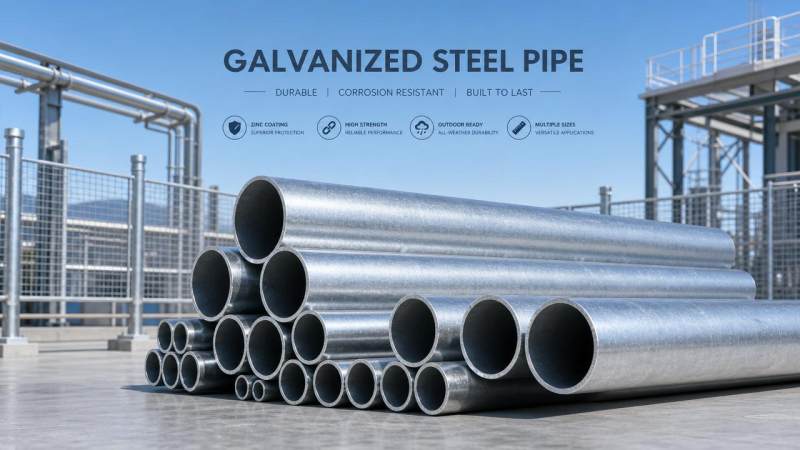
Outdoor steel rarely fails because of one issue alone.
More often, problems come from a poor match between pipe size, zinc coating, and service environment.
That is why galv steel pipe is not just a material choice.
It is a performance decision tied to corrosion rate, load demand, fabrication method, and maintenance expectations.
In practical terms, a pipe for fencing, handrails, water lines, or light structures may all look similar at first glance.
Yet wall thickness, outer diameter, and coating process can change service life significantly.
For construction and industrial projects, the better approach is to compare the full use condition.
That includes humidity, salt exposure, welding needs, storage time, and local standards.
Suppliers with stable production and standard compliance also reduce uncertainty.
This is especially relevant when working across ASTM, EN, JIS, or GB specifications.
When people ask about galv steel pipe sizes, what are they really comparing?
Usually, the question is not only about diameter.
It is really about fit, strength, flow capacity, connection method, and project cost.
A larger galv steel pipe can improve flow or structural stiffness.
At the same time, it increases weight, transport cost, and handling difficulty.
Wall thickness matters just as much.
A thin-wall pipe may be fine for light frameworks or decorative barriers.
For load-bearing use, impact exposure, or long unsupported spans, thicker sections are usually safer.
In outdoor fabrication, another common question is whether the pipe will be cut, bent, drilled, or welded after delivery.
Those operations can damage zinc coverage at the edges.
So sizing decisions should be made together with processing plans, not separately.
A simple way to compare options is shown below.
Are all coating options for galv steel pipe basically the same?
Not really, and this is where many comparisons become too simplified.
The word galvanizing often hides several process differences.
Hot-dip galvanizing usually creates a thicker zinc layer.
That generally supports better outdoor corrosion resistance, especially in wet or polluted areas.
Pre-galvanized material can be suitable for lighter environments.
However, exposed cut edges may need extra treatment after fabrication.
Some projects also add passivation, oiling, lacquer sealing, phosphating, PVC, or painted finishes.
These options do not replace zinc performance in the same way.
Instead, they help with storage, appearance, transport protection, or added barrier protection.
In mixed-material projects, coating coordination matters too.
For example, a steel package may include pipes, channels, beams, and round bars.
In those cases, it helps to align finish choices across components.
A related reference can be A36 Carbon Steel Round Bar, which is often supplied with surface options such as passivation, oiling, lacquer sealing, phosphating, galvanized finish, or painted protection depending on use.
The more useful question is not which coating sounds better.
It is which coating matches fabrication steps, transport conditions, and outdoor exposure time.
A quick coating judgment table
How long does galv steel pipe actually last outside?
There is no single service-life number that fits every site.
Outdoor performance depends on climate, zinc thickness, design details, and maintenance habits.
A galv steel pipe used in a dry inland area can perform very differently from one installed near seawater.
Salt, standing water, industrial fumes, and trapped dirt accelerate damage.
Design also matters more than many expect.
Poor drainage, closed sections without venting, and unsealed cut ends create weak points early.
The usual mistake is assuming galvanizing makes steel maintenance-free forever.
It does not.
It delays corrosion effectively when specification and detailing are correct.
In actual outdoor installations, routine inspection still helps.
- Check welded and cut areas first.
- Look for white rust after storage or transport.
- Remove trapped moisture around clamps and fittings.
- Repair damaged coating before red rust spreads.
Where projects involve multiple structural steel items, consistency in quality control becomes important.
Manufacturers experienced with beams, channels, cold formed profiles, and customized steel parts often manage this coordination better.
What mistakes lead to the wrong pipe choice?
One common error is choosing only by price per ton.
That ignores fabrication loss, coating repairs, replacement risk, and installation time.
Another mistake is treating all standards as interchangeable.
Even when dimensions look close, tolerances, chemistry, and test requirements may differ.
There is also a habit of ordering a standard galv steel pipe first, then checking whether fittings, brackets, or bending tools will match.
That reverses the safer sequence.
A better process is to confirm application details before locking the specification.
- Exposure level: inland, coastal, industrial, or sheltered.
- Structural role: load-bearing, enclosure, guardrail, or conveying.
- Processing plan: drilling, threading, welding, or bending.
- Standard target: ASTM, EN, JIS, or GB.
- Delivery need: stock size, OEM fabrication, or bundled steel package.
This is also where supply reliability enters the picture.
A source with stable production, documented quality control, and export experience can reduce avoidable delays.
For global projects, that often matters as much as the nominal pipe price.
How should you compare suppliers and related steel products?
The most practical comparison is not just product against product.
It is project support against project support.
For example, galv steel pipe is often purchased alongside angle steel, channels, beams, or fabricated components.
If those items come from separate sources, dimensional coordination and delivery timing may become harder.
A manufacturer with broader structural steel capability can sometimes simplify this.
Hongteng Fengda works in that wider steel supply context, covering standard structural sections and custom solutions for construction, industrial, and manufacturing use.
That kind of experience is useful when a project mixes pipe, profiles, and machined steel items.
It also helps when documents need to align with ASTM, EN, JIS, or GB requirements.
In some designs, round pipe is paired with solid bar components for connectors, frames, or fabricated assemblies.
That is where materials such as A36 Carbon Steel Round Bar can be relevant, especially when strength, wear resistance, and multiple length or diameter options are needed within the same steel package.
The useful comparison checklist is simple.
- Can the supplier confirm coating type clearly?
- Are size tolerances and standards documented?
- Is there support for OEM or mixed steel orders?
- Are lead times realistic and consistent?
- Is export packing suitable for moisture control?
So what is the smartest next step before specifying galv steel pipe?
Start by narrowing the real use case.
That means defining outdoor exposure, expected life, load demand, fabrication steps, and inspection access.
Then compare galv steel pipe options by size, wall thickness, and coating process together.
Looking at only one factor usually leads to rework later.
It also helps to request matching information for any related structural steel items in the same project package.
When specifications, finishing, and delivery planning are aligned early, outdoor performance becomes more predictable.
In short, the best galv steel pipe choice is the one that fits the environment, not just the drawing.
If you are comparing options now, build a short checklist around size, galvanizing method, post-fabrication treatment, standards, and supply consistency.
That gives a clearer basis for judging durability, cost, and sourcing risk before the order is placed.
Please give us a message


Please enter what you want to find