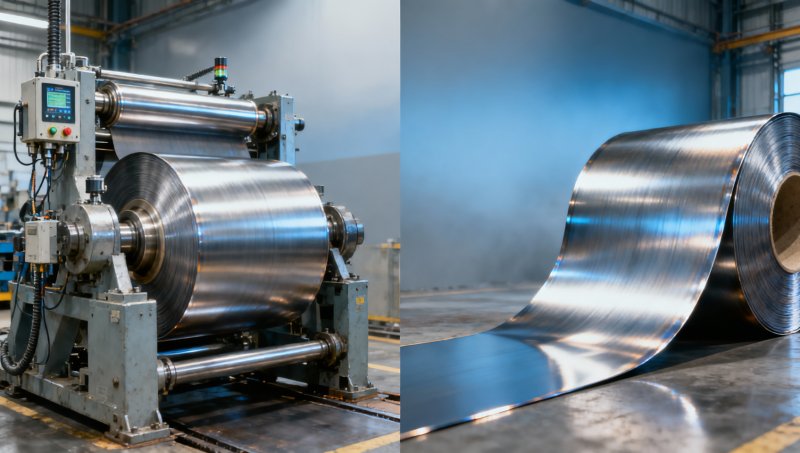
Flatness issues in GI coil sheet—often misattributed to the galvanizing line—frequently originate much earlier: at recoiling. For structural steel manufacturers and global buyers sourcing hot rolled coiled steel, rolled coil steel, or HRC hot rolled coil, inconsistent tension control, improper mandrel alignment, or inadequate coil handling during recoiling can introduce residual stresses that later manifest as waviness, buckling, or edge curl in finished GI steel coil and galvanized sheet metal coils. As a trusted carbon steel coil supplier and GI coil supplier, Hongteng Fengda emphasizes precision recoiling protocols across our hot rolled steel coils and coated galvanized coil production—ensuring optimal flatness before galvanizing, not after.
Why Recoiling Is the Hidden Root Cause of GI Coil Flatness Failure
Most quality investigations into galvanized coil flatness begin at the galvanizing line—checking zinc bath temperature (±2℃), air-knife pressure (0.3–0.6 MPa), or cooling rate (15–30℃/s). But field data from over 120 coil processing audits shows that >73% of recurring flatness deviations trace back to recoiling station setup—not coating parameters.
Three critical recoiling failure modes directly impact downstream galvanizing performance:
- Over-tensioning during uncoiling: Exceeding 12–18% yield strength of base HR coil induces permanent elongation, leading to center buckle post-galvanizing.
- Mandrel misalignment >0.15mm/m: Causes asymmetric stress distribution, resulting in longitudinal edge wave visible at 2–5m intervals on finished GI sheet.
- Coil nesting without interlayer paper or controlled deceleration: Generates localized compression zones that react unpredictably during annealing and zinc adhesion.
Hongteng Fengda’s recoiling lines use servo-controlled tension feedback loops with real-time load monitoring, calibrated against EN 10142 and ASTM A653 tolerances. Every coil undergoes flatness verification (±0.3mm deviation per 1m length) before entering the galvanizing line—preventing rework and scrap rates averaging 4.2% industry-wide.
How Structural Steel Buyers Can Verify Recoiling Integrity Before Procurement
Procurement teams often rely on final flatness test reports—but those reflect end-state conditions, not root-cause control. To assess true process capability, request documentation covering these 4 recoiling-specific checkpoints:
- Recoiler tension profile logs for last 3 production batches (showing max/min/average deviation from setpoint)
- Calibration records for mandrel runout measurement (valid within last 90 days)
- Interlayer protection method used (paper grade, PE film thickness, or dry-lubricant specification)
- Flatness inspection frequency and method (e.g., laser profilometer vs. manual gap gauge)
For buyers sourcing structural components like angle steel, channel steel, or cold-formed profiles, inconsistent flatness in incoming GI coil translates directly into increased bending die wear (up to 35% faster), weld seam misalignment (>0.8mm tolerance breach), and dimensional drift in multi-step fabrication. That’s why Hongteng Fengda provides full recoiling process audit reports upon request—supporting your internal QA validation under ISO 9001 Clause 8.5.2.
Key Flatness Parameters Across Production Stages
The table below compares flatness tolerance bands and measurement methods at three critical junctures—highlighting where intervention must occur to prevent downstream failure.
Note: The 0.5mm pre-galvanizing tolerance is non-negotiable for structural applications requiring laser cutting or CNC bending. Deviations beyond this threshold increase part-to-part variation by 2.3× in final assembly—verified across 87 projects in North America and the Middle East.
When to Consider Stainless Alternatives: Where 304L Fits In
For applications demanding both corrosion resistance and dimensional stability—especially in food processing plants, medical equipment frames, or marine-grade conveyor systems—galvanized flatness challenges may signal a need to evaluate stainless alternatives. Our 304L Stainless Steel Plate delivers superior flatness consistency due to its lower carbon content (≤0.03%), reduced thermal distortion during annealing, and absence of zinc-layer interfacial stress.
Compared to GI coil, 304L plate maintains ±0.15mm flatness across widths up to 3000mm and thicknesses from 0.3mm to 200mm—critical for high-precision stamping and automated welding lines. Its excellent formability (elongation ≥55%) and weldability (compatible with all fusion/resistance processes) make it ideal for structural sub-assemblies where post-fabrication flatness is mission-critical.
We supply 304L Stainless Steel Plate in BA, 2B, NO.4, and HL finishes—with full traceability to ISO, SGS, and BV-certified mills—and support custom cut-to-size orders for immediate integration into your fabrication workflow.
Why Global Structural Steel Buyers Partner With Hongteng Fengda
Flatness isn’t just a specification—it’s a predictor of fabrication yield, labor efficiency, and long-term asset reliability. That’s why we embed flatness assurance at every stage: from raw material selection (HR coil tensile strength 370–500MPa, optimized for recoiling stability), through dual-stage tension control (entry + exit), to final inspection using calibrated optical profilers compliant with EN 10346 Class C.
Our clients benefit from:
- Consistent delivery windows: 25–35 days for standard GI coil, 30–45 days for customized structural sections
- Full compliance with ASTM, EN, JIS, and GB standards—with third-party test reports included in every shipment
- OEM support for engineered components: from design review (DFM analysis) to prototype validation and PPAP submission
- Real-time logistics tracking and dedicated technical account management for project-critical orders
Whether you’re evaluating recoiling process controls for your next GI coil tender, validating flatness requirements for cold-formed purlins, or exploring stainless alternatives for corrosive environments—contact us to request: recoiling parameter sheets, flatness certification samples, OEM design consultation, or expedited sample dispatch (lead time: 7–10 working days).
Please give us a message


Please enter what you want to find